'More businesses report they are finding ways to navigate through the uncertainty'
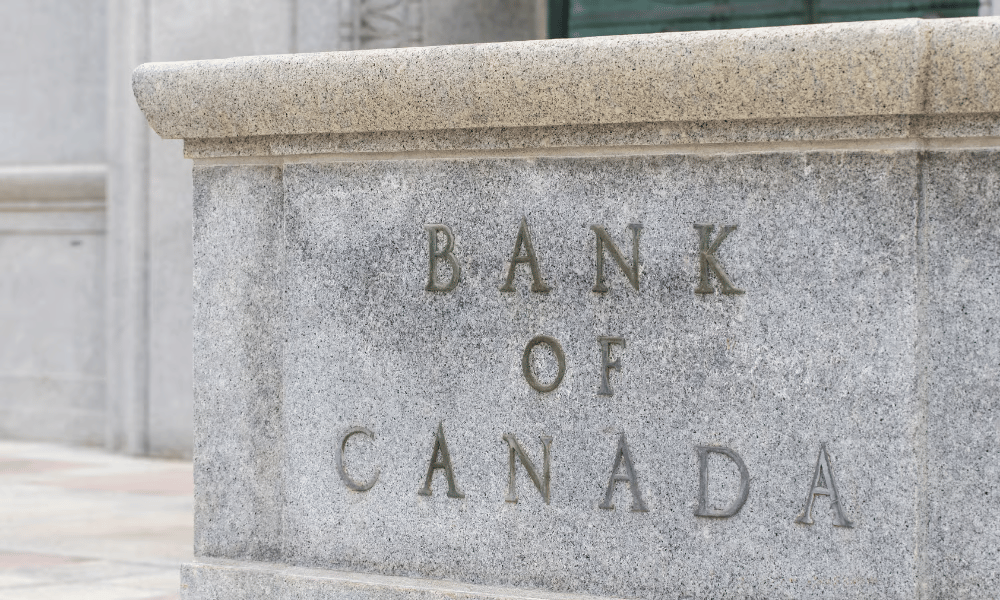
The Bank of Canada held its target for the overnight rate at 2.25% once again, as the central bank points to continued labour market slack.
The central bank also put the deposit rate at 2.20%.
Governing Council said it "judges the current policy rate remains appropriate to sustain the economic recovery and bring inflation back to the 2% target," in line with its Monetary Policy Report projections.
The Bank of Canada acknowledged "uncertainty is still high" and said it will "continue to assess the strength of the Canadian economy and the outlook for inflation," while remaining "prepared to adjust monetary policy as needed."
The bank added it is "committed to maintaining Canadians' confidence in price stability through this period of global upheaval."
This marks the sixth straight hold on the rate from the bank.
Growth picking up in Canada
The central bank said Canada's economy is improving, with growth picking up and inflation projected to ease gradually.
Despite that improvement, the Bank of Canada was direct about ongoing weakness in employment. "Labour market conditions have remained soft, reflecting ongoing economic slack," the Bank of Canada said in its announcement.
The national unemployment rate stood at 6.5% in June and, according to the bank, "has hovered in a range of 6½%-7% since the end of 2024." The bank added that growth "resumed in the second quarter, with growth estimated at 2.5%," though it cautioned the pickup "largely reflects the unwinding of temporary factors."
Canada's economy grew 0.5% in April after a March contraction, a rebound that signalled tightening labour demnd in energy, manufacturing, and construction.
Inflation and economic outlook
Consumer price index inflation rose to 3.2% in May, driven mainly by higher gasoline prices linked to the war in the Middle East, the Bank of Canada said. Excluding gasoline, inflation was 2.2%, with core measures close to 2%.
The Bank of Canada projected inflation will "stay elevated in June and then ease gradually in the coming months, returning to around 2% in early 2027," noting the forecast depends on oil and gasoline prices. Inflation is expected to average around 2% in 2027 and 2028.
On growth, the Bank of Canada forecast the economy will expand by 0.7% in 2026, followed by 1.8% growth in both 2027 and 2028, with slack "gradually absorbed" as the recovery proceeds — a timeline suggesting a tighter labour market remains years away.
Trade, population and global risks
The Bank of Canada noted GDP data "was choppy and growth stalled as the economy adjusted to new tariffs, high uncertainty and slower population growth." Slower population growth carries direct implications for employers relying on immigration to fill vacancies.
The bank also pointed to trade conditions, stating "more businesses report they are finding ways to navigate through the uncertainty" surrounding the Canada-US-Mexico Agreement's annual reviews. Export growth has resumed and is expected to keep strengthening.
Globally, the Bank of Canada said AI build-out "is supporting economic activity in a growing number of countries," including the United States, growing at about 2½% on strong consumption and AI investment. Global GDP growth is projected to slow to 2¾% in 2026 before recovering to around 3¼% in 2027 and 2028.
Two-thirds of small businesses (64%) say Ottawa should take the time needed to secure favourable terms in a renegotiated Canada-United States-Mexico Agreement (CUSMA), even if it means a longer wait, according to previous research from the Canadian Federation of Independent Business (CFIB).