‘There is still significant uncertainty about when the Canadian economy will be able to really rebound’

The coming months will be even more challenging for small businesses in Canada, according to a recent report.
A cost squeeze on Canada’s small and medium-sized employers is tightening, as fuel and tariff expenses climb faster than businesses can recover them from customers – and hiring is set to take the hit, reports the Canadian Federation of Independent Business (CFIB).
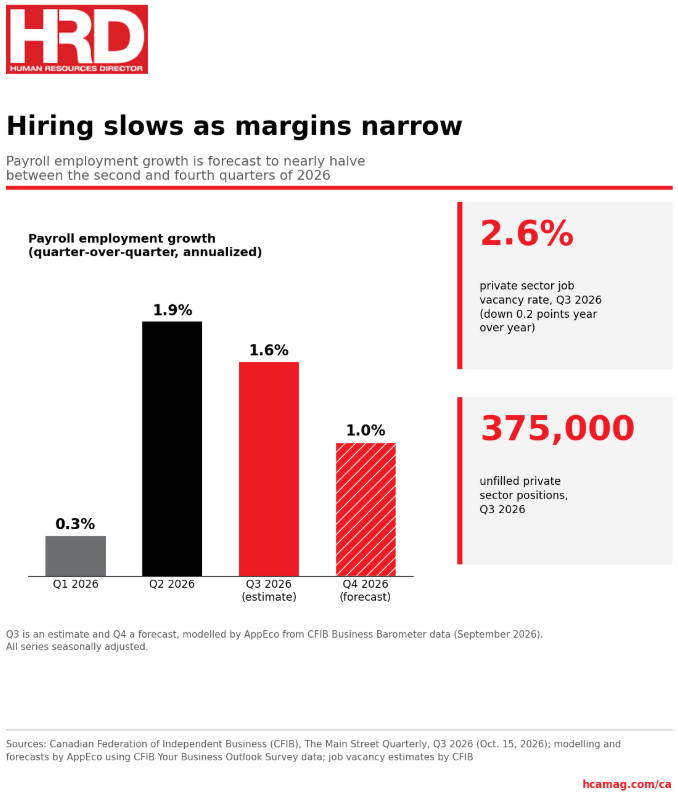
Overall, 64% of businesses say fuel costs are causing them difficulty, while payroll employment growth is forecast to fall from 1.9% in the second quarter to 1.0% in the fourth, according to the group’s third-quarter report.
Cost squeeze outpaces what customers will pay
That share is up 30 percentage points from a year earlier. Yet businesses expect to pass on an average of only about 21% of those higher costs, and roughly seven in 10 expect to pass on none or only a small part.
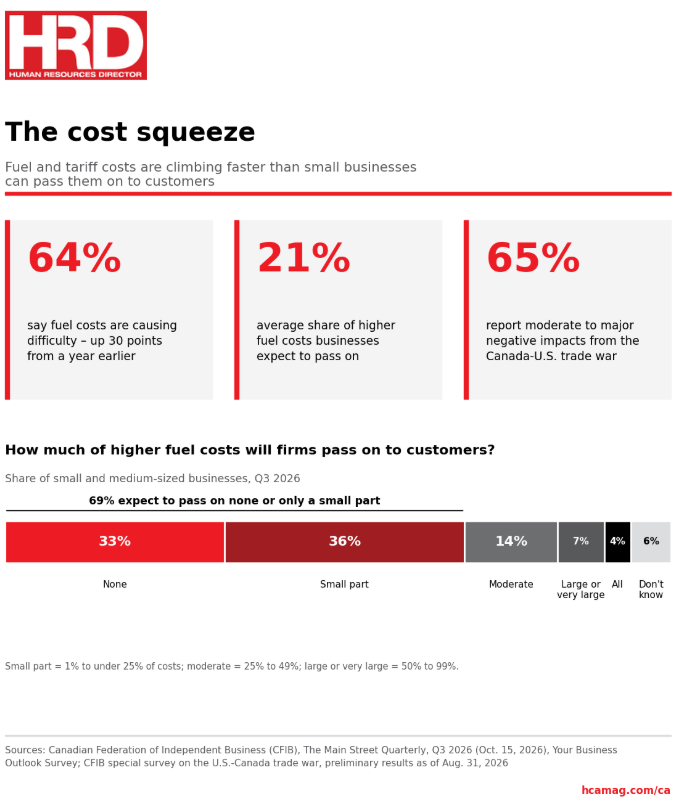
“Many businesses have been dealing with soft demand and weak sales. With customers holding back, most are absorbing higher fuel costs rather than risk losing sales,” said Simon Gaudreault, chief economist and vice-president of research at CFIB.
Tariffs add to the strain. In a CFIB special survey with preliminary results as of Aug. 31, 2026, 65% of businesses reported moderate to major negative impacts from the Canada-U.S. trade war.
Hiring slows as margins narrow
Those pressures are reaching the labour outlook. CFIB’s forecasts, developed with economic consulting firm AppEco, put annualized payroll employment growth at 1.6% in the third quarter.
CFIB attributes the broader economic slowdown to tariffs and high fuel costs squeezing small businesses.
Open positions are thinning, too. CFIB estimates the private sector job vacancy rate eased to 2.6% in the third quarter, leaving about 375,000 roles unfilled. That follows September data showing small business confidence fell to its lowest point since early 2025, with more owners planning layoffs than new hires.
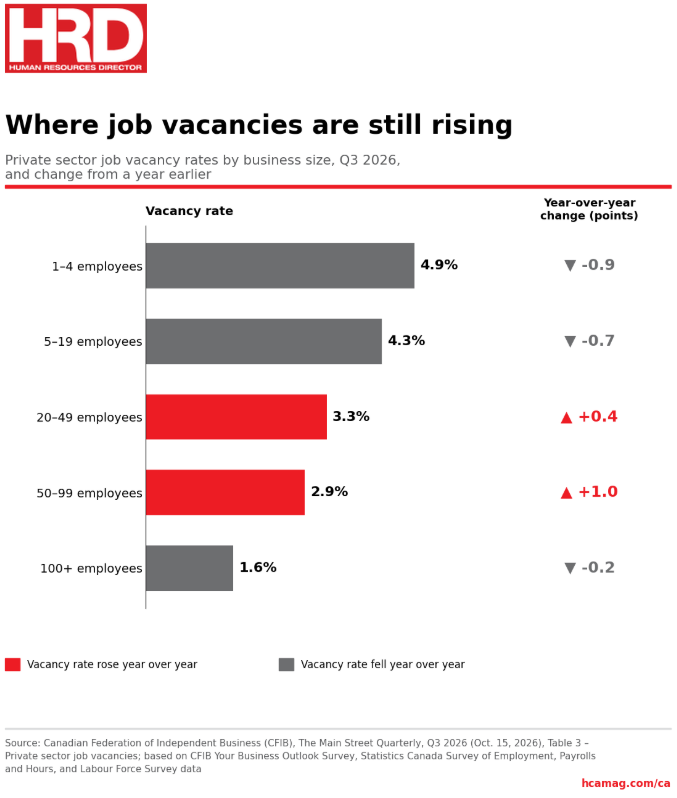
Where are job vacancies still rising?
The retreat is uneven. Vacancy rates fell most at the smallest firms – down 0.9 points to 4.9% for businesses with one to four employees. Mid-sized firms with 50 to 99 employees moved the other way, with vacancies up 1.0 point to 2.9%.
That split echoes HRD Canada’s report on how small business hiring intentions are lagging behind larger employers earlier this year.
“Aggregate data is currently masking a tale of mixed business fates, and there is still significant uncertainty about when the Canadian economy will be able to really rebound, following the latest episodes of this trade war,” Gaudreault said.
No single hiring playbook for HR leaders
CFIB’s analysis of Statistics Canada data shows net business formation – new businesses minus closures – was negative in every quarter of 2025. Fewer new firms means fewer entry points for workers, deepening the challenges in employers’ hiring practices for young Canadian job seekers that CFIB flagged earlier in 2026.
Many entrepreneurs are already charting a way through, according to Pierre Cléroux, chief economist at the Montreal-based Business Development Bank of Canada (BDC).
“Instead of sitting on the sidelines, they’re finding new customers, diversifying their offerings and investing in AI to strengthen their productivity and their competitive position for the long term,” he said as BDC released a separate survey on Oct. 15, 2026.