More employers planning to cut staff than hire, according to new report

Canadian small business confidence has dropped to its lowest point since the first wave of U.S. tariff shocks in early 2025, with new data from the Canadian Federation of Independent Business (CFIB) showing more small businesses are planning to lay off staff than hire in the short term.
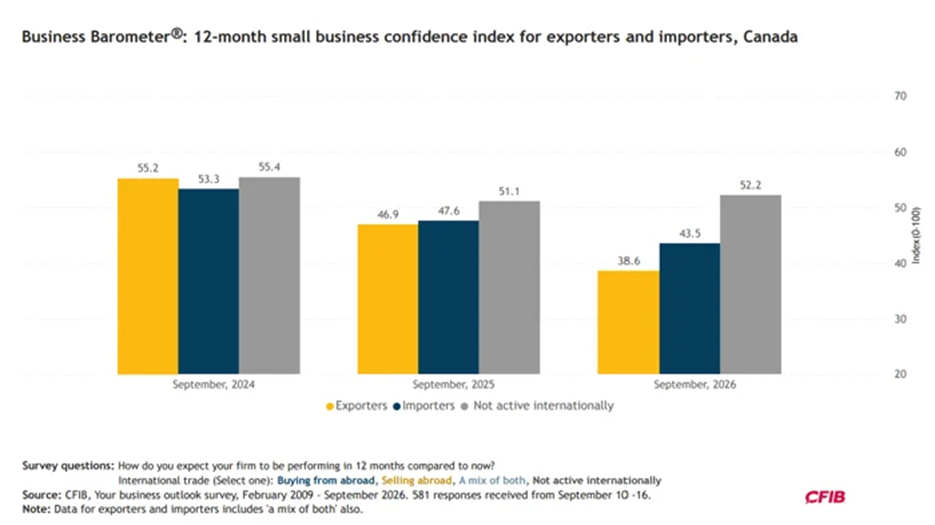
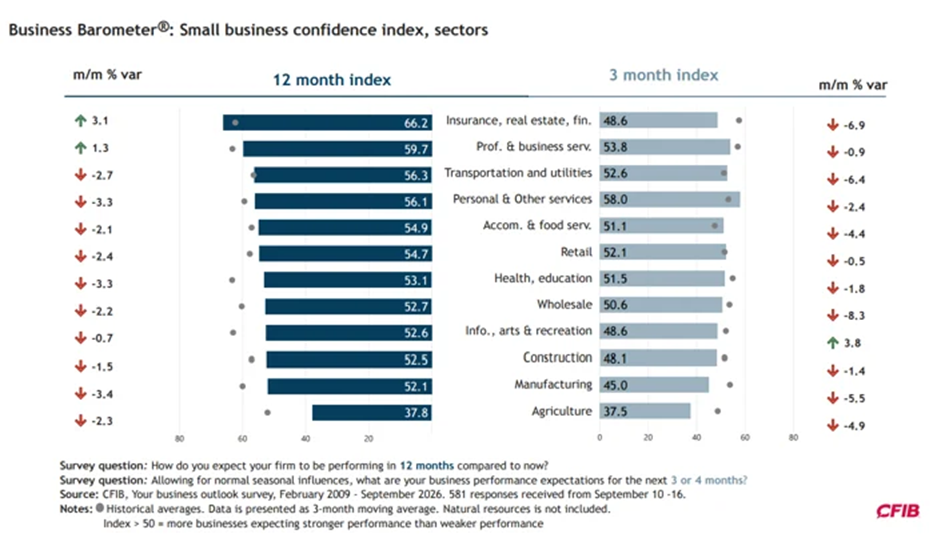
The CFIB's monthly Business Barometer long-term optimism index – which tracks 12-month forward expectations for business performance – fell 10 points in September 2026 to 47.9. The short-term three-month outlook index dropped by the same margin to 43.3. A reading below 50 on the zero-to-100 scale means that more small business owners expect their performance to deteriorate than improve in the period ahead – a signal the CFIB says has been building since July.
In addition, more employers are planning to reduce staff (16 per cent) than hire new staff (13 per cent) in the short term, with net staffing intentions for full-time positions down to minus 3. It’s the second consecutive month of negative net staffing intentions after positive intentions for six of the first seven months of 2026, according to the CFIB data.
Andreea Bourgeois, CFIB director of economics, attributed the September slide to renewed tariff uncertainty alongside rising oil and gas prices, the Canadian Press reported. The broader backdrop is well established: the U.S. imposed 50 per cent tariffs on approximately $28 billion in Canadian goods in August, and Canada responded with $27.6 billion in counter-tariffs on selected U.S. products, effective Sept. 8. U.S. President Donald Trump has also ordered bans on Canadian-made liquor and a selection of dairy products, set to take effect Sept. 29.
Hiring put on hold
Shortly before the U.S. tariffs came into effect, Ryan Mallough, Vice-President of Legislative Affairs at the CFIB in Toronto, told HRD Canada that small-business employers have been gripped by decision-making paralysis. "A lot of investment decisions around hiring, expansion, new locations, new product lines, and that sort of thing are being put off because they're waiting to see what this is going to look like," Mallough said. "Do I want to expand now, or do I want to wait six months when it might look something different?"
That paralysis is translating directly into workforce decisions. Recruitment is stalling, career development conversations are being deferred, and HR leaders at tariff-exposed organizations are making staffing calls based on short-term survival rather than medium-term growth. HRD Canada's analysis of how small business hiring intentions are diverging sharply from larger employer plans documents the growing gap – and the data shows that small business workers are absorbing much of that risk.
"Small business owners have spent years navigating rising costs, and now the tariff war with the U.S. is piling fresh uncertainty and additional costs on top of already weak consumer demand and low small business confidence," Corinne Pohlmann, CFIB executive vice-president, told Retail Insider earlier this week. "It's no surprise small business owners are pressing pause on hiring, investment and expansion as they wait and see what comes next."
The CFIB released a separate report Monday, which sharpened the picture considerably: 22 per cent of Canadian small businesses now describe their condition as weak or critical. Only 18 per cent of owners would encourage someone to start a business today, while 50 per cent would actively advise against it. Among those discouraging new entrepreneurs, 88 per cent cited the high cost of doing business and 86 per cent pointed to economic uncertainty, according to the report.
Government support for tariff-hit businesses
The federal Work-Sharing program offers a structured alternative to cutting staff, allowing eligible employers to temporarily reduce employee hours while Employment Insurance (EI) benefits supplement workers' incomes, with temporary tariff-related flexibilities running until March 31, 2028. The federal government also announced a $7.5 billion federal support package alongside its counter-tariffs, which covers worker retention funding, training support, and business liquidity assistance.
On the policy front, the CFIB is calling for the federal small business tax rate to be cut from nine per cent to six per cent and for the small business deduction threshold to be raised from $500,000 to $700,000. "The business owner will primarily reallocate this money to their HR budget," Simon Gaudrealt, Vice-President of Research and Chief Economist at CFIB told HRD Canada. "The last thing that they probably want to do is to let go of some of the key talent that they've had a hard time recruiting and training in the first place."
With Canadian businesses closing at a faster rate than they’re opening – a trend running for six consecutive quarters from early 2024 through mid-2025, according to a CFIB report released in April, Canada’s Entrepreneurial Drought, Part 1: The Shrinking Business Landscape – the people-management consequences of this pessimism cycle are no longer abstract.