Trips that included a visit to the United States fell 10.6%

As the Canada-United States trade dispute continues, Canadian residents cut back sharply on trips to the United States in the first quarter of 2026 while domestic travel showed some improvement over the same period, according to a recent report from Statistics Canada.
Canadian residents took 78.7 million trips within Canada and abroad in the first quarter, up 1.5% from the same period in 2025.
Trips that included a visit to the U.S. fell 10.6% to 5.5 million, while related spending dropped 13.6% to $5.0 billion, StatCan said. Same-day visitors to the U.S. spent an average of $206 per trip, while overnight visitors spent an average of $1,344 across a 7.9-night stay.
Meanwhile, of the total trips Canadians took, 69.1 million trips included a domestic visit, a 2.3% increase year over year. Domestic spending reached $14.5 billion, up 5.1%.
“I think this year was a great year, things were really busy,” said Craig Foley, the CEO of Hospitality Newfoundland and Labrador, in a CTV News report. “We’ve heard that the season started very early. We’ve also…made a concerted effort around extending the shoulder season [as] we call it.”
Canadian residents returned from approximately 3.8 million trips abroad in April, a year-over-year gain of 2.1% and the first such monthly increase since February 2025, StatCan previously reported.
Outbound trips also see increase
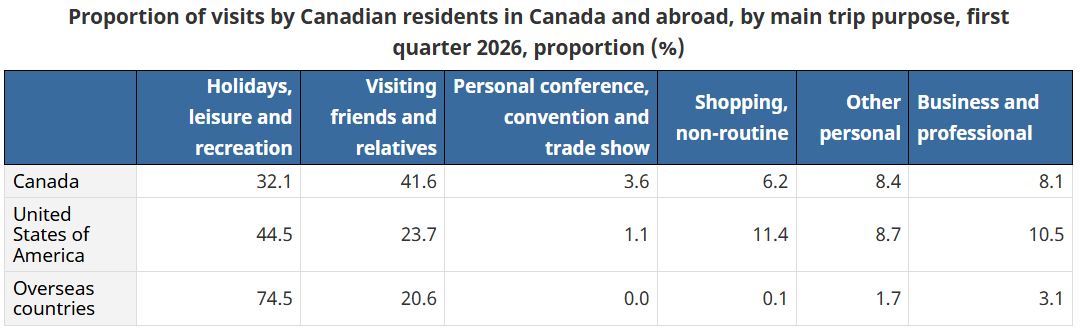
Outbound trips to overseas countries rose 6.2% to 4.6 million, with spending up 16.7% to $10.1 billion, reported StatCan. Mexico was the top overseas destination at 1.3 million visits, and Costa Rica recorded its highest number of Canadian visitors since at least 2018, linked to new direct flights.
Meanwhile, visitors from the U.S. and overseas took 4.5 million trips to Canada in the first quarter, up 3.5% year over year, according to StatCan. Of that total, U.S. residents accounted for 3.6 million trips, a 3.4% increase, with spending up 16.5% to $3.0 billion, while visitors from countries other than the United States accounted for the remaining 990,000 trips, up 3.7%.
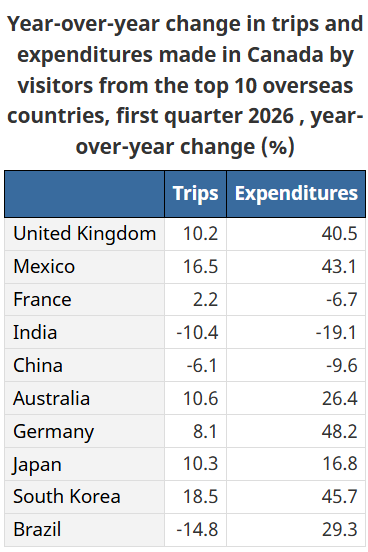
Those overseas visitors spent $2.1 billion in Canada, up 10.2% from the first quarter of 2025. The United Kingdom sent the most overseas visitors (108,000 trips), followed by Mexico (99,000) and France (94,000).
2025 in review
StatCan's release also included full-year 2025 data showing inbound tourism has not fully recovered. Visitors from the U.S. and overseas took 29.6 million trips to Canada in 2025, down 0.7% from 2024, with U.S. trips down 3.0% and overseas trips up 7.5%.
Compared with 2019, before the COVID-19 pandemic, U.S. trips to Canada in 2025 remained down 8.8%, and overseas trips down 8.5%, Statistics Canada reported. Non-resident visitor spending in Canada still reached $32.0 billion in 2025, up 36.7% from 2019 levels.
The gap between trip volumes and spending suggests visitors are spending more per trip even as fewer make the trip at all, a pattern relevant to employers forecasting whether tourism-sector staffing needs will return to pre-pandemic levels.
Is Canadian travel important to the Canadian economy?
Some businesses are feeling the pain caused by the reduced Canadian travel to the U.S.
The clearest damage is showing up at Canada's land-border duty-free stores, which by law can only sell to travellers leaving the country — so when Canadians stop crossing, they lose their entire customer base.
Barbara Barrett, executive director of the Frontier Duty Free Association (FDFA), which represents roughly 31 of these Canadian-owned outlets, told CBC in May that the drop-off in cross-border travel has been so steep that sales figures reported by some of her members are more believable than official StatCan data suggested.
Meanwhile, the Bank of Canada's own research group concluded the opposite trend is helping the broader domestic economy. In a February 2026 analysis, the Bank found Canadians have increased their spending on domestic travel and on grocery products from Canadian companies while reducing spending on similar U.S. products and services.
BMO senior economist Robert Kavcic has put a rough number on that shift, estimating the "Buy Canadian" movement — including more Canadians travelling domestically instead of to the U.S. — could add roughly $10 billion in annual domestic spending, adding about 0.3 percentage points to economic growth, according to a Yahoo! report.
Recently, Canada moved to impose sweeping counter-tariffs on approximately $27.6 billion worth of American goods after trade negotiations between Ottawa and Washington collapsed and the US held firm on a broad 50% duty regime targeting Canadian exports. Alongside the counter-tariffs, the federal government announced a $7.5 billion package of new and enhanced supports, building on nearly $25 billion in trade-related assistance provided since the original round of US tariffs began in 2025, according to the Department of Finance Canada's news release.