US-resident arrivals totalled roughly 1.5 million in April

HR professionals tracking international workforce mobility should take note: Canadian residents made their first year-over-year increase in trips abroad in more than a year in April 2026, according to a recent report from Statistics Canada (StatCan).
That happened even though a sharp decline in air travel to the United States and falling overseas arrivals signal continued unevenness in cross-border movement, the country’s central statistical agency notes.
Canadian residents returned from approximately 3.8 million trips abroad in April, a year-over-year gain of 2.1% and the first such monthly increase since February 2025, Statistics Canada reported. US-resident arrivals rose 6.9% to approximately 1.5 million, the third consecutive monthly year-over-year increase. Overseas arrivals declined 6.7% to 432,700.
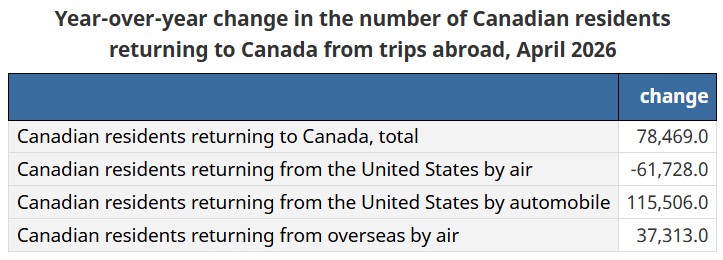
Canadian residents returning from US
Canadian residents returned from approximately 2.4 million trips to the United States in April, up 1.8% year over year and the first increase since January 2025, according to StatCan. The recovery was driven by automobile travel, up 8.1% to approximately 1.5 million return trips, with 65.0% classified as same-day crossings.
Air travel moved in the opposite direction. Return trips by air from the United States fell 7.1% to 805,900, while cruise ship returns fell 38.5% to 3,900, Statistics Canada reported.
For HR professionals, the air-travel decline is significant: employees travelling for business meetings or short-term project work typically fly rather than drive, suggesting continued pressure on cross-border business travel.
Previously, researchers at the University of Toronto analysed anonymised cell phone activity from Canadian devices visiting 266 U.S. metropolitan areas between April 1, 2024 and March 31, 2026. They found a median 42% year‑over‑year drop in visits.
“A general trend that we’ve been seeing with these tariffs and with a decline in visitation to the U.S. is that this has been straining for Canadian employees and employers,” U o T data scientist Yihoi Jung previously told Canadian HR Reporter, pointing to the recent closure of a General Motors plant in Oshawa as one sign of pressure on automotive trade and related jobs.
US-resident arrivals by province
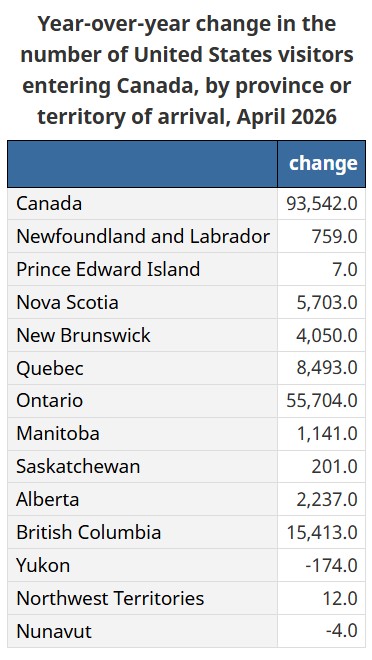
Also, US-resident arrivals totalled approximately 1.5 million in April, up 6.9% year over year.
Ontario recorded the largest absolute gain at 55,704 additional US-resident arrivals, followed by British Columbia at 15,413 and Quebec at 8,493, according to Statistics Canada. Nova Scotia gained 5,703 and New Brunswick added 4,050.
Not all jurisdictions saw increases. Yukon recorded a year-over-year decline of 174 US-resident arrivals, Statistics Canada's data showed.
Air arrivals from the United States increased 7.8% to 366,600, Statistics Canada reported — relevant to HR teams managing US colleagues or candidates travelling to Canadian offices.
Overseas arrivals
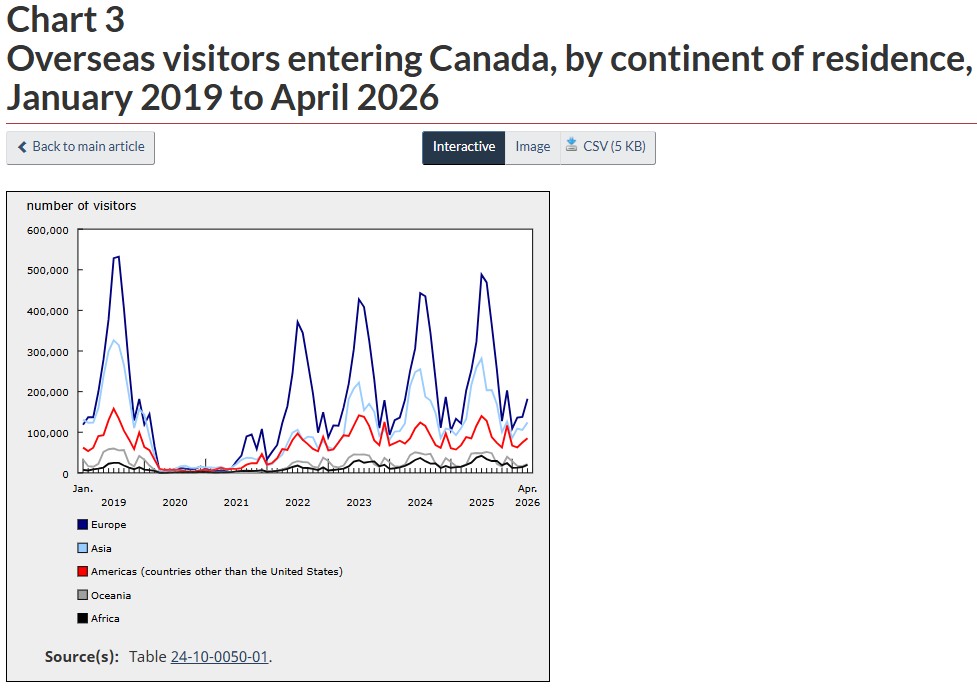
Overseas arrivals totalled 432,700 in April 2026, down 6.7% from April 2025, with 87.9% arriving by air, Statistics Canada reported. The decline was driven by fewer arrivals from Europe, down approximately 10.2% to 182,247, and from Asia, down approximately 6.2% to 124,332.
The United Kingdom remained the top country of residence for overseas visitors. The United Kingdom, France, and Mexico together accounted for 30.4% of all overseas arrivals, Statistics Canada noted.
For HR professionals managing international recruitment from Europe and Asia — Canada's two largest overseas source regions for skilled talent — the sustained year-over-year declines from both continents signal reduced cross-border engagement.
On a seasonally adjusted basis, total Canadian-resident return trips reached 3,653,329 in April
2026, up from a mid-2025 trough of approximately 3.4 million but well below the pre-pandemic monthly range of 4.6 to 4.8 million, StatCan's long-run data showed. Seasonally adjusted US-resident arrivals stood at 1,926,715 and overseas arrivals at 561,382 — both below their 2019 baselines.
HR professionals and employers with staff traveling to the U.S. should be aware of tightening immigration enforcement, following the high-profile case of a Vancouver woman detained for nearly two weeks over a visa denial. In 2025, Jasmine Mooney, a businesswoman and former actress, attempted to enter the U.S. at a border crossing near San Diego but was detained for about 12 days before being sent back to Canada, according to CTV News.