‘Canada's labour market failed to regain its footing in October’

Canada's economy is heading into the final months of 2026 with little momentum, and employers are holding back on hiring rather than cutting staff – making workforce planning urgent for human resources leaders.
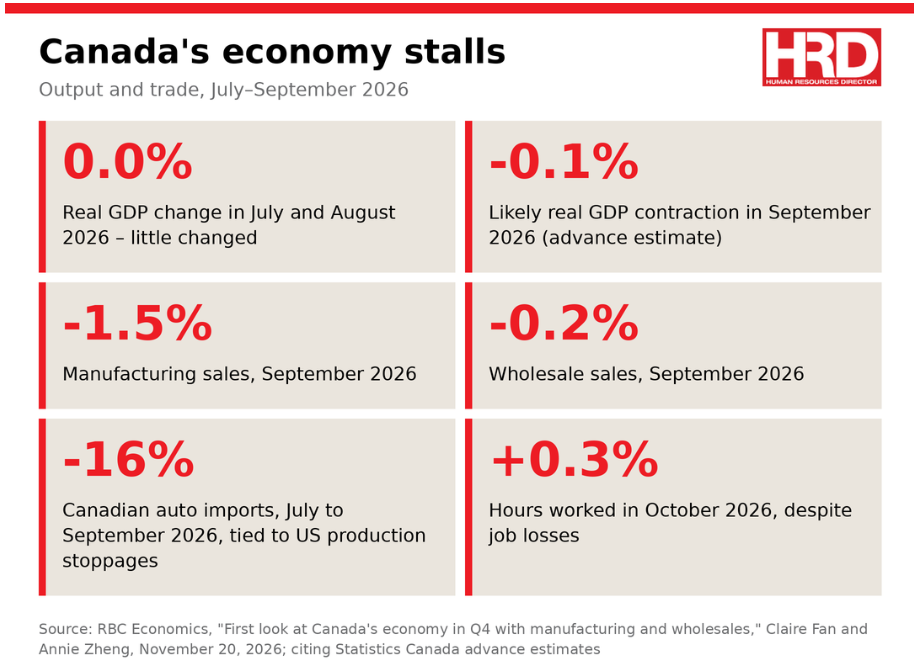
Real gross domestic product (GDP) barely moved in July and August 2026 and probably shrank 0.1% in September, RBC Economics said in a November 20, 2026 outlook, citing Statistics Canada's advance estimate.
Claire Fan, senior economist, and Annie Zheng, economist, at Royal Bank of Canada (RBC) tied that weakness to falling manufacturing and wholesale sales – including a 16% drop in auto imports between July and September linked to United States production stoppages.
Slowing output has shown up in hiring. "Canada's labour market failed to regain its footing in October," wrote Laura Gu, senior economist at Quebec-based Desjardins Group, in a Nov. 6, 2026 note.
Why are Canadian employers hiring less?
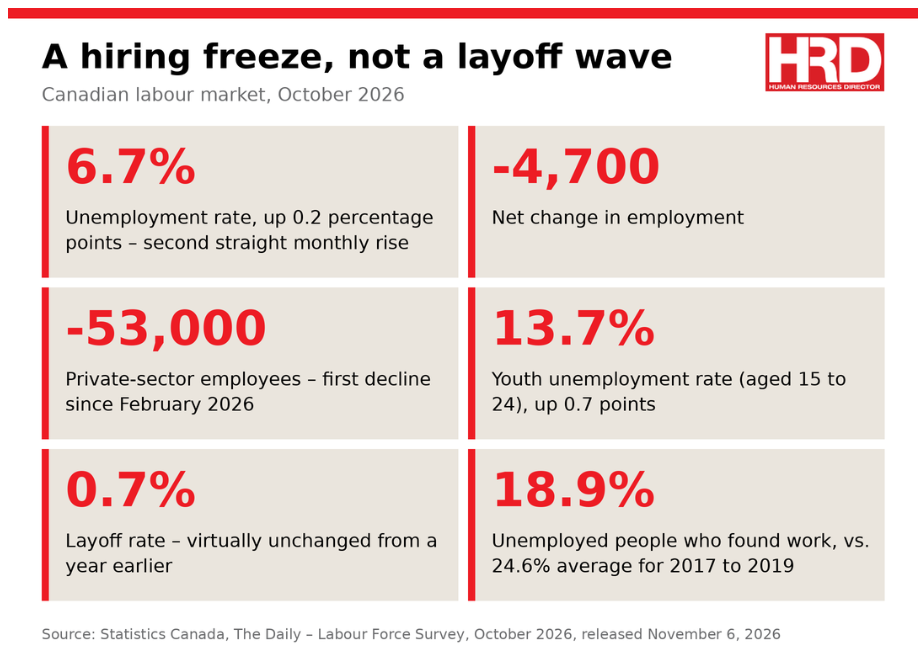
Statistics Canada's (StatCan) Labour Force Survey showed employment was little changed in October 2026, down 4,700 positions, while the unemployment rate rose 0.2 percentage points to 6.7%. Private-sector employees fell by 53,000, as noted in HRD's report on how unemployment climbed as the Canadian job market stalled.
The layoff rate held at 0.7%, while only 18.9% of unemployed people found work in October, well below the 2017 to 2019 average of 24.6%, according to StatCan.
"The problem is hiring," Gu wrote. "The labour market is losing momentum, but the slack is building through slow hiring rather than layoffs."
That pattern echoes the "low hire–low fire" market Bank of Canada External Deputy Governor Nicolas Vincent described in Montreal in May 2026.
Gu expects the Bank of Canada to raise rates again in December 2026 to keep high energy prices from spreading into broader inflation.
Rate hike adds cost pressure
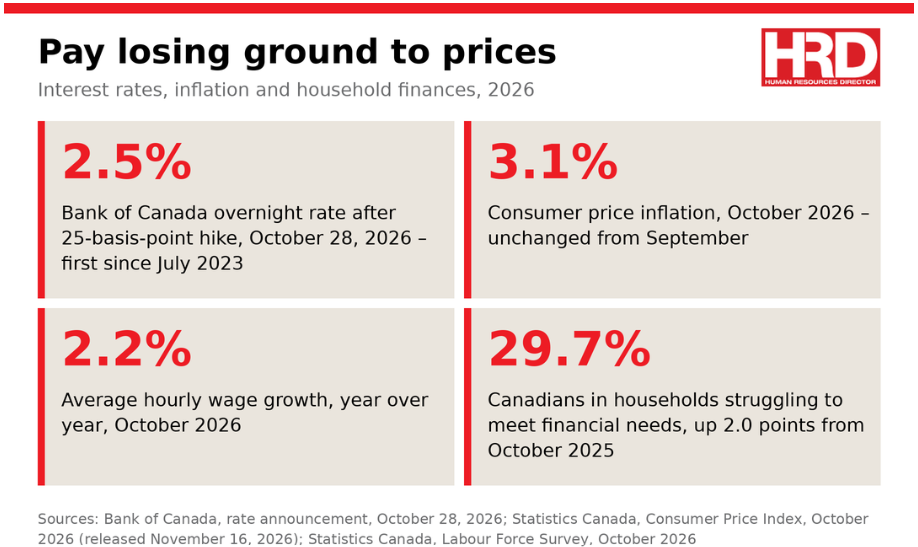
The Bank of Canada raised its overnight rate target by 25 basis points to 2.5% on Oct. 28, 2026, its first hike since July 2023. Governor Tiff Macklem linked the move to cost pressures mainly from war in the Middle East, but said, as reported by The Canadian Press (CP): "Even with this increase, it's still low enough that it's not restraining growth."
Frances Donald, chief economist at RBC, told CP that holding after a single hike would be "atypical," and Desjardins expects another 25-basis-point increase in December 2026.
Inflation, meanwhile, held at 3.1% in October 2026, StatCan reported on Nov. 16 – and that is where employees feel the squeeze.
What does this mean for HR leaders?
Pay is losing ground. Average hourly wages rose 2.2% year over year in October, below inflation, according to StatCan. The agency also found 29.7% of Canadians lived in households that struggled to meet their financial needs, up 2.0 percentage points from a year earlier.
That points to retention and wellbeing risks even as hiring slows, making compensation reviews, financial wellness benefits and internal mobility key tools when hiring budgets are frozen.
Vincent's advice from May still applies. "Regardless of the uncertainty around the scale and scope of the structural forces shaping our economy, it's important to be thinking now about how to respond and adapt," he said.
RBC expects modest growth and labour market improvement through year-end, citing renewed household spending and lower gasoline prices, Fan and Zheng wrote.
Employers that keep staff engaged now will be best placed when hiring resumes, as the organizations in HRD Canada's 2026 Best Places to Work in Canada special report show.