How can HR best support business in Q3 2026?

Business conditions in Canada seem to be improving, but HR professionals must reassess their recruitment and retention strategies now, as new data from Statistics Canada shows recruiting skilled workers remains one of the most significant obstacles facing Canadian employers this quarter.
Nearly three-quarters of businesses (72.6%) described themselves as very or somewhat optimistic about the next 12 months, StatCan reported.
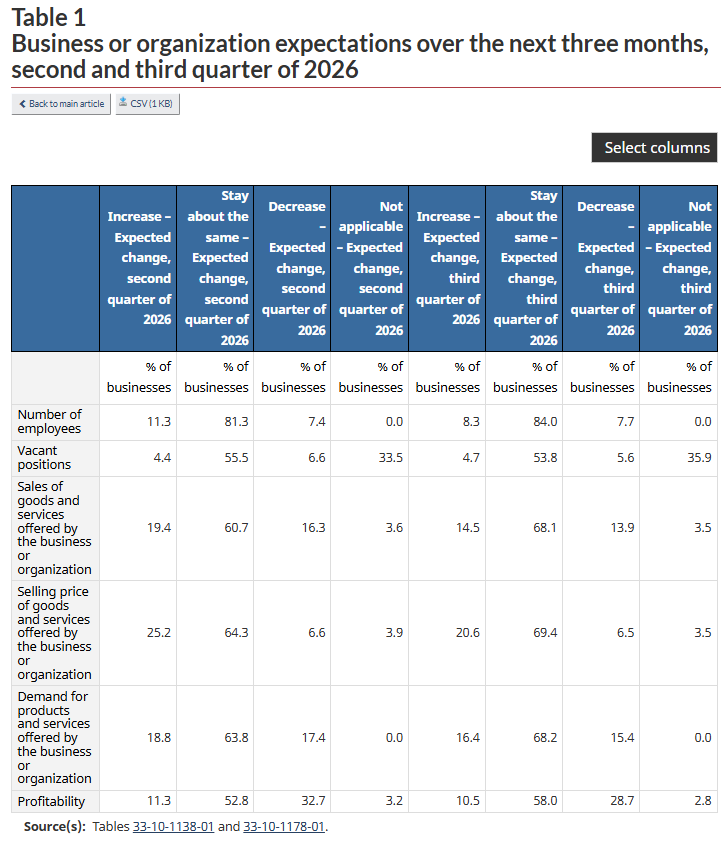
Expectations for near-term sales growth softened, with 14.5% of businesses anticipating higher sales, down from 19.4% last quarter.
About 20.6% of businesses expect their selling prices to rise, most notably in accommodation and food services, at 34.6%.
Inflation and cost pressures ease slightly
This comes as fewer businesses expect cost-related obstacles this quarter, with 59.8% anticipating cost pressures, down from 64.3% in the second quarter, according to StatCan.
Inflation remains the most commonly cited concern, expected by 41.6% of businesses, led by accommodation and food services at 58.3%.
Consumer inflation rose 3.0% year over year in July, following a 2.8% gain in June, according to Statistics Canada.
Tariffs continue to weigh on planning
However, 32.3% of businesses still expect United States tariffs on Canadian imports to hurt them over the next 12 months.
Manufacturing, transportation and warehousing, and wholesale trade reported the highest tariff concerns, StatCan found.
Over one-quarter (27.4%) of businesses said they had already passed tariff-related costs on to customers over the past year.
Recently, the Canadian Federation of Independent Business (CFIB) called on Ottawa to create a Small Business Tariff Relief (SBTR) program.
AI adoption grows slowly amid security concerns
One-quarter (25.2%) of businesses reported plans to use artificial intelligence over the next 12 months, up from 14.5% last year, StatCan said.
Most businesses without adoption plans (79.1%) said AI is simply not relevant to their operations.
Separately, 2.7% of businesses reported theft of sensitive data over the past year, with half reporting higher cybersecurity costs as a result.
Organisations are deploying AI into core operations faster than they can recruit and reskill the workers needed to run it, according to a previous report.
Recruiting remains top obstacle
One-quarter of businesses, or 25.2%, expect difficulty recruiting skilled employees over the next three months, according to the StatCan report.
Manufacturing, accommodation and food services, and health care and social assistance reported the highest recruitment concerns, at 38.2%, 33.6% and 31.7%, respectively.
And 8.9% of 10 businesses named recruiting skilled employees as their single most challenging obstacle overall.
Here are some things that HR professionals can do to best support businesses in Q3 2026, according to previous reports:
|
Action |
Supporting data point |
|
Average merit increases held at 3.0% and total increases at 3.3% in 2026, consistent with 2025; employers are differentiating pay by role rather than issuing equal raises |
|
|
Apply for tariff workforce supports |
Ottawa introduced a $7.5-billion support package including a new Workforce Retention and Retraining Program combining EI Work-Sharing and the Worker Retention Grant, with up to $1,000 per participant for training costs (London Chamber of Commerce, "Support for Canadian workers and businesses affected by U.S. tariffs," Aug. 27, 2026) |
|
61% of Canadian HR leaders say reviewing AI-generated applications has slowed their hiring process; 89% report heavier workloads from rising application volumes |
|
|
Invest in upskilling over headcount growth |
Skills gaps persist across industries; many firms are responding by training their existing workforce rather than expanding headcount, particularly amid tariff uncertainty (Canadian Chamber of Commerce, Business Data Lab, Business Insights Quarterly Q1 2026) |
|
Re-benchmark compensation |
Over four in 10 small firms say a shortage of skilled labour limits their ability to increase sales or production; 57% report a gap between candidate pay expectations and what businesses can offer (Canadian Manufacturing, "Skilled labour shortage hurting Canadian SMEs, CFIB report says," 2026) |
|
Plan for TFW transitions |
More than 1.3 million temporary foreign worker permits are set to expire by the end of 2026; 57% of businesses relying on TFWs say they would scale back growth plans without continued access (Canadian Manufacturing, "Canadian Federation of Independent Business calls for TFW program support," March 2026) |
|
Prepare tariff-region contingency plans |
Manufacturing has shed roughly 51,800 jobs over the past 12 months, concentrated in Ontario; an economist warns the pain isn't over for the automotive sector given six- to 12-month work contract cycles (The Globe and Mail, "Canada's labour market is 'static' after a year of U.S. tariffs, demographic shifts," 2026) |
|
48% of Canadian hiring managers now predict AI will increase headcount over the next two years, not decrease it, as roles are redesigned rather than eliminated |