Union cites falling stoppage data as employers and Ottawa defend new Section 107 rules for federally regulated sectors

The Canadian Labour Congress (CLC) says Ottawa has not proven that the Bill C-39 strike powers would make Canada’s economy more stable.
Its fact-check backgrounder, released Nov. 3, 2026, disputes the federal government’s claim that expanded ministerial authority would prevent disruptions.
Bill C-39, the Building Canada Strong Act, was tabled in September 2026. It would rewrite Section 107 of the Canada Labour Code, which ministers have used to direct the Canada Industrial Relations Board (CIRB) to end work stoppages.
The bill is now before a House of Commons legislative committee, while a Senate committee is conducting a pre-study, according to Parliament’s LEGISinfo database.
“Canadians have every reason to expect reliable transportation, functioning supply chains and a strong economy,” said Bea Bruske, president of the CLC in Ottawa. “But there is no evidence that taking away workers’ rights will deliver that stability or prevent future disruptions.”
What does the data say about strike activity?
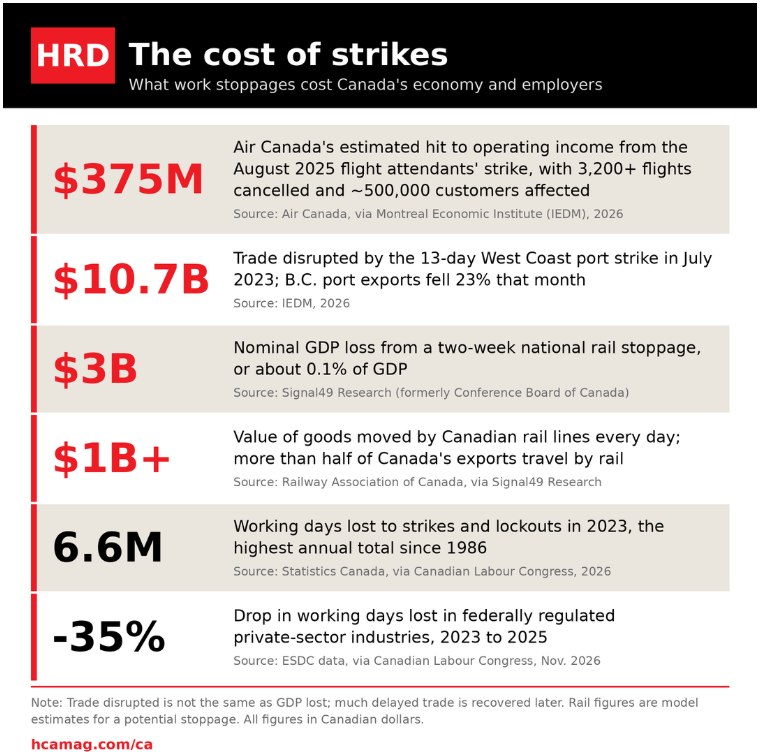
To support that claim, the congress cited Employment and Social Development Canada (ESDC) figures showing that working days lost in federally regulated private-sector industries fell from 127,810 in 2023 to 83,150 in 2025. That is a drop of about 35%. The CLC noted that the data does not measure the value of disrupted trade.
The congress also pointed to a 2010 C.D. Howe Institute study by Benjamin Dachis and Robert Hebdon. It found that when a public-sector contract had been settled by a provincial back-to-work order, the odds of a freely negotiated deal in the next round were 67% lower, the CLC noted.
“Economic stability depends on workers and employers having good reasons to reach agreements that last,” Bruske said. “If the government wants fewer disruptions, it should be strengthening those incentives, not giving employers a reason to wait for Ottawa to intervene.”
Employers and Ottawa see guardrails
Employers read the same bill very differently. “At a high level, I would say there are some positive changes in this bill that will improve and stabilize collective bargaining,” Derrick Hynes, CEO of Federally Regulated Employers – Transportation and Communications (FETCO), told The Canadian Press in September 2026. FETCO represents railway, port and airline employers.
The government makes a similar case. Under the bill, the minister must consider a special mediator’s public report and conclude that a dispute harms the national interest before intervening.
“Bill C-39 would not give the minister any new intervention powers under Section 107 of the Canada Labour Code. Instead, it would create new requirements for the minister to satisfy before any intervention is possible,” Jennifer Kozelj, press secretary to Jobs and Families Minister Patty Hajdu, told CBC News in October 2026.
HR professionals have also weighed in, with national HR bodies calling for tighter limits on federal intervention in labour disputes. The bill would also extend conciliation from 60 to 90 days. Legal analyses published by Mondaq and Legal 500 advise federally regulated employers to review their bargaining strategies now.
Unions warn of legal challenges
Unions, however, remain opposed. The CLC says Section 107 has been used at least eight times since June 2024, and it has urged Ottawa to repeal, not codify, the minister’s power to end legal strikes.
Labour leaders often cite August 2025, when the Canadian Union of Public Employees (CUPE) told flight attendants to defy a CIRB directive, causing Air Canada to halt its restart of flights as the union defied the return-to-work order.
The CLC also warned that the bill could face constitutional challenges, citing the 2015 Supreme Court of Canada ruling in Saskatchewan Federation of Labour v. Saskatchewan.
“Canada cannot claim to champion workers’ rights around the world while weakening them at home,” said CLC Secretary-Treasurer Lily Chang in September 2026. She said the congress would complain to the International Labour Organization (ILO) if the bill passes unchanged.