For workers, lost wages are only part of the picture

Long public service wait times are shifting costs onto Canadian employers and their workers, according to a new report from the Canadian Centre for Policy Alternatives (CCPA).
Published Nov. 2, 2026, the report argues that governments track how long people wait for services but rarely record what happens in the meantime – lost wages, missed shifts, extra caregiving and declining health.
Those costs, says author Nathania Ebegbare – a registered social service worker and Master of Public Policy candidate at the University of Toronto’s Munk School of Global Affairs & Public Policy – fall on individuals, families, employers and other public systems.
“Waiting redistributes costs,” she writes. “Neglect can itself be a policy choice.”
Why wait times are a workforce issue
Ebegbare proposes a gender-responsive Cost of Waiting Analytical Lens (CWAL) to capture them. CWAL sorts the effects of delay into six areas, including employment and education, unpaid care work, and health and well-being. Under employment, the report lists reduced hours, leave, job loss and delayed returns to work.
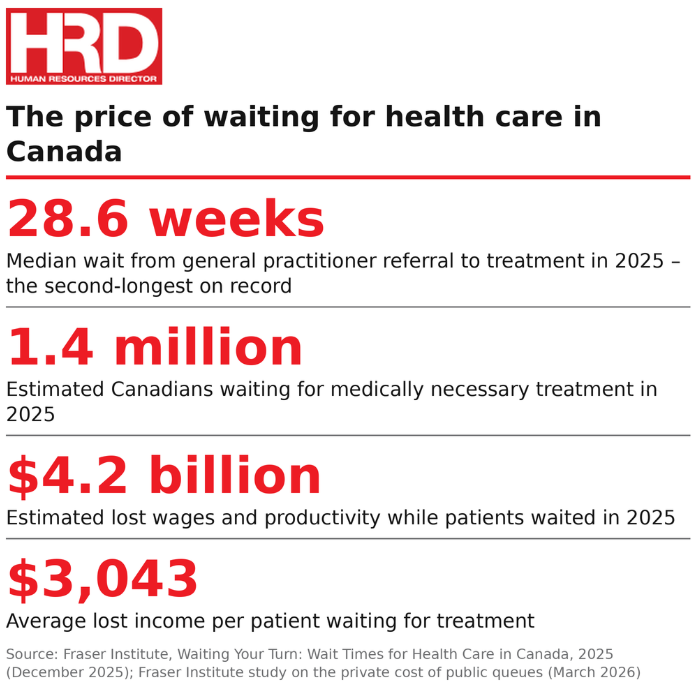
In health care, the market-oriented Fraser Institute found that Canadians waited a median 28.6 weeks from general practitioner referral to treatment in 2025. A follow-up Fraser Institute study, released in March 2026, estimated that about 1.4 million patients lost more than $4.2 billion in wages and productivity while waiting – roughly $3,043 each.
“Long wait times can result in increased suffering for patients, lost productivity at work, decreased quality of life, and in the worst cases, disability or death,” Mackenzie Moir, senior policy analyst at the Fraser Institute, said in December 2025.
The care burden shifts to employees
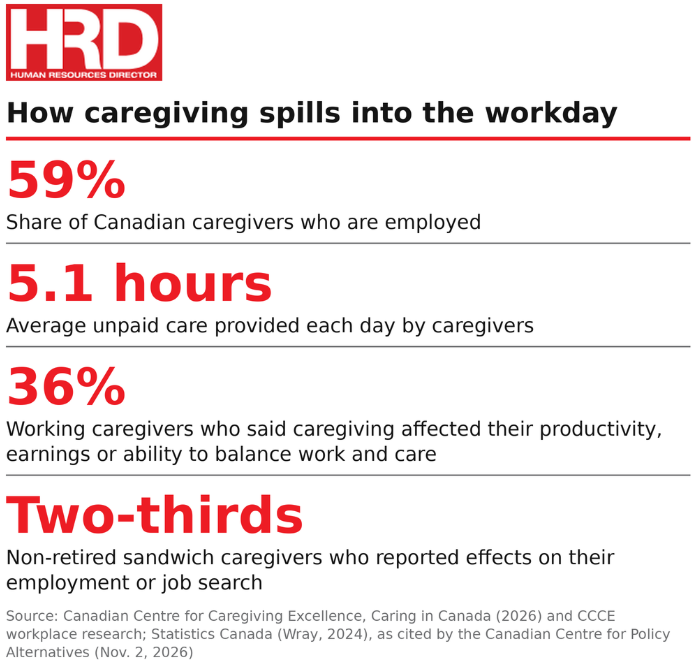
Lost wages are only part of the picture. When a service stalls, the CCPA report says, the care and paperwork it would have handled shift back to households, and disproportionately to women. Citing Statistics Canada research from 2024, it notes that two-thirds of non-retired sandwich caregivers – those caring for both children and care-dependent adults – reported effects on their employment or job search.
The Canadian Centre for Caregiving Excellence’s (CCCE) 2026 Caring in Canada report found 59% of caregivers are employed and provide an average of 5.1 hours of unpaid care a day. Separate CCCE research found 36% of working caregivers said caregiving demands had affected their productivity, earnings or ability to balance work and care responsibilities.
“Caregivers are suffering financially, their mental health is suffering,” said Liv Mendelsohn, executive director of the CCCE, as reported by Wealth Professional. “Really, they are the unseen backbone of the healthcare system.”
More than half of sandwich generation moms leave jobs for caregiving responsibilities, and benefits fall short in addressing the invisible crisis facing the Sandwich Generation.
Mendelsohn has also put the onus on employers. “Caregiving touches every Canadian family, and employers can no longer afford to ignore it,” she said in a CCCE workplace report.
What can HR leaders and stakeholders do?
The CCPA report directs most recommendations at governments, urging stable funding for shelters, transitional housing and child care for survivors of gender-based violence (GBV).
It also advises GBV-sector employers to treat stable employment, supervision and worker well-being as investments in service capacity, and to use existing HR data on vacancies, turnover and sick leave for workforce planning.
Beyond the sector, absence and leave data can show where public service delays are surfacing inside an organization, and whether benefits, flexible work and leave policies are absorbing them.
Ebegbare acknowledges the tool still needs testing with people who have lived through long waits.