Record waits for specialist care stretch disability claims, absences and return-to-work timelines for Canadian employers

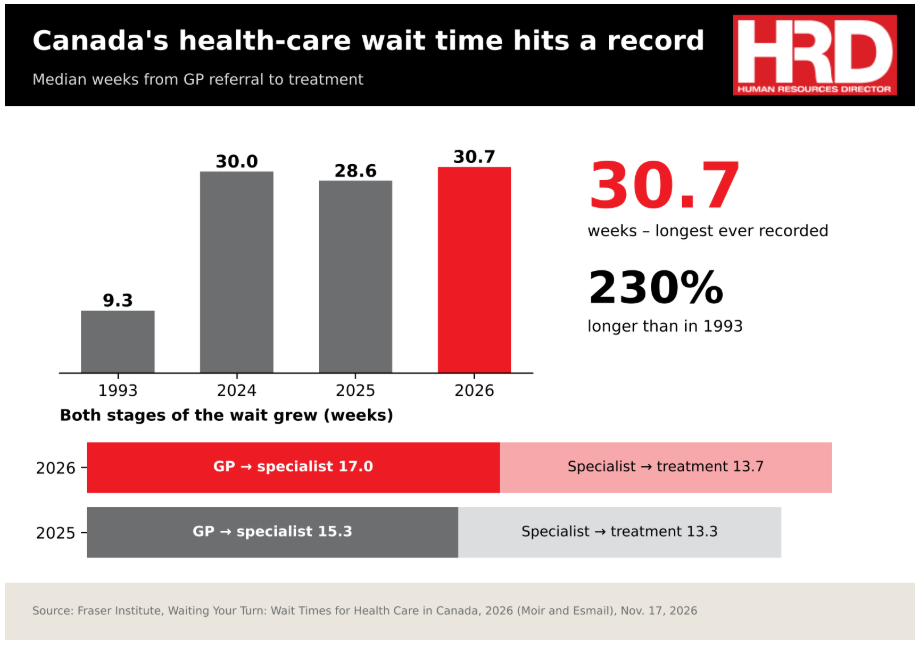
Employees referred for specialist care in Canada now wait a median 30.7 weeks for treatment – more than seven months of potential absence, reduced hours or working through pain. That health-care wait time is the longest on record, according to a Fraser Institute report released Nov. 17, 2026.
The think-tank’s study, Waiting Your Turn: Wait Times for Health Care in Canada, 2026, surveyed physicians across 12 specialties. The median beats the previous high of 30.0 weeks in 2024, up from 28.6 weeks in 2025, and is 230% longer than the 9.3 weeks recorded in 1993.
“Remarkably long wait times for medically necessary care have become a defining characteristic of the Canadian health care experience,” said Nadeem Esmail, director of health policy studies at the Fraser Institute and co-author of the study.
Where health-care wait time is longest
That delay builds in two stages. The wait from a general practitioner (GP) referral to a specialist consultation rose to 17.0 weeks from 15.3 weeks in 2025, while the wait from consultation to treatment grew to 13.7 weeks from 13.3 weeks, the report says.
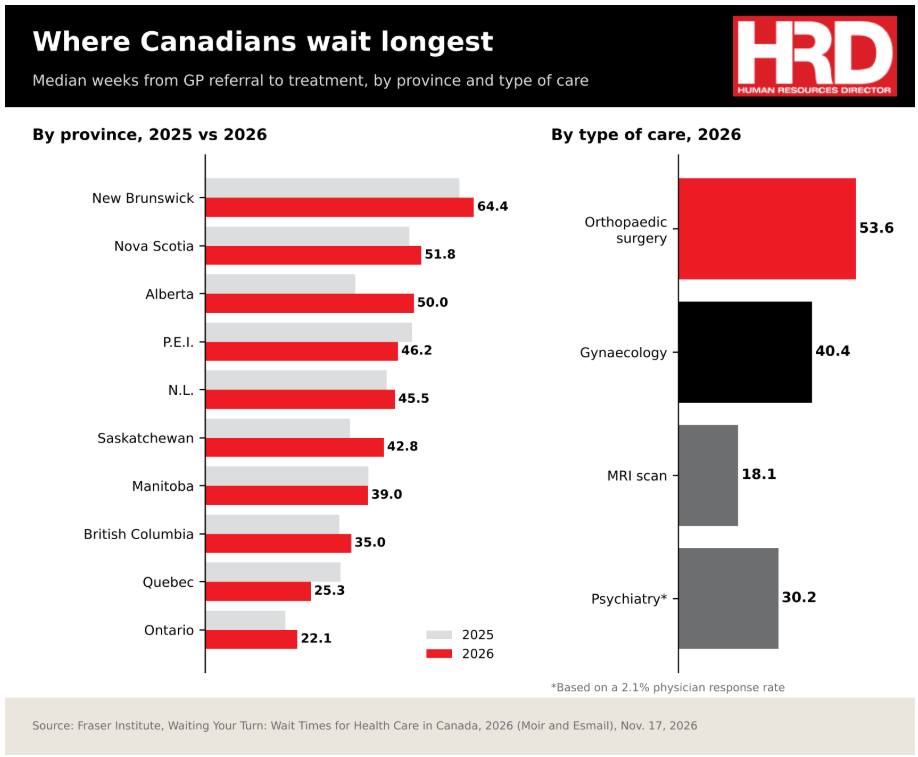
Location matters for employers with staff across provinces. New Brunswick recorded the longest median at 64.4 weeks, followed by Nova Scotia at 51.8 weeks and Alberta at 50.0 weeks, up from 36.0 weeks in 2025. Ontario had the shortest at 22.1 weeks.
The type of care matters too. Orthopaedic surgery carried a 53.6-week median and gynaecology 40.4 weeks, while patients waited 18.1 weeks for a magnetic resonance imaging (MRI) scan. Even after seeing a specialist, physicians said patients waited 38% longer than they consider clinically reasonable.
Psychiatric care is also slipping. Its median wait rose to 30.2 weeks in 2026 from 25.3 weeks in 2025, though the Fraser Institute cautions that the figure rests on a 2.1% response rate.
The cost to productivity
Those delays show up in output. “Long wait times can result in increased suffering for patients, lost productivity at work, decreased quality of life, and in the worst cases, disability or death,” said Mackenzie Moir, senior policy analyst at the Fraser Institute and study co-author.
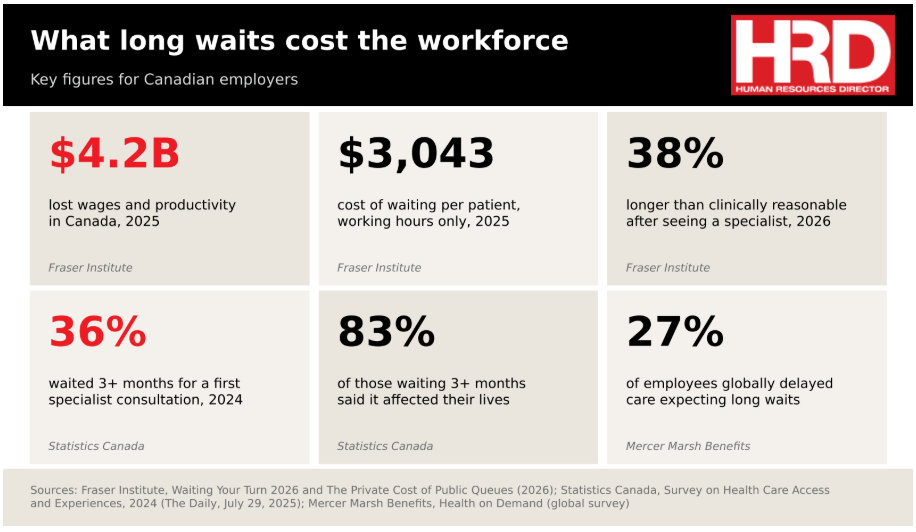
Earlier Fraser research by Moir and Esmail put that cost at approximately $3,043 per patient in 2025, counting only working hours. Nationally, as HRD Canada reported, medical wait times cost Canadians $4.2 billion in lost wages and productivity that year.
In Statistics Canada’s 2024 Survey on Health Care Access and Experiences, 36% of Canadians who had a first specialist consultation waited three months or more, and 83% of that group said the wait affected their lives.
Some employees avoid care altogether. In Mercer Marsh Benefits’ global Health on Demand research, 27% of employees said they had delayed care in the past two years because they expected long waits.
What can employers do about long wait times?
A Canadian Centre for Policy Alternatives (CCPA) report published Nov. 2, 2026, by Nathania Ebegbare argues that the costs of waiting fall on individuals, families and employers.
“Waiting redistributes costs,” Ebegbare writes. That shift is detailed in HRD Canada’s coverage of public service wait times driving leaves, lost hours and job exits.
Employers cannot shorten provincial lists, but Mercer recommends assessing how waits affect the workforce, allowing flexible scheduling for medical appointments and expanding virtual care. As HRD Canada’s Elite Women 2026 special report on top HR leaders shows, HR’s remit keeps widening – and health access now sits within it.