Why are so many Canadians ending access to mental health support earlier than planned?

Mental health continues to affect workplace functioning, according to a new report.
Among employed Canadians whose mental health affects their ability to function, 34% said their work was highly disrupted, up from 30% in the previous survey wave.
Overall, 28% of Canadians said their mental health affects their day-to-day functioning, while one-third of employees reported interference with their work, finds Mental Health Research Canada’s (MHRC) latest quarterly report.
Burnout affected 26% of Canadians overall.
Mental health challenges cost the Canadian economy $180 billion annually, with employers accounting for 61%, or roughly $110 billion, of those costs through disability leave, accommodations, compliance requirements and related expenses, according to a recent study by the CSA Public Policy Centre.
Mental health care ends too soon
Also concerning: More than half (56%) of Canadians who accessed mental health support said they ended care earlier than planned or needed, according to
“The topline numbers do not tell the whole story,” says Akela Peoples, MHRC's CEO. “Access to mental health support is essential, but access alone is not enough. People need support that feels practical, trusted and useful enough to continue. When more than half of those who access care leave earlier than they should, it raises important questions about whether people are getting the kind of support that works for them.”
Among Canadians who ended treatment earlier than planned, the most frequently cited reasons were not seeing real-world progress or improvements (19%) and not feeling understood, respected or able to be honest without judgment (16%). Other reasons are found in the chart below.
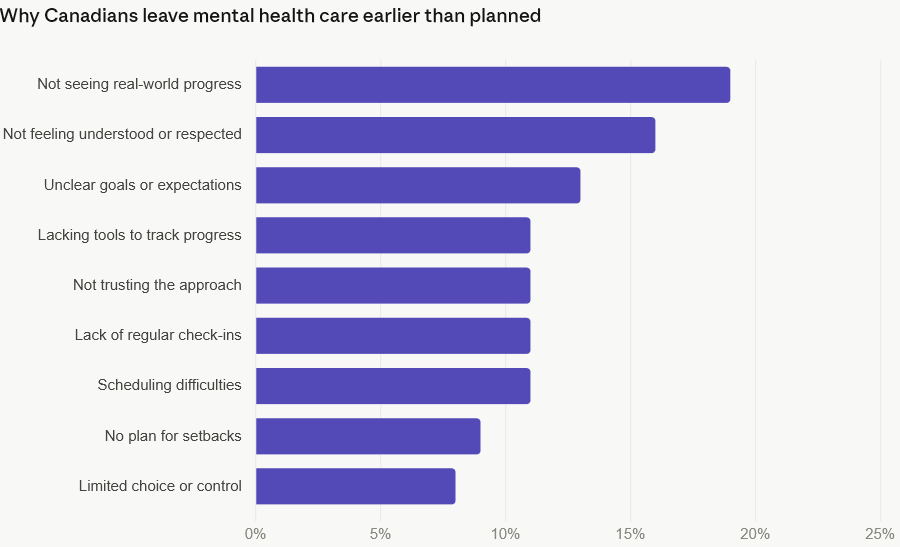
Ending care early was more common among people reporting severe anxiety symptoms (68%) and severe depression symptoms (77%). Members of 2SLGBTQIA+ communities (64%), racialized Canadians (64%), and Canadians with a weak sense of belonging to their local community (64%) were also more likely to report ending care early.
Other Canadian research has identified concerns about patients feeling unheard during care and the availability of culturally relevant services for specific populations. A national survey cited by the Black Women’s Institute for Health found that 76.6% of Black women, girls and gender-diverse respondents felt “unheard or disbelieved” by health-care providers when accessing services.
Moderate or severe anxiety
Self-rated anxiety and depression remained stable at 11% and 9%, respectively, found MHRC. However, other indicators showed increased strain.
Using the Generalized Anxiety Disorder-7 screening tool, 18% of Canadians reported moderate or severe anxiety symptoms, up from 15% in the previous survey wave. Young women aged 16 to 34 were the most likely to report moderate or severe anxiety symptoms at 32%.
Canadians’ self-rated resilience declined to 62% from 66%, the lowest level recorded since MHRC began tracking the measure in 2022.
The report found that 17% of Canadians accessed mental health support in the past year, while another 5% said they needed support but did not access services. Separate research presented at Public Health 2026 found unmet mental health needs were highest among adults aged 18 to 34, with 52% reporting needs that were unmet or only partially met.
Financial strain and coping habits
Nearly half of Canadians (45%) said the cost of living is negatively affecting their mental health, while 36% cited concerns about paying household bills, found MHRC. Another 42% said global political events are negatively affecting their mental health.
The report also identified links between screen use and mental health outcomes. Canadians spending four or more hours daily scrolling social media, consuming entertainment content or playing video games were about twice as likely to report severe anxiety and depression symptoms than those spending less than four hours per day on those activities.
“The screen findings are not about blaming technology,” said Michael Cooper, vice-president, data & partnerships at MHRC. “They show that when screen use is passive, frequent or extends beyond what people intended, it can be an important marker of mental health strain, especially among young people.”
Among women aged 16 to 24, 64% said they scroll social media or watch videos to cope with stress or emotions, while 69% reported spending more time scrolling than intended.
Eating disorders, alcohol dependence
Four in five Canadians said turning to friends or a partner is helpful when dealing with stress or mental health concerns, found MHRC. Nearly half (48%) described their sense of belonging to their local community as strong, while 41% described it as weak. Canadians who participated in group activities were more likely to report a strong sense of belonging (61%).
The report also found that one in 10 Canadians reported eating-related thoughts or behaviours that may place them at higher risk for an eating disorder, rising to 19% among women aged 16 to 24.
Signs of alcohol dependence and cannabis dependence remained relatively stable nationally at 6% each, though both were strongly associated with other mental health indicators.
The survey of 4,044 Canadian adults was conducted from April 29 to May 13, 2026, in partnership with Pollara Strategic Insights.
Have something to say about this story? Leave a comment below.