Lack of coverage for community‑based services pushing cost up for Canadian employers, say researchers

Poor mental health now represents one of the largest cost and productivity risks facing Canadian employers, according to a new report from CSA Group’s Public Policy Centre.
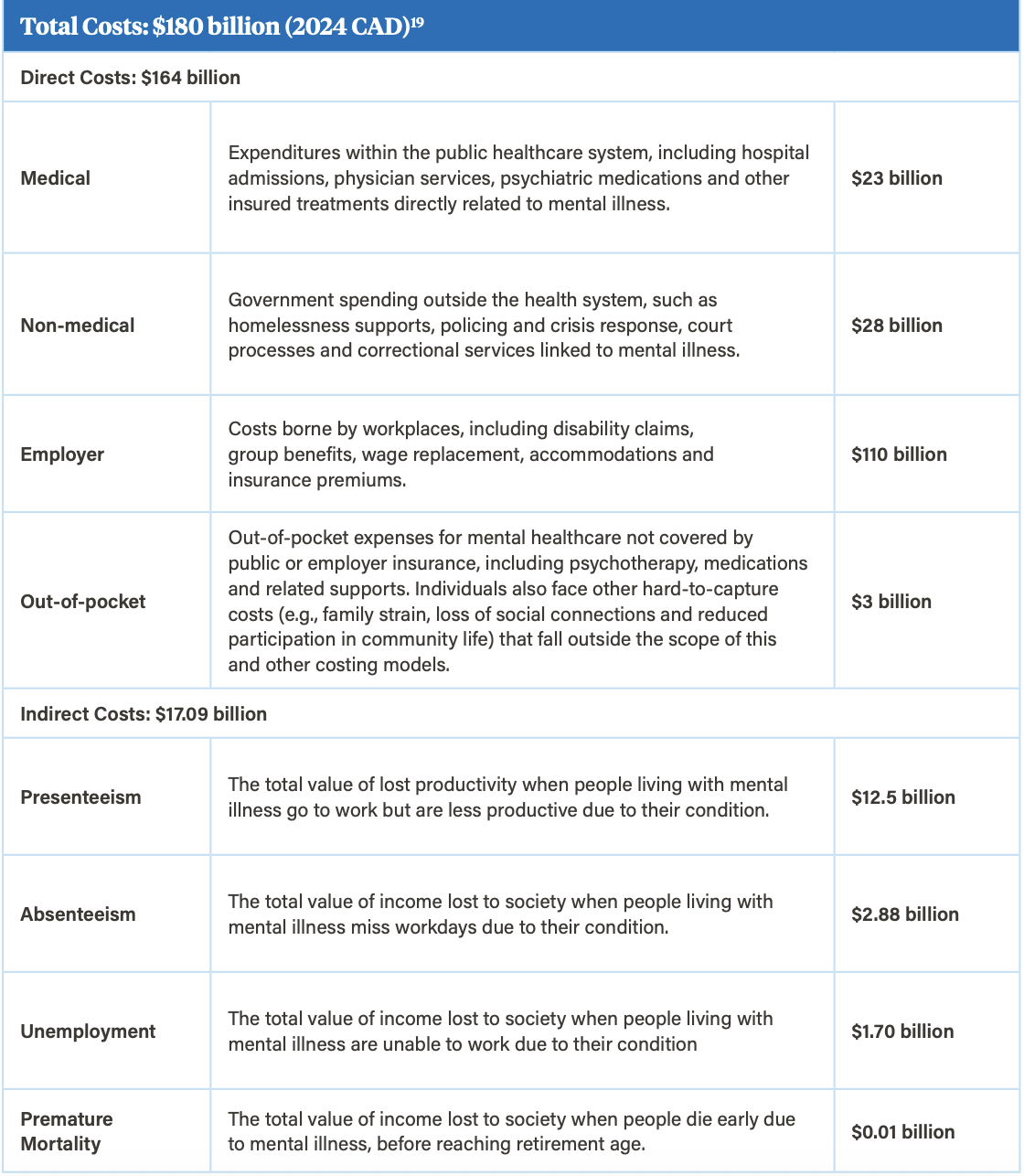
The Economic Cost of Mental Health in Canada – authored by Olga Morawczynski, Kathleen Dobson and William Howatt – estimates that poor mental health costs the country $180 billion annually. Of that, employers absorb about $110 billion through disability claims, wage replacement, benefits, overtime, accommodations, turnover and compliance costs.
The authors warn that “if Canada continues on its current trajectory, the annual cost of poor mental health is expected to rise to $600 billion by 2050.”
Direct and indirect cost breakdown
CSA Group finds that $164 billion of the total are direct costs. These include $23 billion in medical spending within the health‑care system, $28 billion in non‑medical public expenditures such as homelessness, policing, crisis response and corrections, $110 billion in employer costs, and $3 billion in out‑of‑pocket payments by individuals.
The remaining $17.09 billion are indirect costs tied to lost productivity. Presenteeism accounts for $12.5 billion, absenteeism for $2.88 billion, unemployment for $1.70 billion and premature mortality for $10 million. According to the report, “presenteeism accounts for $12 billion annually, nearly 90% of all indirect costs and one of the largest components of the $180 billion national burden of mental illness.”
The report argues that decades of policy choices have shifted costs away from the health system and into other public and private systems, including workplaces. Only 5% to 7% of provincial and territorial health budgets are directed to mental health, below the Organisation for Economic Co‑operation and Development benchmark of 10% to 11%.
Because many community‑based services — such as psychologists, psychotherapists, social workers and peer support — are not routinely covered under public plans, the authors say “Canadians must rely on private insurance or pay out‑of‑pocket for therapy and prescription medications” outside hospital settings. As a result, employers and individuals are increasingly funding treatment through benefit plans and direct payments.
Nearly two-thirds (62%) of professionals across Canada are burned out, and it’s intensifying, according to a previous report. And HR and legal professionals have the highest burnout levels in Canada, according to a separate study.
Productivity and reform agenda
CSA Group also links mental health to Canada’s lagging productivity. The report states that mental health conditions are “a significant contributor” to declines in business productivity through reduced workforce participation, presenteeism, absenteeism and early exit from the labour market. “When nearly one in three Canadians are not fully present or performing at their potential because of mental health challenges, the productivity gap will only widen,” the authors write.
To address what it calls an “unsustainable” trajectory, the CSA Group report recommends that the federal government – the biggest employer in Canada – do the following:
-
Conduct more frequent national surveillance of poor mental health and illness prevalence to capture emerging trends.
-
Establish capacity to evaluate innovative treatments, early intervention models and pilot programs. Publicly funded programs, whether clinical or community‑based, should be expected to demonstrate measurable improvements in outcomes, equity and cost‑effectiveness.
-
Expand data collection to better capture how psychosocial factors and workplace conditions interact with mental health. This includes impacts on productivity, the proportion of workers who are effectively accommodated, employer confidence in providing accommodations, and levels of workplace stigma.
-
Invest in robust data linkages across administrative, clinical and employment datasets to support a more integrated understanding of mental health and work.
Meanwhile, other employers should be “ditching the one‑size‑fits‑all approach to employee wellness,” according to AllOne Health, an EAP and organisational consulting firm.
“Instead, they should focus on providing personalised wellness programs and mental health initiatives that truly suit their people.”
According to the company, options available to employers looking to personalise their employees’ health care include:
-
Advanced needs assessments: By harnessing the power of AI to gather and analyse employee data efficiently, employers will have a greater understanding of individuals’ needs, personal challenges and preferred support methods.
-
Customisable wellness schemes: Employees can be given credits or a budget to select their own plan details and coverage options.
-
Preventive care for transitions: Employees who are about to undergo changes in the workplace, such as a promotion or branch relocation, should be provided with preventive mental health support to ease their transition experience.
-
Specific accommodations: As we gain insight into neurodivergence, employers must provide accommodations for employees who might experience the workplace differently. Accommodations include quiet workspaces, alternative communication channels and access to specialised support.
Canada’s Gen Z employees are experiencing the fastest growth in mental health issues and chronic disease compared with other age groups, putting employers at higher risk of lost productivity and escalating benefits costs in the workplace, according to a previous Sun Life report.