‘The policy question is how strong infrastructure and interest are converted into consistent teaching, practical capability and worthwhile economic opportunities’

Canadian employers may soon be welcoming new talent into their fold who may need intense artificial intelligence (AI) training so these new hires can actually contribute to the organization, based on the findings of a recent report.
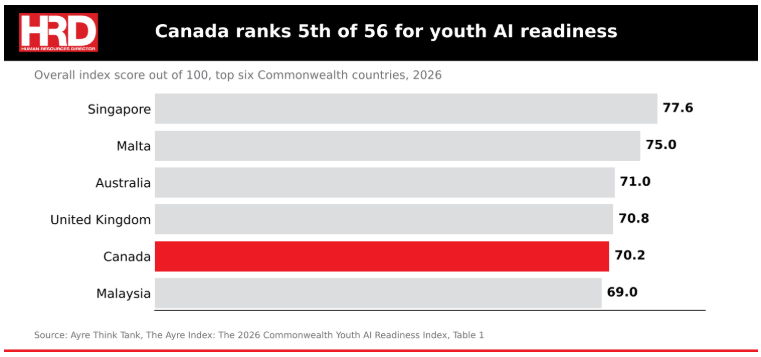
Canada ranks fifth of 56 Commonwealth countries for youth AI readiness, but it trails on education and training, according to an index released Nov. 5.
The Ayre Index: The 2026 Commonwealth Youth AI Readiness Index gave Canada 70.2 out of 100. Singapore, Malta, Australia and the United Kingdom ranked higher. The Antigua-based Ayre Think Tank, founded by entrepreneur Calvin Ayre, distributed the findings through a paid press release. The release came a day after the Commonwealth Heads of Government Meeting (CHOGM) closed in St John’s, Antigua and Barbuda.
The report’s profile of Canada sets out the challenge. “The policy question is how strong infrastructure and interest are converted into consistent teaching, practical capability and worthwhile economic opportunities,” it states.
Already, youth hiring is slowing, and half of young Canadians say AI is affecting their long-term career plans.
Access outpaces training
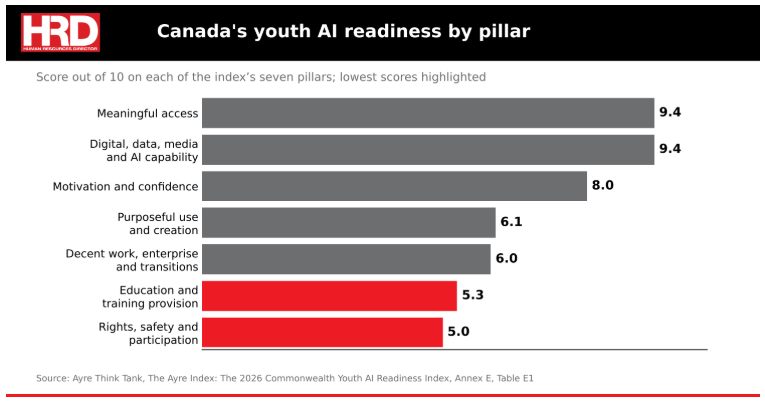
Canada scored 9.4 out of 10 for meaningful access and 9.4 for digital, data, media and AI capability, according to the Ayre Index. Its lowest score, 5.3, came in education and training provision.
The white paper says Canada’s curriculum evidence records computing only in some schools or districts. It adds that the national teacher-policy indicator it used does not mention AI.
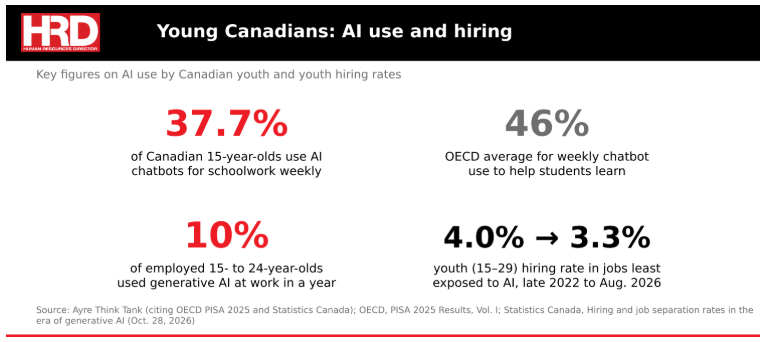
The think tank reports that 37.7% of Canadian 15-year-olds used AI chatbots for schoolwork at least weekly.
The Organisation for Economic Co-operation and Development (OECD) puts the average for weekly chatbot use to help students learn at 46%. That figure comes from its Programme for International Student Assessment (PISA) 2025 results.
What the data mean for employers
The white paper states that frequent AI use does not, by itself, demonstrate competence. Lisa Taylor, founder and CEO of Toronto-based workforce consultancy Challenge Factory, agreed in the think tank’s announcement.
“While youth may be regular users of AI tools, the real priority is ensuring they know how to use AI effectively, question its outputs and harness its potential to build career skills and create opportunities,” Taylor said.
PISA 2025 found that students who used chatbots to draft or summarize scored lower in science than non-users. Students who used AI weekly to help them learn showed no such gap.
Youth hiring slows, but not because of AI
Young Canadians are entering a cooler job market. Tahsin Mehdi and Marc Frenette published a Statistics Canada study on Oct. 28, 2026. It found that hiring rates for workers aged 15 to 29 in the jobs least exposed to AI fell from 4.0% to 3.3% between late 2022 and August 2026.
The study found no broad evidence that AI has substantially reduced hiring or increased job separations. That suggests employers blaming AI for weak youth hiring may be off target.
“AI is no doubt reshaping sort of workflows and redefining jobs right now,” Mehdi told The Canadian Press, adding that “it may not be eliminating entire jobs right now.”
Calls for action
Employer adoption is accelerating. In Statistics Canada’s second-quarter 2026 survey, 19.2% of businesses said they had used AI in the previous year, up from 12.2%.
The Ayre Think Tank’s announcement identifies five global priorities, including education that develops practical skills and stronger routes from training into employment. Employers weighing what AI skills are best for early career employees in Canada may find those priorities a useful reference point.
“Young people should be equipped to question new AI tools, to improve them and to be supported in building alternatives suited to their own needs – whether that happens, however, will depend on choices made now,” said C. Justin Robinson, pro vice-chancellor and campus principal of the University of the West Indies, Five Islands Campus, in Antigua and Barbuda.