Labour shortages, staffing challenges among top reasons for business pessimism: report

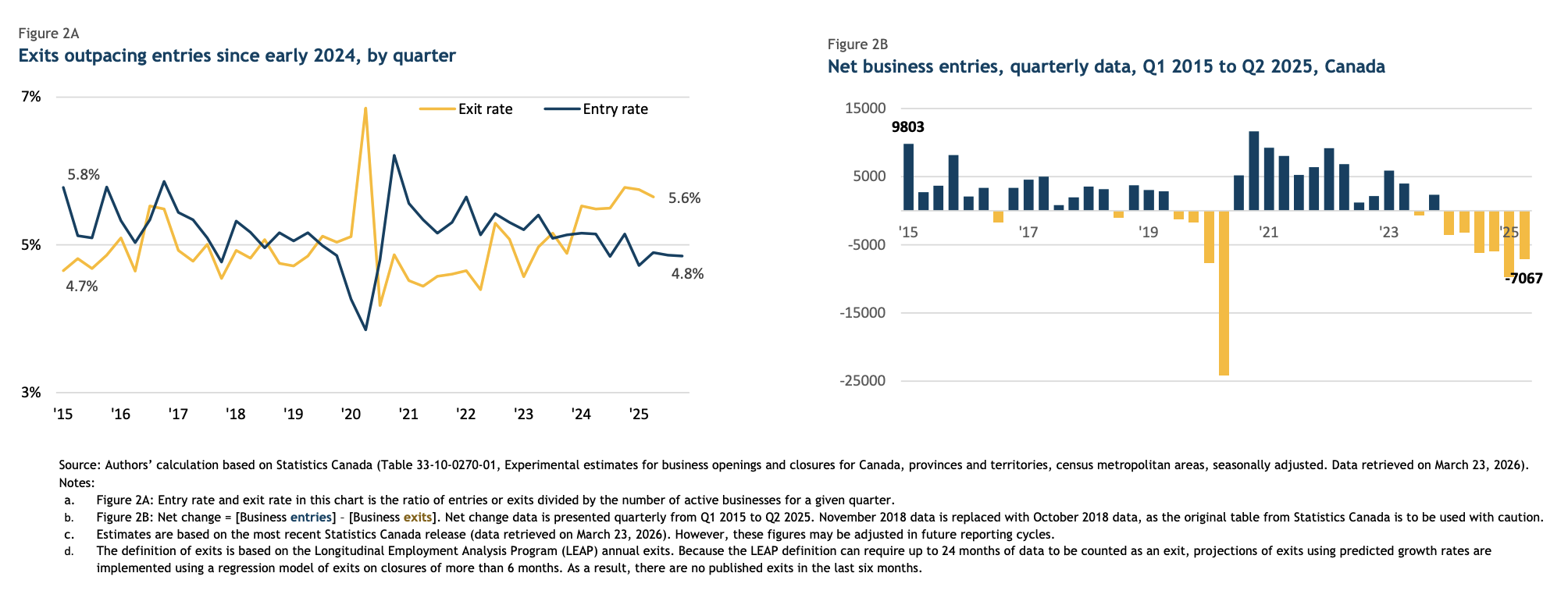
More Canadian businesses are closing than opening, with exits outpacing entries for six consecutive quarters – a reversal that threatens job creation, wage growth and career mobility across Canada, one group has warned.
A new report from the Canadian Federation of Independent Business (CFIB) shows business exits have exceeded entries every quarter since early 2024, putting Canada in what it calls an “entrepreneurial drought.”
In the second quarter of 2025, the national exit rate reached 5.6% of active firms, while the entry rate fell to 4.8% in the fourth quarter – some of the highest closure and weakest start‑up levels outside the pandemic, according to the report.
CFIB defines an entrepreneurial drought as “four or more consecutive quarters in which business entry rates are strictly lower than business exit rates, resulting in a net loss of entrepreneurial activity.”
Small‑business shakeout’s impact on labour market
In its report, Canada’s Entrepreneurial Drought, Part 1: The Shrinking Business Landscape, CFIB points to structural pressures pushing more firms towards “unhealthy exits.” At least 54% of small businesses identify government regulation and paperwork as major impediments, the report says.
In 2024, businesses spent an average of 735 hours – “equivalent to 32 working days” – on compliance, at an estimated cost of $51.5 billion, including $17.9 billion attributed to red tape.
CFIB also notes that small and mid‑sized enterprises (SMEs) “account for nearly 99% of all employer businesses, employing over 60% of the private sector workforce, and contributing almost half of private sector GDP.” When those firms disappear faster than they are created, HR teams face fewer employers competing for talent and fewer local options for displaced workers.
The report warns that this prolonged imbalance “threatens Canadian innovation, competitiveness, and business dynamism.” Under normal conditions, steady firm entry and exit refresh the economy, creating new jobs and opportunities for workers to move up or sideways. For HR, weaker dynamism can show up as slower wage growth, limited internal progression and more pressure to hold the line on headcount.
Even bigger businesses - such as the 7-eleven, Starbucks, and the Hudson’s Bay Company - have announced closures in Canada.
Barrier to business entry
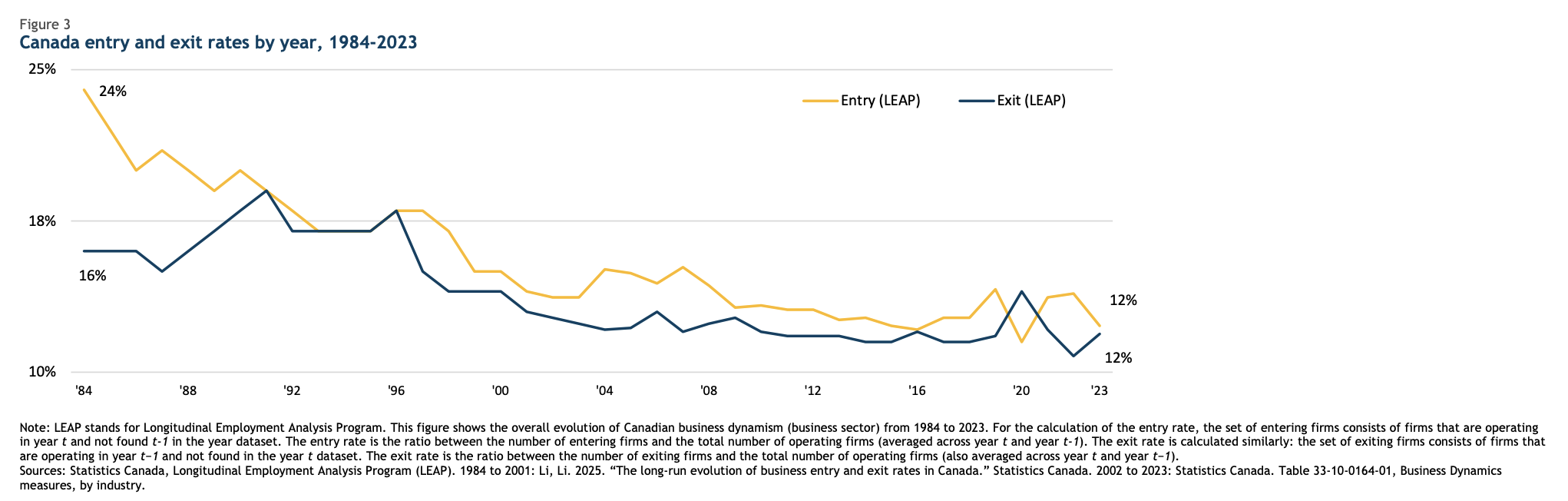
CFIB also stresses that the problem is structural. On top of the exits, business entry rates have “plummeted nearly 50% since the mid‑1980s and remain stuck at historic lows,” it says, with annual entry and exit rates now nearly level.
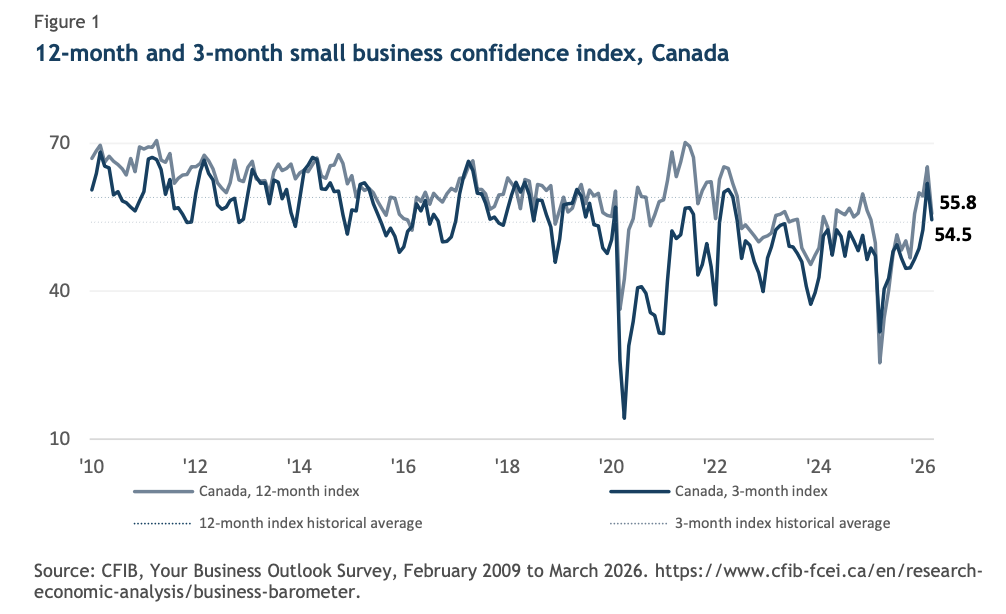
More than half (55%) of SMEs are advising against starting a business in the current economic environment. They cite the following reasons for their pessimism:
- High costs of doing business (91%)
- The economy is too uncertain/stressful (84%)
- Uncertainty around trade (70%)
- The tax burden is too high (68%)
- Heavy government regulation (62%)
- Work‑life balance/personal time concerns (59%)
- Labour shortages (52%)
- Other staffing challenges (46%)
- Lack of access to financing (35%)
- Weak demand for services/products (24%)
- High competition (21%)
“Canada’s economic foundation is crumbling,” said Brianna Solberg, CFIB’s director for the Prairies and the North. “We cannot afford to regulate ambition out of our economy. When more than half of current small business owners are telling you they wouldn’t recommend starting a business, it’s time to listen.”
In 2023, the Angus Reid Forum conducted a public opinion survey on behalf of CFIB to assess Canadians’ interest in entrepreneurship and perceived barriers to starting, purchasing or taking over a business. The results suggest that while interest in entrepreneurship exists, many Canadians feel that barriers make it difficult to pursue. When asked whether Canadians had an interest in starting a business within the next 10 years, just over 16% indicated they did.
Those interested in entrepreneurship cite the following barriers to entrepreneurship in Canada:
-
Earning a living (56%)
-
Trying to access financing (54%)
-
Balancing work and personal life (49%)
-
Finding and/or attracting new customers (44%)
-
Competition from big businesses and/or online giants (44%)
-
Finding information and resources to get a business up and running (38%)
-
Navigating legal or regulatory requirements (38%)
-
Finding government support programs (35%)
-
Applying/qualifying for government support programs (32%)
-
Managing multiple roles within the business (27%)
-
Lacking support networks and/or mentors (24%)
-
Finding and retaining employees (23%)
“Compared with the U.S., Canadians demonstrate a higher level of entrepreneurial interest, but fewer Canadians translate that interest into starting a business,” reads part of the CFIB report. “This disconnect suggests that Canada’s entrepreneurial spirit is not absent; it is being constrained by fear and barriers. The risks associated with leaving stable employment, taking on personal debt, and navigating complex and costly rules often outweigh the perceived rewards of entrepreneurship. While fear of failure is high in both Canada and the U.S., it is higher in Canada, further suppressing business creation.”
Reversing Canada’s ‘entrepreneurial drought’
CFIB argues that rising market concentration is already visible in sectors from retail to professional services, as larger corporations and private‑equity groups acquire independent firms.
A more concentrated employer base can reduce alternative job options for employees and strengthen the bargaining power of dominant players over wages and working conditions, complicating HR retention and succession efforts.
“Reversing Canada’s entrepreneurial drought must be treated as a national economic priority,” the organisation concludes. “Strengthening the environment for starting and growing a business, while restoring confidence in the viability of entrepreneurship, is critical to rebuilding Canada’s economic momentum and prosperity.” CFIB is calling for lower taxes, less red tape and policies that better reflect “the realities on Main Street.”
In October 2025, the federal government announced a new $100 million initiative to support entrepreneurs and small businesses in rural and remote communities across the country amid the tariffs issue.