‘The goal is to encourage folks to take a moment and think about what they really want’
Pay-to-quit incentives may help employers keep their most committed people, finds a study published, in the Journal of Management Accounting Research.
The payments prompted employees less attached to their organization to leave, showing, the authors wrote, that such incentives "both help retain highly identified employees and motivate those who remain."
The authors are Leslie Berger and Lan Guo of Wilfrid Laurier University and Kelsey Matthews of the University of Waterloo, both in Waterloo, Ont., and Bradley Ruffle of McMaster University in Hamilton, Ont.
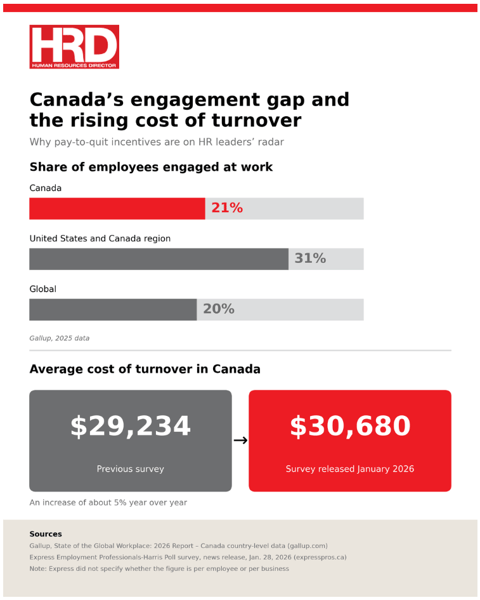
That matters in Canada, where Gallup's State of the Global Workplace: 2026 Report found just 21% of employees were engaged at work, fuelling debate over whether Canadian workers are really quiet quitting.
What the pay-to-quit research found
The team's experiments measured how closely participants identified with the organization. Weakly attached employees tended to leave and strongly attached ones to stay regardless, so the payment mattered most for those in between.
The offer did more than sort people. "We also find that employees who forgo the pay-to-quit incentive subsequently exert higher work effort than before," the authors wrote.
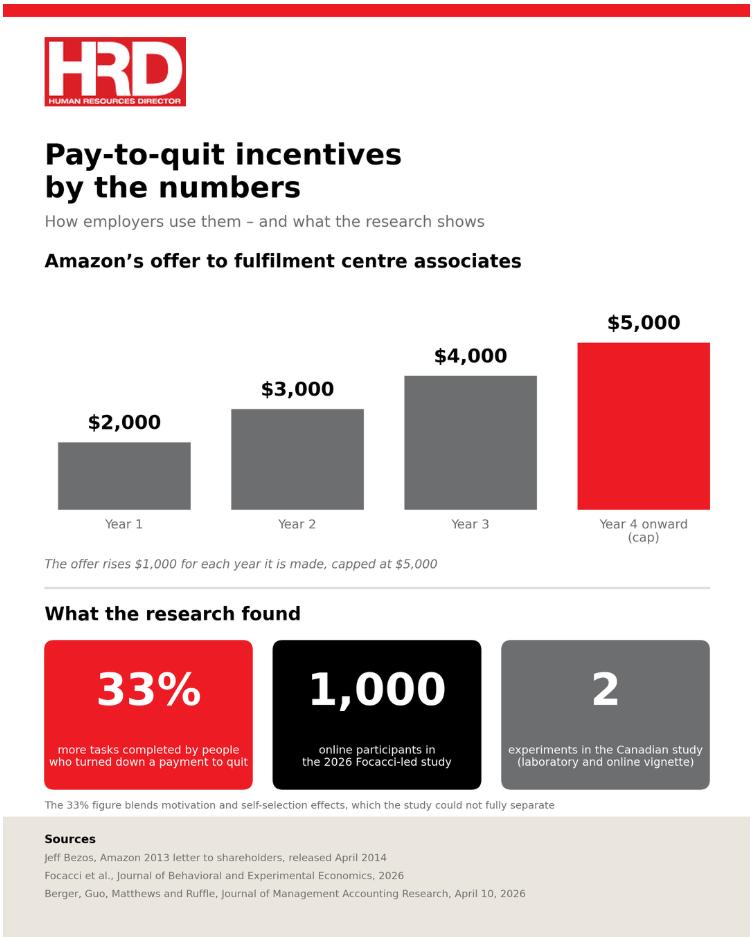
A separate 2026 study agrees. In an online experiment with 1,000 participants, published in the Journal of Behavioral and Experimental Economics by a team led by Chiara Natalie Focacci, people who rejected a small payment to quit completed 33% more tasks than a control group – though motivation and self-selection could not be fully separated.
How pay-to-quit programs work in practice
Amazon is the most prominent employer to try the approach. In an April 2014 shareholder letter, founder Jeff Bezos said fulfilment centre associates were offered $2,000 to quit, rising $1,000 a year to $5,000, under the headline "Please Don't Take This Offer."
"The goal is to encourage folks to take a moment and think about what they really want. In the long-run, an employee staying somewhere they don't want to be isn't healthy for the employee or the company," Bezos wrote.
Bezos credited the idea to Zappos, and the logic has academic support: Uri Gneezy, a behavioural economist at the University of California San Diego, argued in Harvard Business Review in May 2023 that such offers reveal true commitment.
What employers and workers in Canada should weigh
In Canada, the idea resembles the voluntary exit program, highlighted in HRD Canada's coverage of voluntary severance packages at Rogers and BCE, but structure matters.
"The decision really does have to remain with the employee in order for these payments to remain lawful and not run counter to the obligation to provide reasonable notice or pay in lieu of that notice," Craig Stehr, then a lawyer at Nelligan O'Brien Payne in Ottawa, told Canadian HR Reporter in 2014.
Workers face consequences too: quitting without just cause generally disqualifies them from regular Employment Insurance (EI) benefits under subsection 30(1) of the Employment Insurance Act.
Employers face their own math. An Express Employment Professionals-Harris Poll survey released in January 2026 put the average cost of turnover at $30,680, as HRD Canada explored in the real cost of employee churn for Canadian employers.
Since both studies were controlled experiments, a pilot makes sense.
Stehr advised applying any program uniformly and obtaining a full and final release – and staff should know accepting may affect EI eligibility.