As Canadian employers add monitoring tools, research on Chinese officials who fake compliance shows how heavy oversight can backfire

Ontario employers with 25 or more staff already need a written policy explaining how they monitor employees electronically. Across most of Canada the rules are thinner, and there is still no federal law on how AI-generated monitoring data can be used to discipline or dismiss workers, HRD has reported.
That leaves much of the judgment with employers. Before they make it, a very large experiment in oversight is worth a look.
Xi Jinping has spent more than a decade tightening discipline across China's Communist Party. In a speech published this month, he complained that officials feign obedience and likened the corrupt to "sick trees" that should be pulled out. Discipline authorities punished 983,000 people in 2025, up from 889,000 the year before, according to official figures. Senior officials meet in Beijing this week for a Central Committee session, a year before Xi is expected to secure a fourth term.
What the oversight produced
At the local level, a good deal of what all that pressure produced was a better performance of compliance. Ben Hillman of the Australian National University and co-author Tan Zhao drew on fieldwork in six provinces for a study published in January in The China Journal. They found that county and township officials, facing stricter discipline, heavier reporting and elaborate performance reviews, often respond "for the purposes of self-preservation" with formalism: shirking, feigned compliance, falsification and form over substance.
Beijing wants formalism gone. The authors argue its campaign is failing and making the problem worse.
The link to workplace monitoring is a fairly direct one. When oversight is extensive and its purpose unclear, people put their effort into satisfying the system.
Read next: Is it worth it? 'Bossware' can push workers to take risks: report
What the evidence on bossware says
A recent U.S. government review is a useful guide. The Government Accountability Office looked at 122 studies and found that digital surveillance can make workers safer but can also raise anxiety and injury risk when it is used to push productivity. Workers did better when monitoring was clearly explained, aimed at safety and limited in scope.
Monitoring that people understand and accept works as a safety tool. Monitoring they suspect is there to catch them out gets the response Hillman found in rural China.
Read next: Managers' engagement levels falling, with direct impact on employee behaviour: report
Managers feel it first
In China, the strain lands on local officials who must deliver central targets with thin resources. In Canadian organisations, it lands on middle managers.
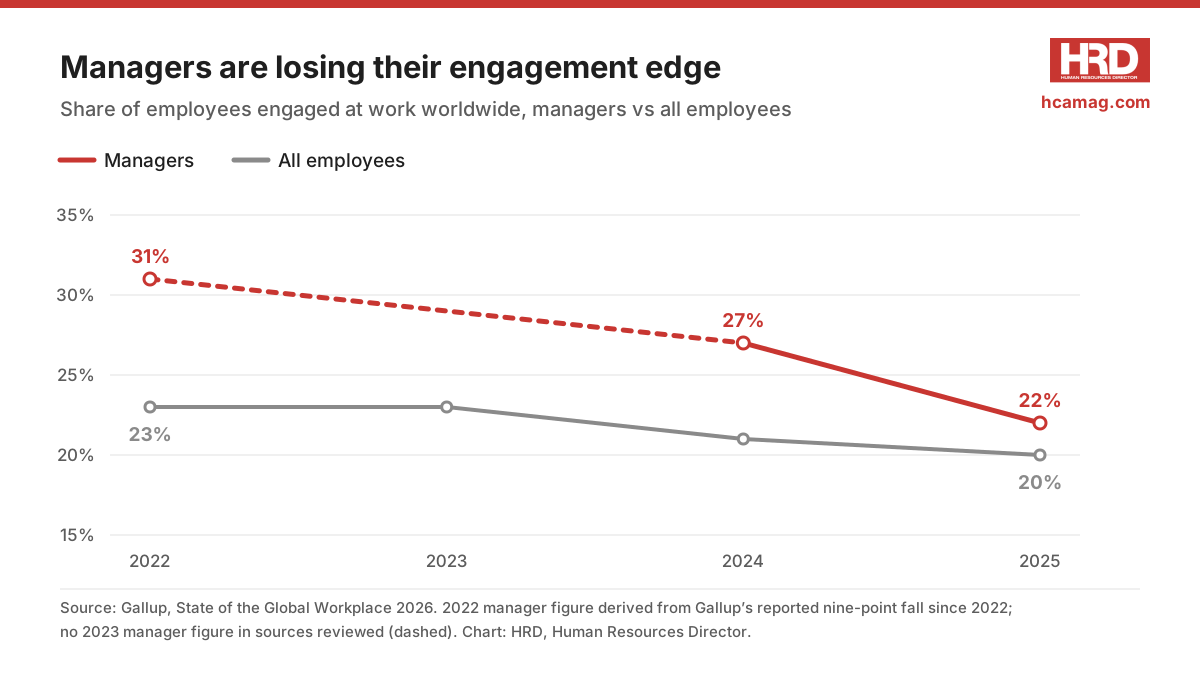
Gallup's State of the Global Workplace 2026 found manager engagement worldwide fell from 27% to 22% in 2025, its largest annual drop, pulling overall engagement down to 20%. The US and Canada remained the most engaged region, at 31%.
Harvard Business School professor Amy Edmondson's research on psychological safety explains why this matters. Teams learn when people feel safe admitting mistakes and raising problems. Add fear, and people stop raising them.
Four questions before adding a monitoring tool
What problem is it meant to solve, and would employees describe its purpose the same way? What will the data never be used for, and is that written down? Ontario employers already have to document their approach, and the habit is worth copying elsewhere.
Who will check, a year from now, that the tool is still used only for its stated purpose? And how many reports and attestations are managers already filing that nobody reads? Cutting those can do more for trust than any new dashboard.
Read next: Global employee engagement slumps to 5-year low
Canada's patchwork of monitoring rules gives employers room to choose. The research from China suggests a simple test for that choice: oversight that people trust tends to make an organisation safer, while oversight they fear mostly teaches them to look busy.