
Canadian employers and human resources (HR) leaders should be training and upskilling their own people for digital roles, researchers say.
That’s because digital jobs are growing considerably faster than the rest of the workforce and spreading well beyond the technology sector into banks, hospitals and construction firms.
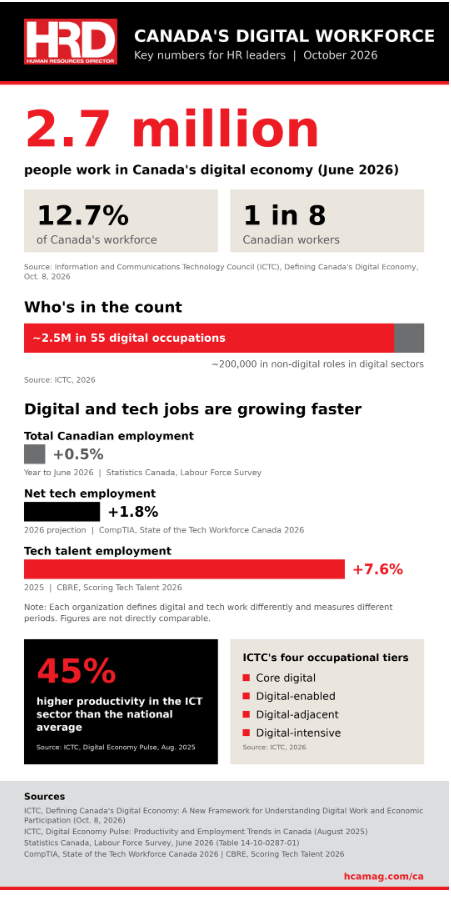
The growth figure comes from the Information and Communications Technology Council (ICTC), an Ottawa-based not-for-profit research organization. ICTC’s report, released Oct. 8, 2026, puts the digital workforce at 2.7 million people as of June 2026. That is 12.7% of all workers, or roughly one in eight.
Statistics Canada’s Labour Force Survey recorded national employment growth of 99,000 jobs, or 0.5%, in the year to June 2026. CompTIA’s State of the Tech Workforce Canada 2026 projects net tech employment will rise 1.8% this year to about 1.54 million workers. CBRE’s Scoring Tech Talent 2026 report found Canadian tech talent employment grew 7.6%, or 91,300 jobs, in 2025. Each organization defines digital and tech work differently.
“Technology is fueling economic growth, but Canada’s talent pipeline isn’t keeping pace,” said Gary Mofford, Canada account director at CompTIA. He warned that without faster workforce training, innovation and competitiveness could suffer.
Anne Patterson, chief research and communications officer at ICTC in Ottawa, said the payoff depends on skills.
“Canada’s ability to compete will depend on how effectively businesses adopt technology, workers develop the skills to use it, and those investments translate into greater productivity and innovation,” said Patterson.
Where are Canada’s 2.7 million digital workers?
According to ICTC, about 2.5 million people work in one of 55 digital occupations, while some 200,000 hold non-digital roles inside digital economy sectors. ICTC also counts digital workers outside 26 core industries such as software, telecommunications and e-commerce.
In a Policy Magazine article, Patterson and ICTC senior economist Erhan Baydar note that software developers now work in banking and energy. They point to health care, professional services and construction as sectors where a narrow definition could miss emerging skills needs.
The new total is not directly comparable with ICTC’s October 2025 estimate of 2.48 million, which was produced before the definition was modernized.
What the numbers mean for HR leaders
HRD Canada has reported on one in three Canadian workers overstating their artificial intelligence (AI) abilities. A separate Robert Half survey found just 5% of Canadian employers had the skills and headcount for priority projects. And BDO Canada’s research on why AI spending alone won’t fix productivity points to a gap between investment and results.
ICTC’s August 2025 Digital Economy Pulse found productivity in the information and communications technology (ICT) sector was 45% above the national average. The most in-demand roles it named included software engineers, data scientists, computer and information systems managers and cybersecurity specialists.
The new framework sorts occupations into four tiers based on how central digital work is to each job: core digital, digital-enabled, digital-adjacent and digital-intensive.
It maps skills data to the National Occupational Classification (NOC). It also includes more than 50 indicators, among them an AI Impact Score and an AI Readiness Gap, which ICTC says existing Canadian statistics do not track.
“This framework brings leading international approaches to digital economy measurement into the Canadian context, giving us a clearer picture of where transformation is happening and how jobs and skills are changing,” said Patterson.