New forecast shows impact of AI on the job market

Artificial intelligence (AI) is set to create more jobs than it eliminates by the end of the decade, according to new forecasts from Gartner.
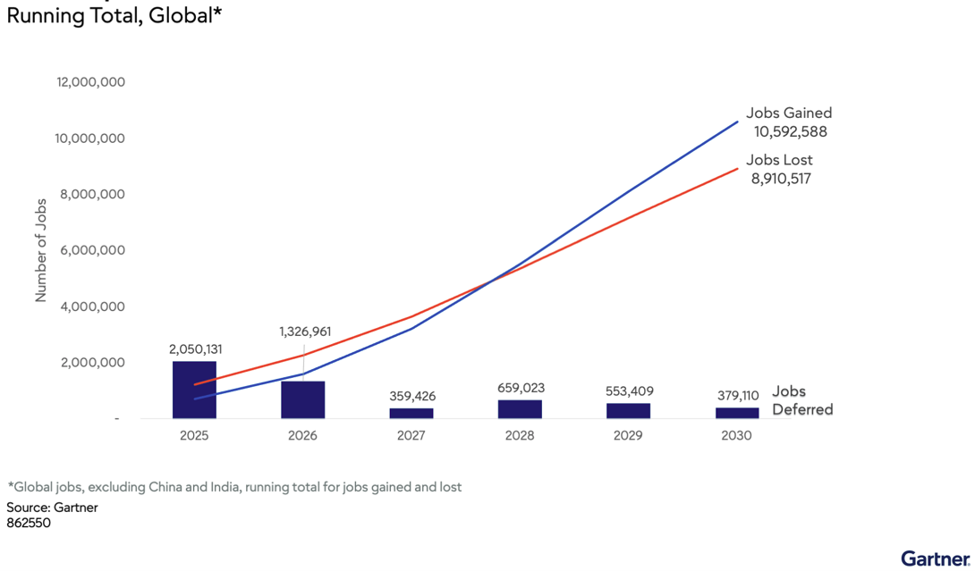
The business and technology insights company projects that AI will generate 10.6 million new jobs and remove 8.9 million by 2030, a net increase of 1.7 million positions.
Gartner also broke down the expected impact of AI on jobs across three types of industries.
In asset-intensive industries, Gartner expects AI to create 6.4 million jobs and eliminate six million by 2030. AI-driven job losses are projected to affect 0.4% of the sector's workforce.
These industries, which deal in physical products or deliver services within capital-intensive physical infrastructure, account for the largest share of jobs globally.
The technology sector is heavily affected by AI, with nearly 70% of its workforce highly exposed. Even so, Gartner expects the sector to create 1.9 million jobs and lose 0.4 million by 2030. AI job losses are projected to represent 1.8% of the global technology workforce over the period.
The public sector is the only one of the three where Gartner forecasts more jobs lost than gained: 0.9 million losses against 0.4 million gains by 2030.
AI-driven job losses are projected to total 0.4% of the global public sector workforce. Gartner added that AI investment in the sector is unlikely to be enough to offset severe future skills shortages driven by other factors.
Gartner's findings come amid worker fears that AI will wipe out jobs. Last year, Anthropic CEO Dario Amodei warned that AI could eliminate half of all entry-level white-collar jobs and push US unemployment to between 10 and 20% in the next one to five years.
But Helen Poitevin, Distinguished VP Analyst at Gartner, said the organisations furthest along with AI are using it to rethink how they operate, not simply to cut staff.
"Organisations most advanced in AI execution view AI not as a replacement for labour, but as a catalyst to reinvent operations and rebalance workforce and technology capabilities to compete in changing markets. They ensure AI's economic value goes beyond replacing labour," Poitevin said at the Gartner IT Symposium/Xpo in Barcelona.
Hiring put on hold
Despite the positive overall outlook, Gartner's forecast points to a less visible effect of AI on the labour market: roles that are never created.
According to Gartner, one of the most significant impacts on the job market in 2026 was executives' decisions to defer the creation and hiring of 1.3 million positions. Gartner's 2026 figures also show 2.2 million jobs lost and 1.6 million gained.
By 2030, Gartner expects five million people to have experienced delayed hiring as business and IT executives postpone the creation of new positions.
"Deferred jobs are not the same as lost jobs. They simply aren't created," said John Lovelock, Distinguished VP Analyst, Chief of Research at Gartner.
Job losses limited, transformation widespread
Gartner projects that between 0.4 and 1.8% of workers will experience job loss directly attributable to AI by 2030.
Far more workers will see their roles change. Gartner estimates that just over 20% of workers, or 435.5 million employees, will have to adapt to the new shape of work through 2030. That includes changes to what they do, how they do it and where their responsibilities begin and end.
Poitevin warned employers against assuming AI will affect every part of their business in the same way.
"AI job impacts are unevenly distributed across geographies, job functions and industries. The worst mistake that a business and IT executive can make is to apply lessons from one industry or role to another which can lead to poor errors in judgement and missed targets," she said.
"Each industry faces unique challenges and risks that executive leaders must understand and address."