Two Canadian HR leaders provide tips on how to be involved, from hiring to developing to mobilizing 'culture champions'

“You're going to have a great vision, but you're not going to be able to execute on that vision because you don't have the human resources to do it.”
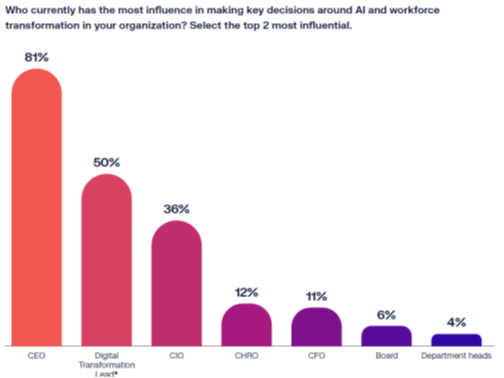
So say Siobhan Calderbank, vicepresident, talent and performance at Element Fleet Management, after a recent U.S. survey of HR leaders and executives found that only 30 per cent of HR leaders claim involvement with their organization’s AI strategy from the outset and nearly half (48 per cent) of HR teams are only brought in during the implementation phase.
Rachel Wong, Vice President, Total Rewards and HR Technology at Symcor, says HR’s training mandate alone is a reason for it to be embedded in AI strategy from the start.
“In order for a company to ensure all the employees are equipped, training is a big part and obviously training is owned by HR,” says Wong. “I think HR being a partner can support the training approach or the roadmap on rolling out the training.”
HR definitely needs to be at the table at the very beginning, agrees Calderbank, pointing to HR’s responsibility for workforce capabilities and planning: “HR is the team that's behind that, so they're going to be looking at the skill sets we currently have and the goal that we're trying to achieve.”
It is not enough to sketch out an AI vision for the organization — HR must also determine whether the organization has, or can develop, the people to deliver it, according to Calderbank, who believes that without that input, AI strategies risk collapsing under the weight of talent gaps.
Hiring and developing for an AI-skilled workplace
The survey, conducted by Beamery, highlights that AI is driving the creation of new roles and the redesign of existing ones. That puts talent acquisition and development at the centre of AI strategy.
Calderbank believes that HR has a “fantastic role” to play in how organizations source and assess talent as technology changes through talent acquisition, as curiosity and comfort with AI tools are now essential dimensions of fit.
“Because AI right now is probably one of the biggest movers and shakers across the globe, do individuals show that dimension of creativity and innovation and are they using the tools and technology? We're looking for that when we're looking to hire individuals,” she says.
For HR, AI strategy is no longer separate from talent strategy. It’s the same conversation, says Calderbank.
Learning, oversight a key part of AI strategy
Another study of U.S. and U.K. workers by Cornerstone found that nearly three in four AI users say they don’t always disclose their use of it to managers or colleagues, and among U.S. workers who are encouraged to use AI, one in three don’t receive training to support their usage.
Closer to home, a recent KMPG survey found that 51 per cent of Canadian employees use generative AI tools at work — a jump from 22 per cent two years ago — but slightly less than half say their employer has provided them with the training and guidance they need to improve their productivity.
For HR leaders, that’s a red flag. AI is being used regularly but without consistent rules, learning or oversight in many cases. That vacuum is exactly where HR should be leading.
Calderbank warns against the familiar pattern of rolling out a platform, offering a short training and walking away. She describes a learning approach that combines formal teaching, expert input, and psychologically safe experimentation.
“For us on the learning side, it’s being able to provide our team members with constant opportunities to develop and grow in this space, whether it be through training, having subject matter experts come into the organization and do presentations, providing them with the tools and safe spaces to be able to try it, make mistakes, and then be able to learn from those mistakes to do even better,” she says.
HR’s own AI capability
Calderbank also believes that we're still in the early stages of implementing AI into organizations.
“This is one of those skill gaps that, similar to when the internet came out or even if you go back as far as just learning how to use Microsoft, that was a switch for a lot of people,” she says.
Wong adds that HR must build its own AI capability first to lead credibly.
“As HR leaders, we need to know what is AI and we need to be AI users ourselves, and be comfortable with the language first,” she says.
A key role HR can play in an organization’s AI strategy is making sure that everyone can adapt, as not everyone will do so at the same pace. Creating spaces for people to compare approaches and share lessons is part of HR’s role in organizational AI implementation, says Calderbank.
“I think if you bring the people together to have conversations around how they’re using the tool, then they start to have connections with each other and they can learn,” she says. “Then they’re more productive overall because everyone’s learning from each other.”
Making organizational transformation a shared journey
Calderbank recommends mobilizing “culture champions” across the organization to keep the conversation going, encourage the transformation, and create a feedback loop with HR.
“HR teams can provide additional levels of support that are required to keep people still motivated, inspired, engaged, and empowered to utilize the tools,” she says.
Calderbank believes that developing that kind of network through HR helps keep AI from becoming another isolated tech project and turns it into a shared change journey.
The Beamery report shows AI is reshaping job structures while driving redeployments, role consolidation and new positions. In that environment, Calderbank says HR must connect needs assessment, upskilling, and change skills over a multiyear horizon.
“We’re having conversations to help [employees] on this journey, and asking ‘How do we upskill you so that five years from now you can still perform the role’ while the role itself will evolve,” she says. “And then preparing those change skills like resiliency and adaptability, and encouraging innovation to get to that end result that we're looking for.”
Keeping people at the centre of AI strategy
Calderbank is direct about what happens when HR is not part of an organization’s AI strategy from the outset: “If HR isn’t at the table, what will end up happening is you have an idea, you're building it, but you're not building the right pipeline of individuals to support it and then it's going to fall apart,” she says.
“So you need to have them at the table at the beginning, and if they're not, then they need to be able to be able to define the consequences of HR not being there.”
The Beamer study shows that executives are highly confident in their AI-driven workforce changes, but relatively few use detailed task or skills analysis to decide what to automate. HR can counterbalance that optimism with evidence from workforce data and employee feedback, says Wong, who believes certain HR analytics should be part of AI strategy from the start.
“Direct linkages to retention and revenue will help, and these are the conversations that HR needs to have with the executive team,” she says.
If we take the people out of not just AI but any strategy, we’re really neglecting the employee experience, says Wong.
“Having HR out there, it helps to understand how to address the concerns employees have, or how can we complement our HR program with the AI strategy or any company strategy. It's the employee experience that we need to be mindful of.”
AI strategy is core HR strategy
Calderbank underlines HR’s role in maintaining connection and psychological safety as automation scales up in an organization.
“As we keep talking about artificial intelligence, and it's all really great to have these bots doing all of these this this research, people still want to connect to people, and that’s the role of HR,” she says. “How do we connect and make sure that people still feel that sense of safety, security, that they're valued, that they're engaged, that they feel that I can do this in a safe way and I'm not going to be penalized if I don't get it right the first time? That requires change management, which is part of the HR function, too.”
“If you want to take people on this transformational journey, you have to remember that people are at the center of it and that’s why HR needs to be part of that conversation,” adds Calderbank.
For both Wong and Calderbank, AI strategy is now core HR strategy, so securing a seat at the strategy table is the only way to ensure the promise of AI is matched by the skills, trust, and human experience needed to make it real.