Deloitte predicts real GDP growth to fall to 1.5 per cent from estimated 1.7 per cent in 2025

Canadian employers are heading into 2026 with slow economic growth, cautious hiring plans and limited wage pressure, even as conditions are being laid for a modest recovery later in the year, according to a recent report.
In its Winter 2026 Economic Outlook, Deloitte forecasts that Canada’s real GDP growth will edge down to 1.5 per cent in 2026, after an estimated 1.7 per cent in 2025, as it “will take time for the impact of monetary easing and fiscal policy to stimulate the economy.”
The firm describes the outlook as “cautiously optimistic,” saying it expects that “conditions are being put into place to allow for stronger economic growth by the second half of the year.”
For HR professionals, that suggests a two-speed year: a cautious first half with restrained staffing and pay decisions, followed by the potential for renewed hiring in late 2026 if the recovery materialises.
“This year is likely to mark an inflection point for Canada’s economy as governments attempt to execute on policies that will create a more attractive environment for investment,” says Deloitte’s chief economist Dawn Desjardins.

Jobless rate is falling
The Deloitte report portrays a labour market that has cooled from the post-pandemic surge but remains fundamentally resilient. Employment fell in the third quarter of 2025, led by “losses in information, culture and recreation; business and support services; public administration; and construction.” Deloitte notes that “job growth resumed in October and November, and we expect employment to rise in the final quarter of 2025, offsetting earlier losses.”
Looking into 2026, the firm expects hiring to slow across both goods-producing and services-producing industries as weaker domestic demand and tariff-related disruptions weigh on activity, especially in manufacturing. Recent data “highlighted tariff-related declines in manufacturing, and recent announcements point to more job losses ahead for the sector,” according to the report.
Despite these headwinds, Deloitte projects that the unemployment rate will gradually improve after peaking at 7.1 per cent in August and September 2025. The key reason is not strong job growth, but a slowdown in labour supply. “Labour supply growth will remain severely constrained by reduced non-permanent resident numbers and lower permanent resident admission targets,” the report says. With labour supply “expanding more slowly than demand, the unemployment rate should drift downward.”
Persistent headwinds, soft labour markets
Deloitte warns of persistent headwinds for consumer-driven sectors. It notes that while “consumer spending surprised on the upside last year, rising 2.1 per cent in 2025 despite weak labour market conditions,” much of that strength was “front-loaded,” with real spending contracting in the third quarter — something the report describes as “a rare occurrence outside of a recession.”
Looking ahead, Deloitte expects per capita spending to remain weak, citing “soft labour markets, low confidence, and mortgage renewals at higher interest rates,” alongside slightly negative population growth.
In its Labour Market Outlook 2025 into 2026, Robert Half noted that interim and project-based hiring will continue to expand. “Economic uncertainty and specialised skill demands are prompting many companies to lean more on contract professionals,” it said. “Businesses are seeking flexible talent solutions for projects ranging from enterprise system implementations to cybersecurity initiatives.”
Canada’s tightrope labour market is expected to edge toward improvement in 2026, but the theme is stability more than strength, as hiring remains subdued and policy uncertainty clouds the outlook, according to a previous report.
Wage growth, AI
After several years of elevated pay gains, Deloitte expects wage growth to remain under control in 2026. The report states plainly that “soft labour market conditions will keep wage growth from accelerating this year.”
The report also underscores the need to lift productivity, including through adoption of artificial intelligence.
“Over the past year, it has become increasingly clear that Canada must take bold steps to improve productivity,” Deloitte argues, pointing to “accelerated depreciation and AI adoption” and “expanding market opportunities” as examples.
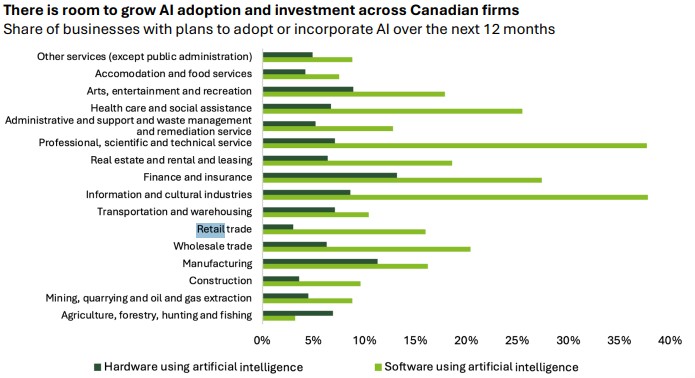
Survey data in the outlook show “room to grow AI adoption and investment across Canadian firms,” with relatively modest shares of businesses planning to incorporate AI in the next 12 months.
AI and automation are having a limited impact on hiring, according to a previous report.