Total AI investment is understated by 30 to 50%, finds study

Despite the surge in organisations’ spending for artificial intelligence (AI), very few can say that it has actual return on investment, according to a recent report.
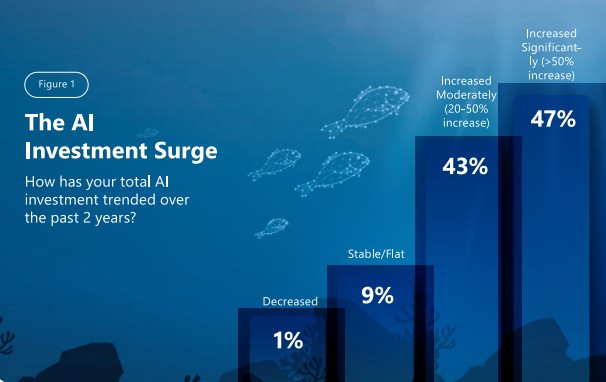
Nine in 10 organizations have ramped up artificial intelligence spending over the past two years, but only 12% can rigorously measure the revenue it generates, according to a global survey released by Comviva.
This measurement gap, however, will be settled within 18 months, according to the firms surveyed.
The report – The AI Efficiency Divide: Measuring AI's Real Value Beyond the Hype – draws on a survey of more than 200 senior executives at telecommunications, retail, and e-commerce firms worldwide.
It finds that 86% of marketing leaders have been asked by their board, investors, CEO, or CFO to justify AI spending in the past 12 months, while only 16% feel very confident they can defend their current AI budget with quantified business evidence.
Escalating AI costs are emerging as a central challenge for large employers, pushing HR leaders to play a larger role in workforce planning, governance and productivity as organisations struggle to justify returns, according to a previous report.
|
Key statistics |
|
|
90% of organizations increased AI marketing in the past two years. Yet, only 12% can quantify the revenue it generates. |
|
|
86% of marketing leaders have been asked by their board or C-suite to justify AI spending in the past 12 months. |
|
|
67% cannot determine what AI actually costs once infrastructure, data, and talent are included. |
|
|
79% rely on portfolio estimates or activity proxies. Only 12% can link AI spend to revenue at the campaign level. |
|
|
12% of companies rigorously measure AI’s incremental revenue impact. |
The hidden cost in HR's budget
The Comviva findings most relevant to HR concern cost visibility. Some 67% of organizations cannot determine total AI costs once infrastructure, data, and talent are included, the report says, with most tracking only the licence fee.
When Comviva itemized those costs, talent and integration emerged as the largest blind spots: 62% of organizations include software and API fees in their AI cost calculations, but only 40% account for talent and 38% for systems integration.
The report describes "data engineers, ML specialists, integration work, and ongoing model maintenance" as the highest hidden cost, noting these "span HR, IT, and departmental budgets."
The result, Comviva estimates, is that total AI investment is understated by 30 to 50% — a distortion driven largely by uncounted people costs.
Recently, Canada's federal government launched AI for All: Canada's new national artificial intelligence strategy, pledging more than $2.3 billion and targeting an additional $200 billion in economic growth to reshape how the country works and competes.
Accountability now a board expectation
Comviva frames the shift as a turning point.
"AI is rapidly moving from experimentation to enterprise-wide adoption, and the industry is entering a phase where accountability and outcomes will define success," says Rajesh Chandiramani, chief executive officer at Comviva. "Organisations will increasingly focus on connecting AI investments directly to business metrics — whether it is revenue growth, customer lifetime value, or operational efficiency.
“The real opportunity lies in building the right measurement frameworks and data foundations that enable this shift. Those who can translate AI from a capability into a consistently measurable business driver will be best positioned to lead in the next phase of digital transformation."
The report adds that the firms able to prove AI's value share tight alignment between the CFO and CMO, with cost capture "across infrastructure, talent, and integration." It also flags governance risk, with 58% of organizations finding AI explainability "significantly challenging to measure".
"Soon, the question will not be whether you use AI," the report concludes. "It will be whether you can prove it works."
Catriona Campbell, EY's AI Client Strategy Leader, says that employers should focus on a solid AI foundation to get the most out of AI.
"AI isn’t an IT transformation. It’s an organisational redesign that HR must drive if businesses are to unlock AI’s full strategic potential," she says in a LinkedIn post. "The organisations that build solid foundations will create smarter systems and stronger, more adaptive workforces."
One other challenge to HR professionals: Employees are doing most of their work-related AI tasks through personal accounts that employers cannot easily monitor, creating fresh governance, privacy and offboarding risks, according to previous research.
|
Key statistics |
|
12% can rigorously measure AI’s incremental revenue impact using controlled methods. |
|
32% track activity metrics, campaigns launched, engagement rates, but have no visibility whether AI actually pays for itself. |
|
35% have a rough estimate of AI’s contribution but cannot isolate it from seasonality, market shifts, or parallel campaigns. |
|
21% measure some initiatives but lack consistent infrastructure across their AI portfolio. |
|
86% of leadership (board, investors, CEO, CFO) asked to present evidence of AI’s business impact on a monthly/quarterly basis in the last 12 months. |
|
Only 16% of organizations are very confident that they can defend their current AI budget with quantified business value evidence. |