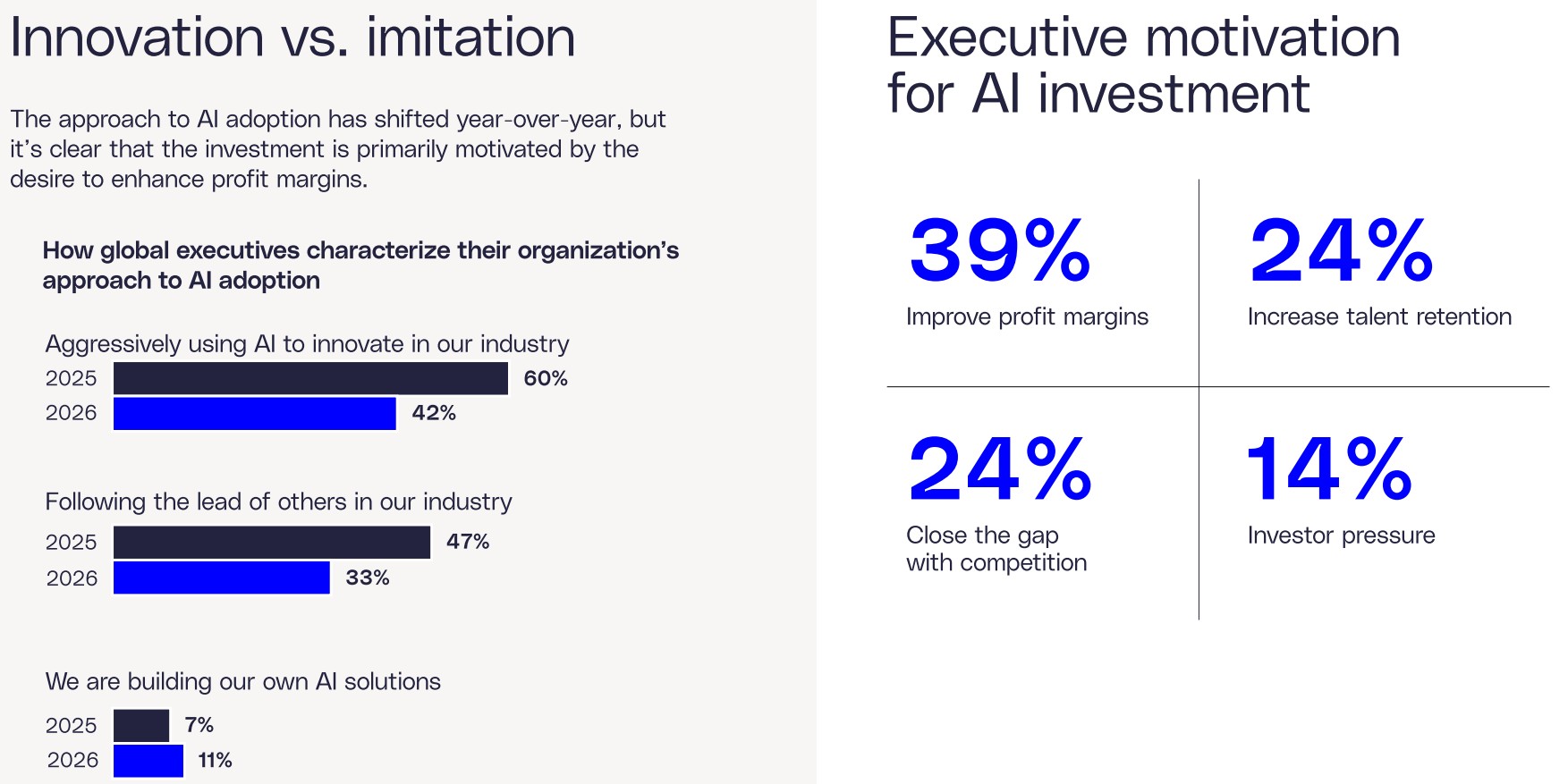
Share of executives aggressively using AI to innovate drops to 42%, down from 60%

HR leaders face a tougher AI accountability climate this year that will reshape training budgets, performance management and global hiring strategy.
Nearly 3 in 4 (73%) of executives say their AI investments have fallen short of expectations and nearly 70% are prepared to cut AI budgets if 2026 goals are not met, according to G-P's third annual AI at Work Report released today.
The report – based on a Wakefield Research survey of 2,850 senior executives in the United States, Germany, Singapore, Australia and France, plus 500 U.S. HR professionals – marks a sharp pivot from last year's enthusiasm. The share of executives who describe their organizations as aggressively using AI to innovate has dropped to 42%, down from 60% in 2025, even though every executive surveyed reports using AI in some form.
About 16% of companies recorded a negative ROI on last year's AI spending.
"To get AI right, you have to move past the hype and focus on where it actually moves the needle," says Nat Natarajan, Chief Operating Officer at G-P. "A smart strategy isn't about doing everything at once, it's about identifying high-impact use cases and preparing your team before you start."
AI accuracy problems
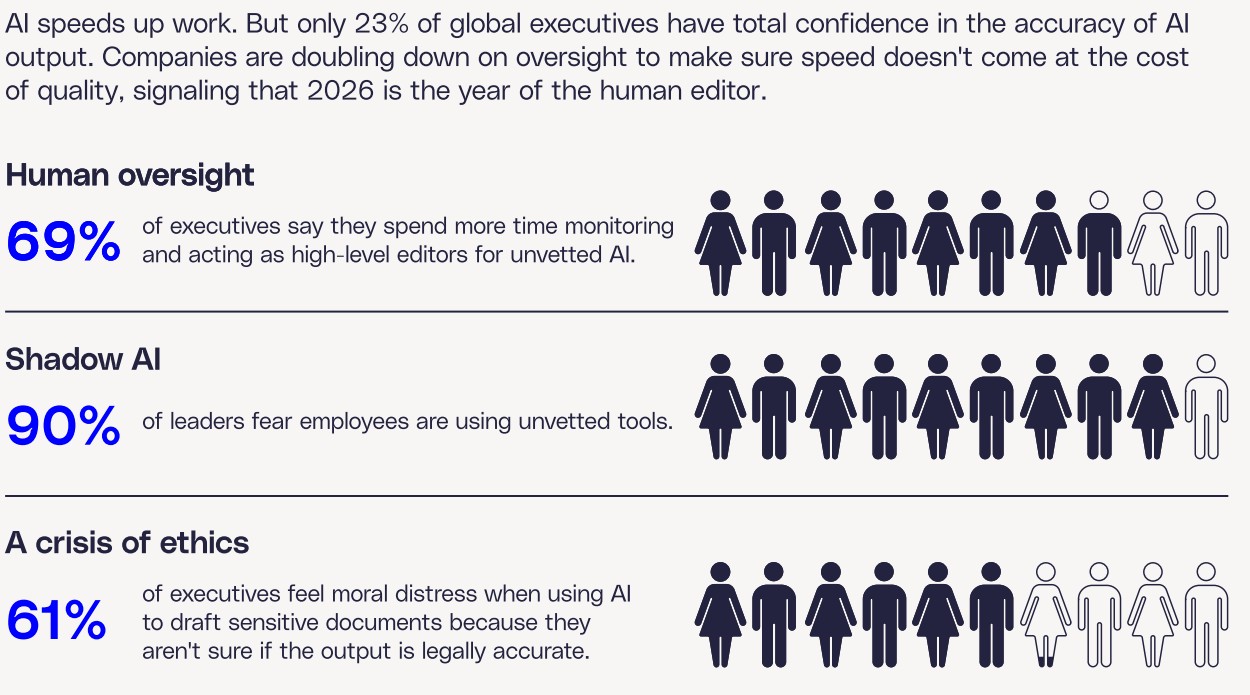
The pressure is already showing up inside the workforce. Some 69% of executives say employees are spending more time reviewing, correcting and updating AI-generated work, while only 23% express full confidence in AI output accuracy. Nine in 10 fear staff are using unvetted "shadow AI" tools.
Concerns about workplace behaviour are climbing in parallel. About 88% of executives worry employees are using AI to "perform productivity" — appearing busy and meeting AI-usage mandates without generating real business value — and 47% believe this behaviour is already happening inside their organizations.
In a finding HR leaders will need to confront directly, 82% of executives admit AI has lowered the value they place on human employees. G-P warns the trend "could jeopardize the very human-led innovation required to make AI successful." Only 12% of executives strongly agree that sacrificing employee privacy for AI monitoring is worth the trade-off to reach business goals, and 61% report moral distress when using AI to draft sensitive documents, citing uncertainty over legal accuracy and labour-law compliance.
More than 70% of employees are using AI tools every week, and up to one-third are doing so without IT oversight, pointing to the rise of “shadow AI” across workplaces, according to a previous report.
But just 13% of Canadians have used autonomous AI in the past six months — systems that go beyond offering recommendations to taking action without human intervention, accoding to an EY report.
Talent strategy
Talent strategy is being redrawn around AI skills. About 82% of global executives told G-P they would hire in a country where they have no existing employees to secure top AI talent, while 52% cite AI talent shortages and weak data literacy as the biggest barriers to their AI goals.
"The competition for specialized AI talent is no longer a local battle; it's a global one," said Laura Maffucci, Head of HR at G-P.
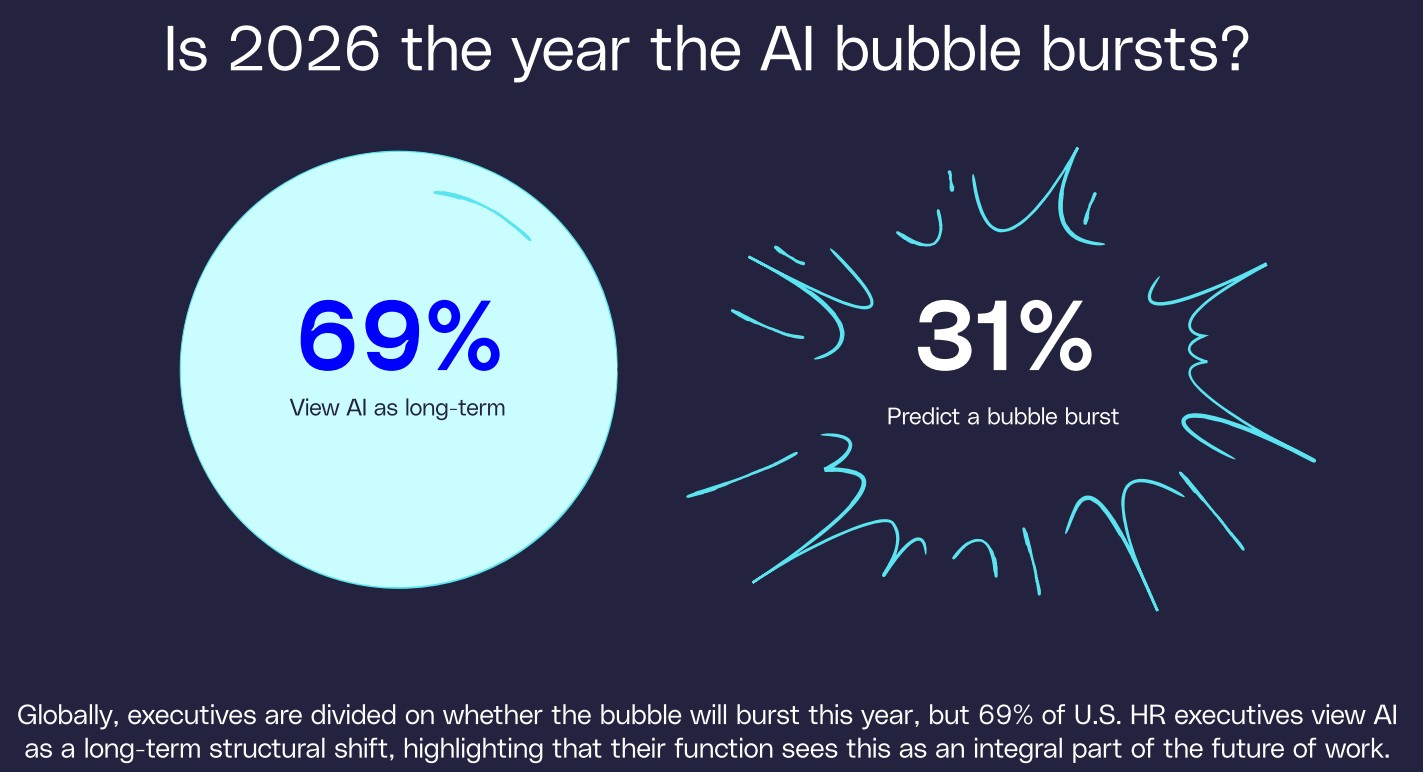
Global executives are split on whether the AI bubble will burst in 2026 — 44% expect it to — but 69% of U.S. HR executives view AI as a long-term structural shift in how work gets done.
"AI is increasingly being measured by trust, accountability and business impact," said Pete A. Tiliakos, Principal Analyst and Strategic Advisor at GxT Advisors, in commentary included in the report. "The future belongs to companies that pair AI with the right expertise, governance and operational discipline to turn opportunity into real business outcomes."
G-P’s tip: “As AI becomes more capable, human-only skills become more valuable. High-stakes roles require empathy, ethics, and strategic nuance that algorithms can’t replicate.
“Get ahead of productivity paranoia the right way by reinvesting in human-centric skills”