Canada's job vacancy rate hits lowest level in nearly a decade: StatCan

The job vacancy rate has hit its lowest level in nearly a decade, according to a Statistics Canada (StatCan) report.
The rate fell to 2.7% in May 2025, marking its lowest point since October 2017.
The number of job vacancies dropped by 20,400 (-4.1%) to 478,200 in May, extending the downward trend seen in April.
The national job vacancy rate dipped to 2.8% in April.
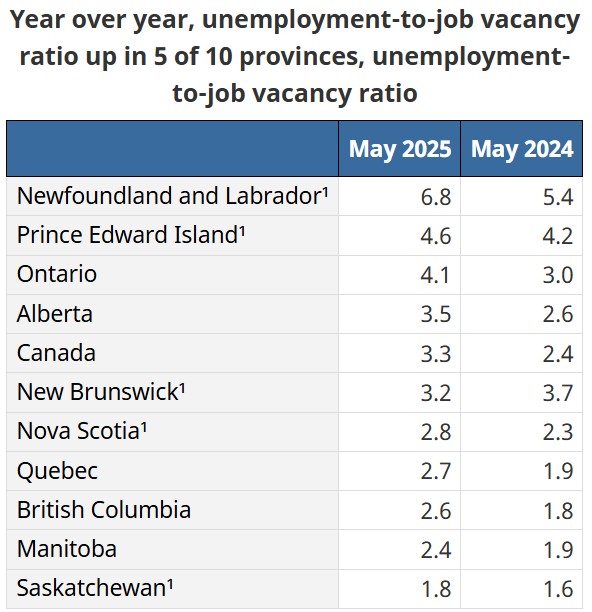
Meanwhile, the ratio of unemployed persons to job vacancies rose to 3.3 in May, the highest level since January 2017, excluding the pandemic years. This shift reflects both a decrease in available positions and an increase in the number of unemployed Canadians.
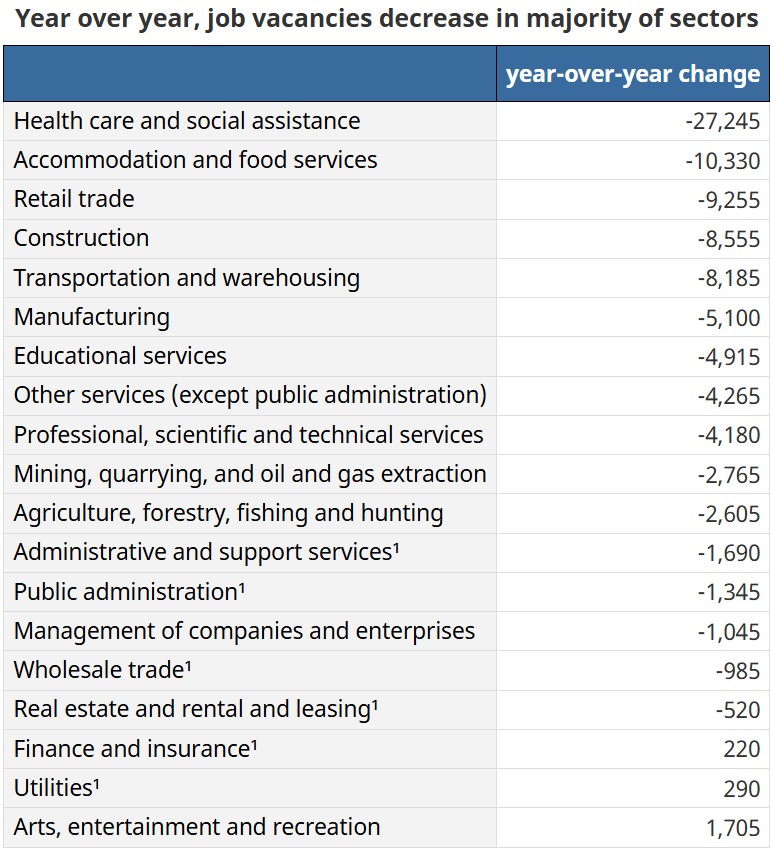
Job vacancies declined in several major sectors, including construction, professional, scientific and technical services, mining, and management of companies. The largest year-over-year decreases were seen in health care and social assistance, accommodation and food services, and retail trade. Only the arts, entertainment and recreation sector recorded an increase in vacancies over the past year.
Employment growth
Despite the tightening labour market, payroll employment in Canada continued to grow, albeit at a slower pace. In May, payroll employment increased by 15,300 (+0.1%), following a similar gain in April. On a year-over-year basis, payroll employment was up by 43,300 (+0.2%).
Employment growth was led by health care and social assistance (+6,200; +0.3%), retail trade (+5,600; +0.3%), and construction (+1,200; +0.1%).
However, these gains were partially offset by declines in manufacturing (-6,400; -0.4%), administrative and support, waste management and remediation services (-3,500; -0.4%), and wholesale trade (-2,900; -0.3%).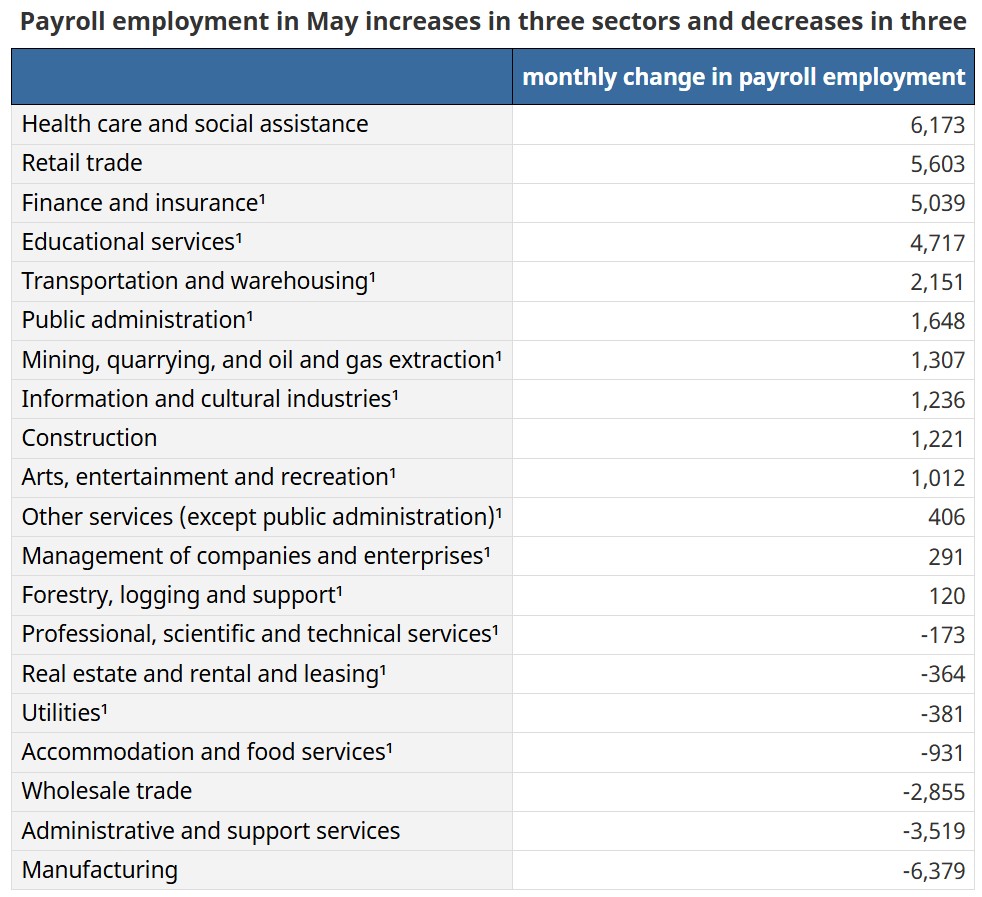
Previous reports from StatCan state that Canada has seen some job gains, with job vacancies dropping below to the pre-pandemic levels.
Year over year, average weekly earnings were up 3.3% to $1,294 in May, following an increase of 4.3% in April. Slower year-over-year growth in May was broad-based across all sectors.
Also in May, average weekly hours worked were down to 33.3 hours, compared with 33.5 hours in April 2025 and May 2024.
There is ample reason to question whether employment growth has really been as strong as suggested by recent data from the federal government, according to a Canadian economist from CIBC.