'It hasn't been 'job losers' driving the unemployment rate higher over the past year, but the continued difficulties finding work of people entering or re-entering the labour market'

There is ample reason to question whether employment growth has really been as strong as suggested by recent data from the federal government, according to a Canadian economist.
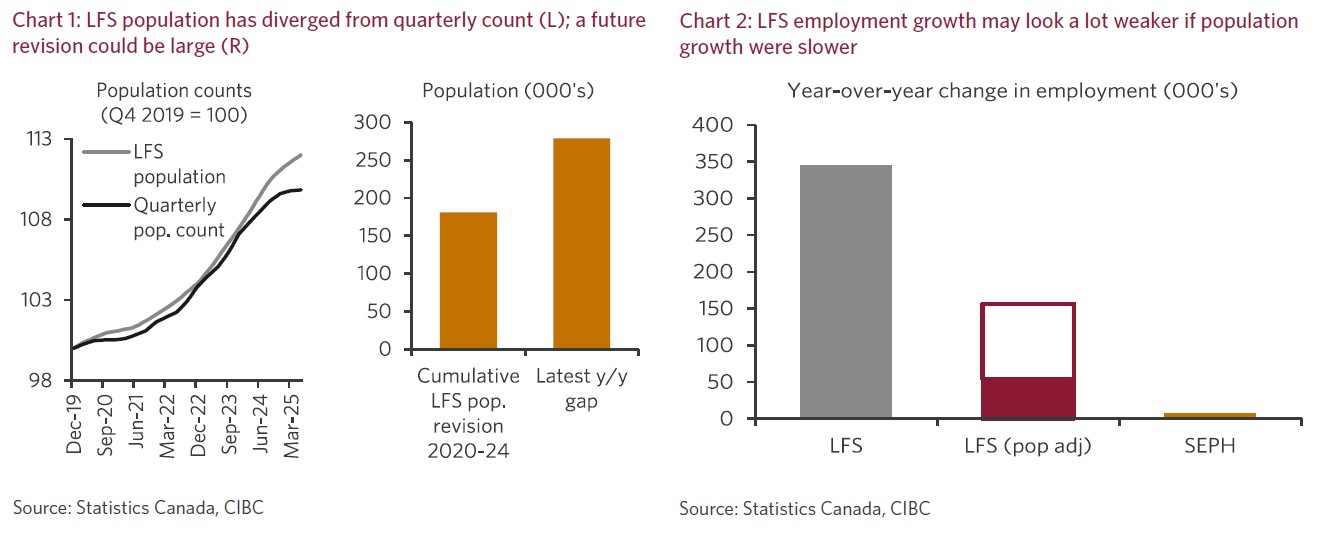
Recent gains reported by the Labour Force Survey (LFS) could be overstated due to discrepancies in population estimates, cautions CIBC economist Andrew Grantham.
He notes that the LFS’s base population has not slowed as much as quarterly population data, particularly due to changes in the number of non-permanent residents. This divergence means the LFS may be inflating both population and employment growth, and future revisions could be substantial.
“If the year-over-year growth rate in population within the Labour Force Survey matched the recent quarterly data, and assuming the employment-population ratio is correct, then job growth over the past year could be cut down to a fraction of what is currently reported,” says Grantham.
He adds that the quarterly count “could actually be understating population growth due to it overestimating the number of non-permanent residents leaving the country, and undercounting asylum seekers and ‘others’.”
“However, even after accounting for this impact, we suspect that actual population growth, and by extension employment, has been weaker than advertised by the LFS. These population-adjusted figures would also be closer to the stall shown in the payrolls survey of employment (SEPH) over the past year.”
Previous reports from Statistics Canada (StatCan) state that Canada has seen some job gains, with job vacancies dropping below to the pre-pandemic levels and even levels recorded in 2017.
Why is Canada's unemployment rate high?
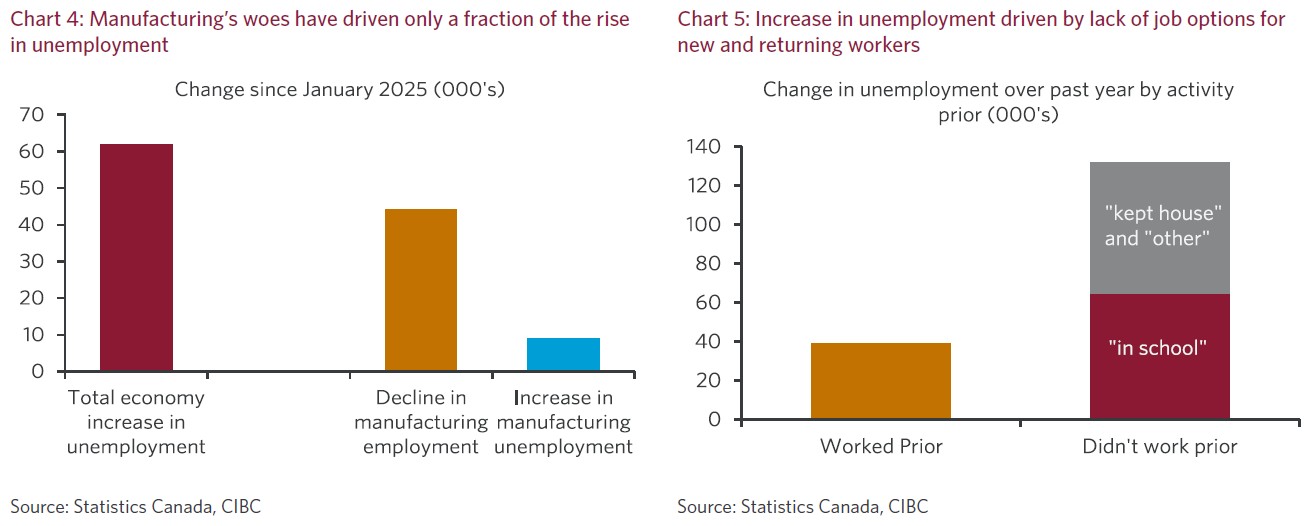
While Canada’s unemployment rate has only edged up to 6.9%, CIBC’s analysis finds that this increase is not primarily due to job losses in sectors like manufacturing.
Grantham explains that while manufacturing employment has fallen by 45,000 since January, unemployment data by sector suggests only a 9,000 increase. In other words, only 20% of the decline in manufacturing employment appears to have been reflected in the unemployment rate.
Instead, the rise is being driven by new entrants and re-entrants to the labour market, such as students and those returning to work after time away, who are struggling to find employment.
“This tallies with aggregate data suggesting that it hasn’t been ‘job losers’ driving the unemployment rate higher over the past year, but rather the continued difficulties finding work of people entering or re-entering the labour market,” says Grantham. “This represents the continued and well-documented struggles of students. However, increasingly it also represents people re-entering the workforce having previously ‘kept house’ or for ‘other’ reasons.”
Also, the issue around tariffs imposed by the Donald Trump administration on Canada has not been the main driver of the rise in unemployment since the start of the year, says the economist.
In Ontario, for example, the current unemployment rate for prime-aged workers is now 1% above the national average. However, while city-level data show large increases in unemployment rates in trade-sensitive areas such as Oshawa and Windsor, these more industrial areas of Ontario have actually accounted for only a fraction of the province-wide rise in the unemployment rate.
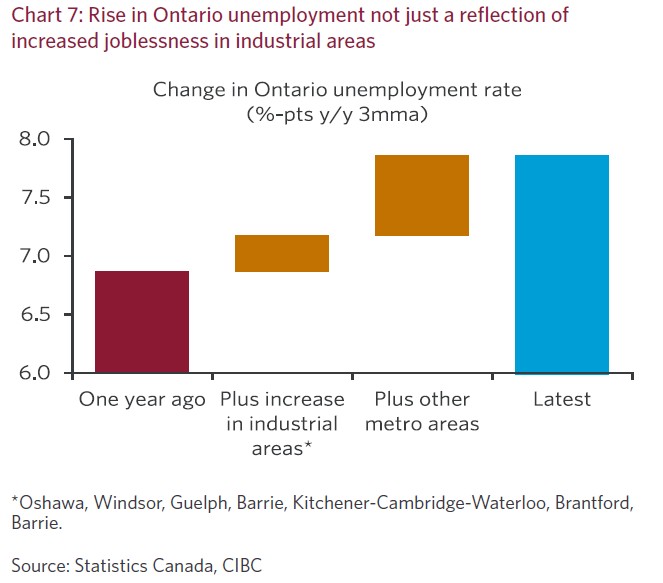
“The notion that Canada’s labour market is in good health, aside from understandable weakness in trade-sensitive areas such as manufacturing, is too simplistic and likely incorrect,” says Grantham.
“A weaker than advertised labour market should, over time, place downward pressure on core measures of inflation and allow the Bank of Canada to cut interest rates again before the end of the year.”
Canada’s failure to address its youth unemployment crisis will cost the country $18.5 billion in GDP by 2034, according to Kings’ Trust Canada and Deloitte.