One-year opening to secure permanent status for up to 100,000 foreign workers

Canada’s newest immigration levels plan gives employers a one-year opening to secure permanent status for up to 100,000 foreign workers already on Canadian payrolls.
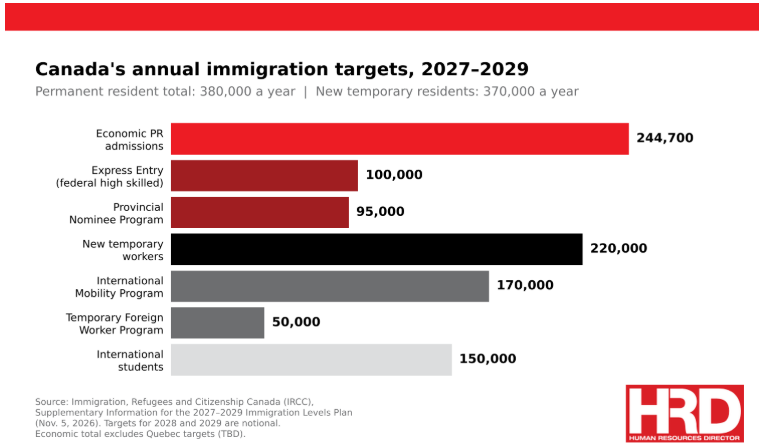
Immigration, Refugees and Citizenship Canada (IRCC) released its 2027–2029 Immigration Levels Plan on Nov. 5, 2026, alongside the federal budget. Its headline targets hold at 380,000 permanent residents and 370,000 new temporary residents a year, according to IRCC’s supplementary information on the plan.
“Canada is building on its progress to return sustainability to our immigration system while honouring the commitments we made to those in need,” said Lena Metlege Diab, Minister of Immigration, Refugees and Citizenship, in a Nov. 10, 2026, IRCC release.
The real change sits outside the headline targets, in one-time measures that could make 2027 a record year for permanent residency.
How the 2027 permanent resident spike adds up
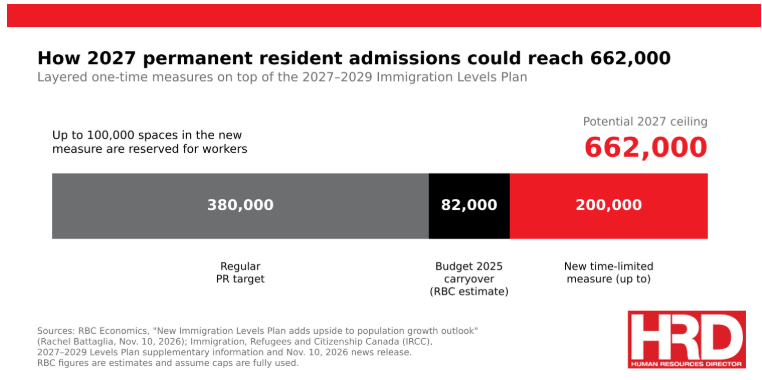
Rachel Battaglia, an economist at Royal Bank of Canada (RBC), puts the 2027 ceiling at 662,000 in a Nov. 10, 2026, analysis. RBC describes that figure as the highest annual intake on record.
Her estimate stacks three layers. The first is the regular 380,000 target. The second is about 82,000 admissions RBC expects to carry over from Budget 2025 initiatives covering up to 115,000 protected persons and 33,000 work permit holders.
The third layer is new. According to an IRCC backgrounder on the 2027–2029 levels plan, a time-limited measure will move up to 200,000 people already in Canada to permanent residence in 2027. Up to 100,000 of those spaces are reserved for workers and their families, selected with provinces and territories; the rest cover humanitarian and family cases.
The measure clears existing files rather than opening new doors. In a Nov. 10, 2026, release issued under Lena Metlege Diab, Minister of Immigration, Refugees and Citizenship, IRCC said it “does not create new programs or re-open closed pathways.”
What the immigration levels plan means for employers
That detail matters for workforce planning. IRCC said applicants “do not need to do anything or contact IRCC” for their files to be processed under the new spaces, so the benefit flows mainly to employees whose applications are already in the system.
Employers should therefore check which foreign staff have pending files and which could still apply before 2027. RBC adds that lower points thresholds for some categories, point boosts for high-wage workers and the elimination of the Labour Market Impact Assessment (LMIA) requirement could encourage more temporary workers to stay.
The release also framed the plan in workforce terms. “Honouring our existing commitments is not only the right thing to do, it will also strengthen Canada’s economy by ensuring Canadian businesses have access to the workforce they need to compete,” said Yvan Baker, Member of Parliament for Etobicoke Centre in Toronto.
Beyond 2027, the regular stream offers continuity. IRCC allocated 244,700 economic admissions a year, including 100,000 through Express Entry programs and 95,000 through the Provincial Nominee Program (PNP), alongside 220,000 new temporary worker arrivals. Immigration firm Fragomen said in a Nov. 6, 2026, alert that stable targets give employers more predictability. That is a contrast with the 2025–2027 plan, which prompted the Canadian Federation of Independent Business’s reaction to Ottawa’s immigration cuts.
That predictability has limits. Ottawa wants non-permanent residents below 5% of the population, and RBC estimates 2.7 million live in Canada today. Battaglia doubts the goal will be met in 2027, noting outflows under the 2024 plan missed their target by about half in 2025.
The 2027 window is finite. How leading people executives approach that kind of talent risk is a recurring theme in HRD Canada’s latest ranking of Canada’s top women in the HR industry.
HRD Canada’s has an ongoing coverage of immigration and workforce policy.