Unemployment rate increases to 6.9 per cent; numbers giving 'cautious signals' to employers, says economist

Canada's labour market delivered another sobering report card in April, and for HR leaders already navigating tariff-driven uncertainty and shifting workforce dynamics, the numbers are concering.
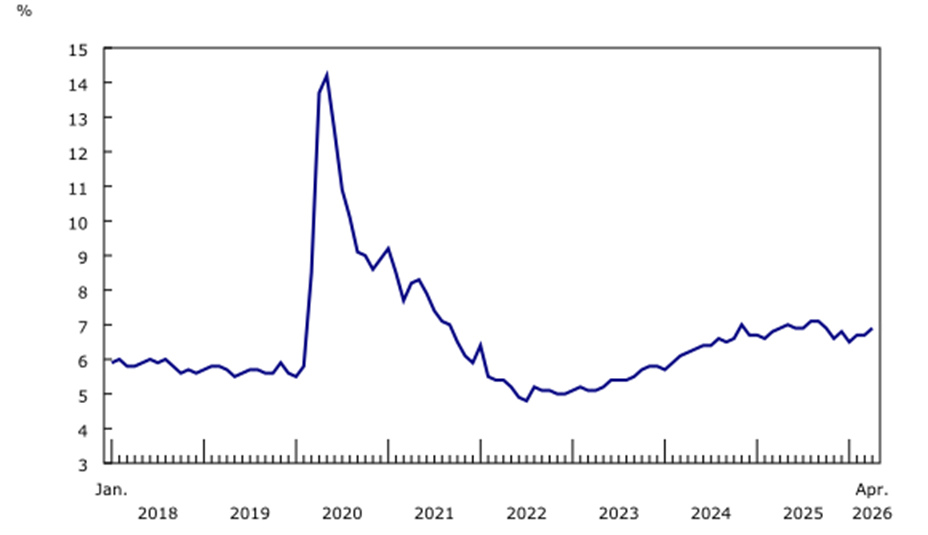
Statistics Canada's April Labour Force Survey, released Friday, showed a net loss of 18,000 jobs last month, pushing the unemployment rate up 0.2 percentage points to 6.9 per cent — a six-month high. Combined with losses in January and February, Canada has now shed jobs in three of the first four months of 2026, representing a net decline of 112,000 positions since January.
The headline figure, however, does not fully capture what’s happening beneath the surface. Full-time employment fell by nearly 47,000 — offset only partially by a gain of 29,000 part-time roles, according to the report. Over the first four months of the year, full-time work has contracted by 111,000 positions. For workforce planners, the shift away from permanent, full-time employment is a structural signal that warrants scrutiny beyond the monthly data cycle.
Anupriya Gangopadhyay, an economist at the Business Data Lab at the Canadian Chamber of Commerce, urges caution before reading the full-time losses as a definitive trend. "It's still early on to say whether the layoffs in full time are going to stay," says Gangopadhyay. "There are so many economic factors. There's AI happening, there's geopolitical stuff going on in the Middle East, not to mention the trade war with the US that began one year ago."
Gangopadhyay points to a distinctive feature of Canadian employer behaviour that may be buffering the impact. "Canadian employers are slow in hiring but also holding on to their people, and that's why we don't see a very strong fluctuation in full-time employment," she says. "There have been some losses, but businesses have been meeting seasonal demands through part-time employment."
For HR leaders tracking workforce composition, that shift is worth monitoring closely. Part-time gains have meaningfully outpaced full-time losses in the April data – a dynamic Gangopadhyay describes as "an interesting point to study," raising broader questions about whether the definition of employment itself may be evolving in the era of the gig economy.
Unemployment rate, Canada
Tariffs and trade uncertainty weigh on hiring confidence
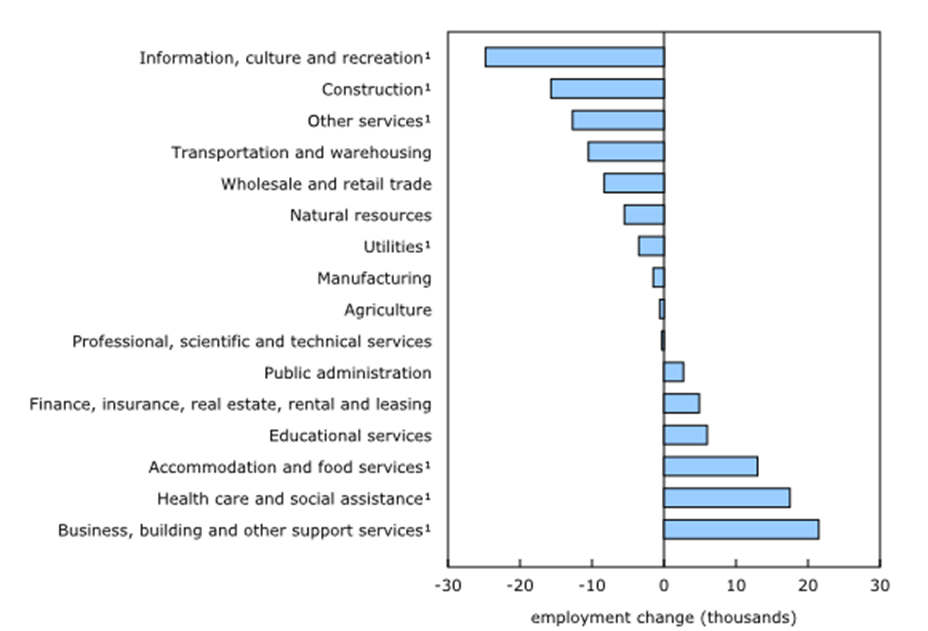
The goods-producing sector — the most directly exposed to US tariffs — shed 26,800 jobs in April, according to StatsCan. The services sector, where four in five Canadians are employed, posted a modest gain of 9,100 positions, providing only partial relief, reported CBC News. The rough start to 2026 reflects a labour market struggling under the weight of prolonged trade uncertainty, with the unresolved future of the North American free trade deal and energy price pressures stemming from the Iran conflict continuing to compound the tariff impact, reported CBC News.
That uncertainty is translating directly into employer hesitation. The Bank of Canada flagged in its April Monetary Policy Report that indicators including the employment rate, hours worked, and job vacancies all point to slack in the labour market — underutilized capacity that organizations must factor into their planning assumptions for the remainder of the year.
The goods-producing sector's job loss is a stark illustration of how trade disruption is translating into real hiring decisions. HR leaders across Canada's manufacturing and export industries have been grappling with this since tariff tensions escalated more than a year ago – but Gangopadhyay believes the picture may begin to clarify.
"The upcoming USMCA negotiations are going to be crucial in deciding where things are heading," she says. "For businesses who are in the goods-producing sector, there have been some losses, but if you recall back in 2025, there were net gains in employment in Canada despite the trade war, especially in the construction sector and warehousing transportation."
Employment change by industry, April 2026
Youth and core-aged workers both feeling the strain
Two workforce segments central to long-term talent pipelines are showing increasing pressure. The youth unemployment rate climbed to 14.3 per cent in April — well above the pre-pandemic average of 10.8 per cent — while unemployment among core-aged workers aged 25 to 54 remained steady, although the rate for core-aged men increased by 0.3 percentage points. For HR leaders, both trends carry planning implications: a generation of young workers is being delayed in building workplace experience, while core workforce segments are facing rising competition for available roles.
The labour force participation rate edged up slightly to 65 per cent, suggesting more Canadians are actively searching for work. A rising participation rate alongside a rising unemployment rate indicates the labour supply is expanding faster than demand — a dynamic that gives employers more candidate volume in the short term, but can mask deeper engagement and retention challenges if organizational culture and growth pathways aren’t clearly articulated.
Where growth is still happening — and what it means
Not every sector is contracting. Health care and social assistance added 18,000 jobs in April and is up 119,000 year-over-year — the most significant growth of any industry over the past 12 months. Business, building and other support services gained 22,000 positions, and accommodation and food services added 13,000.
Average hourly wages rose 4.5 per cent year-over-year to $37.77 — a meaningful figure for compensation benchmarking, though the pace of growth moderated slightly from March's 4.7 per cent. Adjusting for compositional changes in the workforce such as fewer employees with shorter tenures, underlying wage growth sits closer to 3.4 per cent, said StatsCan, providing HR leaders with a more accurate baseline for salary review cycles and total rewards planning.
Analysts polled by Reuters had forecast net gains of 15,000 jobs and an unemployment rate of 6.7 per cent, according to CBC News. The miss on both fronts underscores how difficult the current environment is to model, and reinforces why scenario-based workforce planning is more valuable now than static headcount projections.
Gangopadhyay wasn't surprised by the forecast miss. "Labour force is one of the most unpredictable things to predict and there are so many forces that we as economists tend to see and not foresee," she says.
The April data reinforces a theme that has persisted across the first quarter of 2026: this isn’t a labour market in free fall, but it’s one in which the conditions for confident hiring haven’t returned. Layoff rates remain in line with pre-pandemic averages, and long-term unemployment — while elevated above historical norms at 22.5 per cent of the unemployed population — hasn’t worsened materially.
For HR executives navigating Canada's uncertain labour market, the April data isn't reason to panic, but it is a signal to plan with care, according to Gangopadhyay. "Today's release show's we're at a point where one has to be cautious. It's giving some cautious signals," she says.