Which sectors are seeing cooling market in Canada?

Canadian corporate profits slipped 2% in the third quarter of 2026 as energy, construction and finance cooled, leaving HR leaders to plan 2027 pay and headcount against a softer backdrop.
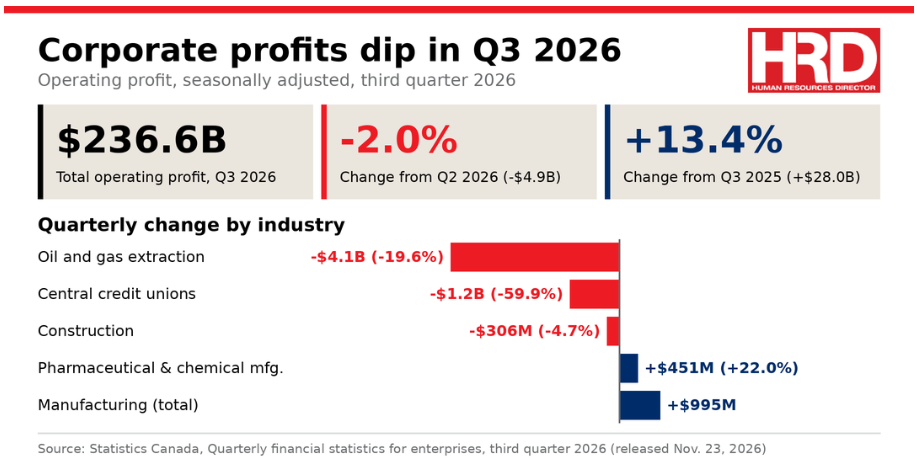
Operating profit across Canadian corporations fell to $236.6 billion between July and September 2026, down $4.9 billion from the second quarter, Statistics Canada (StatCan) reported.
Non-financial industries lost $2.9 billion (-2.2%), while financial industries gave up $2.0 billion (-1.8%).
Year over year, however, operating profit was still up $28.0 billion, or 13.4%, the agency said. That gap between a strong annual comparison and a weakening quarter is the planning problem employers now carry into 2027.
Where corporate profits fell
Energy did the most damage. Oil and gas extraction profits dropped $4.1 billion (-19.6%), which StatCan attributed mainly to crude prices easing from their second-quarter peak as supply disruptions in the Strait of Hormuz temporarily subsided.
The pullback is already visible in the oil patch. ConocoPhillips confirmed another round of Canadian job cuts in October 2026, affecting operations in Alberta and British Columbia.
Construction felt a different squeeze, with profit shrinking $306 million (-4.7%) on higher material, fuel, transportation and labour costs. Manufacturing bucked the trend, adding $995 million as eight of 14 industries posted gains, led by pharmaceutical and chemical makers (+22.0%), according to StatCan.
How profit dip shows up in job market
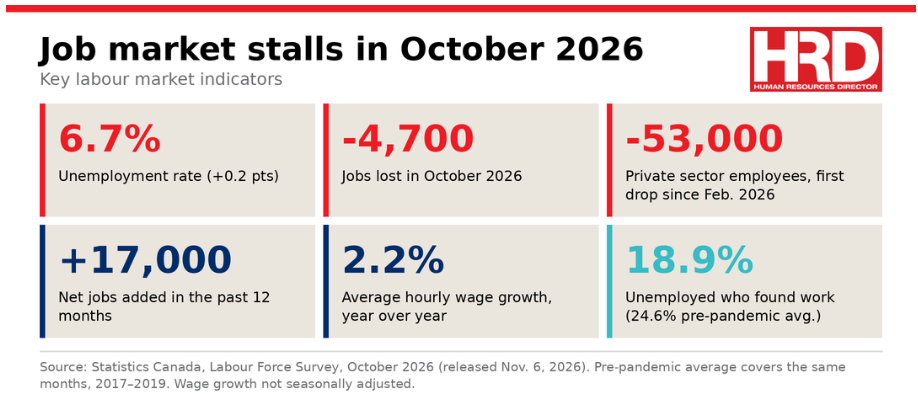
Those uneven fortunes are mirrored in hiring. Canada lost 4,700 jobs in October 2026 and unemployment rose to 6.7%, StatCan's Labour Force Survey showed. Private sector employment fell by 53,000, its first decline since February 2026, while wage growth slowed to 2.2%. Over 12 months, the economy added just 17,000 jobs.
"In a normal year, we would create more than 200,000 jobs," Sal Guatieri, a senior economist at BMO, told CTV News.
The weakness is spreading. "It does look as if we're seeing some weakness in the labour market outside of those trade-sensitive areas. So that's a concern for us right now," Andrew Grantham, senior economist at CIBC, told The Canadian Press (CP).
Laura Gu, senior economist at Desjardins, wrote that slack is building through slow hiring rather than layoffs. "The problem is hiring," she noted. StatCan data backs that up: only 18.9% of people unemployed in September found work in October, well below the 24.6% average for the same months from 2017 to 2019.
What it means for 2027 pay and workforce plans
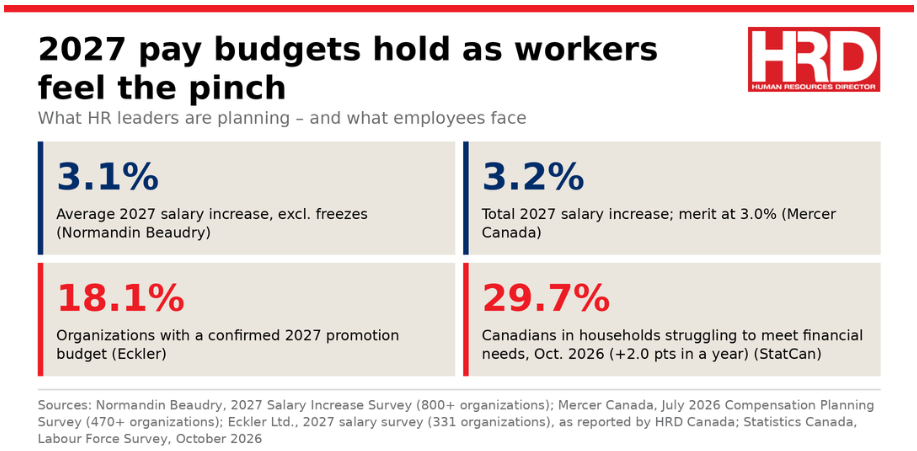
Even so, compensation budgets are holding for now. Normandin Beaudry's survey of more than 800 organizations found employers expect a 3.1% average salary increase in 2027, excluding freezes, matching 2026, as HRD Canada reported on how Canadian employers hold salary budgets at 3.1% for 2027. Eckler Ltd. found just 18.1% of organizations had confirmed a 2027 promotion budget.
The catch is timing. Those budgets were set over the summer, before the third-quarter profit figures landed. Meanwhile, workers are feeling the pinch: 29.7% of Canadians lived in households that struggled to meet their financial needs in October 2026, up 2.0 points in a year, according to StatCan.
That leaves HR leaders defending merit pools if finance teams revisit plans, finding non-salary ways to recognize performance and protecting engagement where restructuring looms – a theme explored in HRD Canada's Best Places to Work in Canada report on the listening advantage.