Strategy will connect employers with job seekers, improve skills training, enhance job matching, says government

The Alberta government has announced a new jobs strategy backed by more than $26 billion in capital investments over the next three years, aiming to strengthen the province’s workforce and address both immediate and future labour market needs.
The plan was unveiled by Joseph Schow, minister of jobs, economy, trade and immigration, at the Southern Alberta Institute of Technology (SAIT).
“The Alberta Jobs Strategy is about empowering people in Alberta to seize the opportunities of tomorrow, with the training, support and information they need to succeed,” said Schow. “This strategy reflects our government’s commitment to creating opportunity, unlocking potential and positioning Alberta as a global hub for talent, innovation and long-term prosperity.”
According to Schow, the strategy will focus on several priority areas:
- Career readiness: Expanding training, support, and access to information so Albertans have the technical and soft skills needed to thrive in the workforce.
- Removing barriers: Improving access to education, training, and employment opportunities for all Albertans to unlock the province’s full potential.
- Employer collaboration: Working closely with employers to ensure government programmes are relevant and responsive to labour market needs.
- Youth employment: Launching new initiatives to help young people connect with jobs, with more details to be announced later this month.
Supporting the strategy, Alberta’s Budget 2025 Capital Plan will help manage current population growth, support future economic development, and encourage private sector involvement. The province is investing more than $26 billion in capital projects over the next three years, with the potential for additional major infrastructure developments.
Schow noted that as technology continues to reshape the workplace, Alberta must act now to prepare its workforce for future demands. Major investments will go toward schools, affordable housing, health care, roads, bridges, municipalities, and other key infrastructure.
These projects are expected to create an average of 26,500 direct jobs and 12,000 indirect jobs each year through 2027–28.
Recruitment challenges in Alberta
The Alberta Jobs Strategy seeks to address current challenges “by connecting employers with job seekers, improving skills training, helping Albertans advance their careers, and enabling the matching of workers with available jobs,” said Schow.
Currently, many employers are having a hard time finding the talent they need, according to the Alberta government.
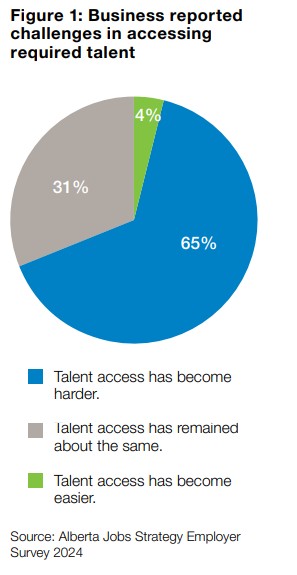
Meanwhile, the rate of youth unemployment in Canada has reached levels beyond what could be expected, according to a previous CIBC report.
Schow emphasised that the strategy is a collaborative effort between government and employers, building on existing programs to deliver a coordinated response to Alberta’s evolving job market. “By working together, we ensure Alberta’s workforce is prepared for the demands of tomorrow,” he said.
New career pathways for Albertans
Brad Perry, president and CEO of Calgary Economic Development, said the strategy will help attract investment and create new career pathways for Albertans. “We have a uniquely skilled, productive, young workforce,” he said. “With a strategic plan like this, we can unlock even more potential and ensure everyone has access to meaningful careers.”
Perry also noted the importance of removing barriers for underrepresented groups and stressed that economic development requires collaboration among governments, educational institutions, employers, and industry.
“Alberta employers need people with the right skills to grow, and Albertans want clear paths to good jobs,” said Shauna Feth, President & CEO, Alberta Chambers of Commerce. “The Alberta Jobs Strategy is a smart investment in the province’s economic competitiveness and shared prosperity, opening doors to opportunity today and in the future.”
Canada’s labour market experienced a setback in June 2025, with payroll employment numbers falling even as job vacancies saw a slight rebound, according to data from Statistics Canada.