Which regions and sectors had the highest number of vacancies?

The Canadian labour market cooled in late 2025, according to a new report.
Payroll employment in Canada declined in November 2025 while job vacancies continued to fall, reports Statistics Canada (StatCan).
The number of employees receiving pay and benefits from their employer decreased by 26,200 (‑0.1%) in November, following an increase of 11,900 (+0.1%) in October. On a year‑over‑year basis, payroll employment was up by 48,300 (+0.3%).
Monthly payroll employment declines were recorded in 10 of the 20 sectors:
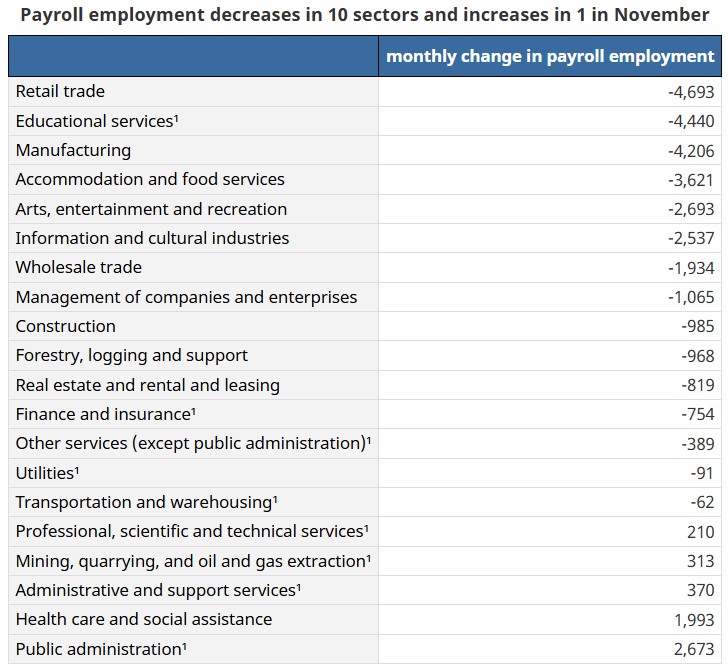
Employment saw mixed changes across industries in October 2025.
Sector snapshots: retail, manufacturing, hospitality
In retail trade, payroll employment fell by 4,700 (‑0.2%) in November, bringing the cumulative decline since June to 14,600 (‑0.7%). Statistics Canada reported that “the decline over this period was driven by clothing, clothing accessories, shoes, jewellery, luggage and leather goods retailers (‑8,400; ‑4.0%) and sporting goods, hobby, musical instrument, book, and miscellaneous retailers (‑4,500; ‑2.2%).”
Year over year, retail payroll employment was down 30,700 (‑1.5%), led by food and beverage retailers (‑12,100; ‑2.2%) and general merchandise stores (‑7,700; ‑2.9%), with declines in seven of nine subsectors.
Manufacturing also continued to weaken. Payroll employment in the sector decreased by 4,200 (‑0.3%) in November, with declines in eight of 21 subsectors, led by transportation equipment manufacturing (‑2,000; ‑1.0%), primary metal manufacturing (‑500; ‑1.0%) and fabricated metal product manufacturing (‑500; ‑0.3%).
Since January 2025, manufacturing payroll employment “has been on a downward trend, with a cumulative decline of 38,100 (‑2.4%),” according to Statistics Canada, with 19 of 21 subsectors recording decreases.
Accommodation and food services recorded its third consecutive monthly decline, with payroll employment down 3,600 (‑0.3%) in November and cumulative losses of 9,000 (‑0.7%) since September, partly offsetting gains from April to August. Year over year, sector payroll employment was down 10,500 (‑0.8%), and “full‑service restaurants and limited‑service eating places (‑7,700; ‑0.8%) accounted for most (73.2%) of the year‑over‑year decline.”
Health care and social assistance: ongoing growth
In contrast, health care and social assistance continued to expand. Payroll employment in the sector rose by 2,000 (+0.1%) in November, following a cumulative increase of 19,500 (+0.8%) in September and October. The sector “has generally trended upward since September 2022, with an overall gain of 266,000 (+12.0%) over this period,” Statistics Canada said.
Since September 2025, cumulative increases have been recorded in 15 of 18 industries, led by general medical and surgical hospitals (+5,000; +0.8%), child day‑care services (+4,700; +2.3%) and home health care services (+2,600; +2.9%).
Job vacancies and regional patterns
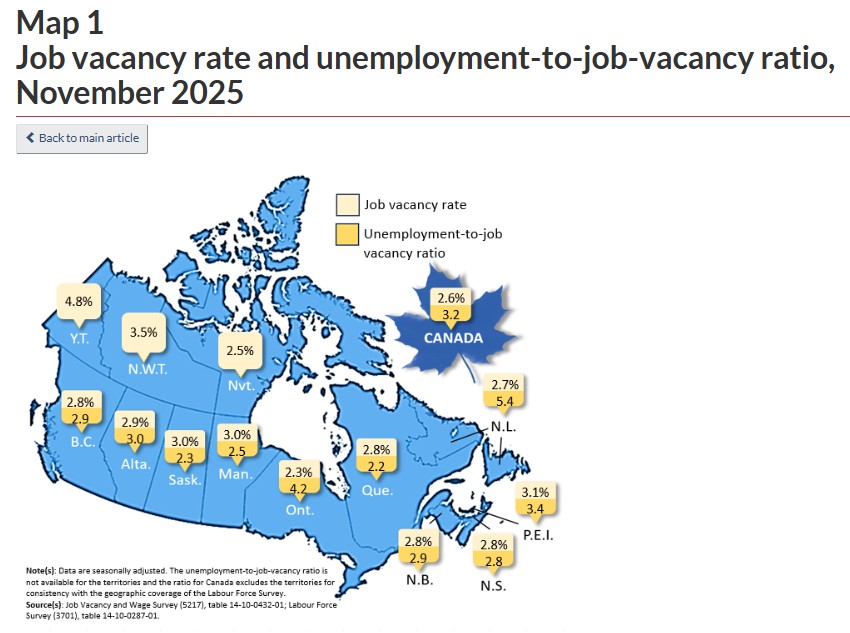
There were 472,100 vacant positions in November, little changed from October, but vacancies were down 67,200 (‑12.5%) year over year. The job vacancy rate was 2.6%, unchanged from October but down from 3.0% a year earlier. There were 3.2 unemployed persons for every job vacancy in November 2025, compared with 3.3 in October, while the ratio was up 0.2 over the year as “job vacancies [were] decreasing at a faster rate (‑12.5%; ‑67,300, excluding the territories) than the number of unemployed persons (‑4.9%; ‑75,800).”
Vacancy declines were concentrated in British Columbia (‑25,200; ‑26.3%), Ontario (‑24,800; ‑13.5%) and Quebec (‑10,900; ‑8.7%). Newfoundland and Labrador recorded the highest unemployment‑to‑job‑vacancy ratio at 5.4, followed by Ontario (4.2), while Quebec had the lowest ratio at 2.2.
Also, year over year, average weekly earnings rose 2.5% to $1,317 in November, following a 2.0% increase in October. Statistics Canada noted that “growth in average weekly earnings can reflect a range of factors, including changes in wages, composition of employment, hours worked and base‑year effects.” Month over month, average weekly earnings were little changed.
Average weekly hours worked were 33.3 hours, also little changed from October but down 0.6% compared with November 2024.
Canada’s private sector is heading into 2026 with a persistently tight labour market and modest economic growth, according to a quarterly survey from the Canadian Federation of Independent Business (CFIB).
In a separate report, Nathan Janzen, assistant chief economist at RBC, said the country is undergoing “a fundamental structural shift” as population growth pauses after an unprecedented surge in recent years. As a result, the “breakeven employment” rate—the pace of monthly job creation needed to stop unemployment from rising—is “shrinking dramatically” because fewer jobs are now needed to absorb new entrants into the labour force.