‘Canada’s workforce is strongest when employers and training partners work together’

The federal and Newfoundland and Labrador governments have signed a $10.6-million agreement to retrain workers in tariff-affected industries – giving employers in the province access to Work-Sharing-linked upskilling supports they can weigh against layoffs.
Employment and Social Development Canada (ESDC) said the funding will be for three years to workers and employers in industries directly or indirectly affected by global tariffs.
“Canada’s workforce is strongest when employers and training partners work together,” said Patty Hajdu, Minister of Jobs and Families and Minister responsible for the Federal Economic Development Agency for Northern Ontario.“As global trade evolves, no worker will be left behind. Through the Workforce Tariff Response, that means providing the tools and training workers need to secure good jobs, continuing to build strong communities, and ensuring Canada remains resilient in the face of global challenges.”
Funding’s reach
ESDC said support will be delivered through the province's network of Employment Centres to three groups: unemployed workers seeking skills for in-demand jobs; workers whose employers are using Work-Sharing Agreements and want to retrain during a slowdown; and employed workers in companies, or communities reliant on those companies, directly affected by tariffs.
The Work-Sharing pathway gives employers facing reduced demand a funded alternative to layoffs, since staff can remain employed at reduced hours while accessing training. Cooperatives, not-for-profits, municipal and Indigenous governments, and public health and educational institutions may also qualify, in addition to private-sector employers.
ESDC said the new funding builds on an existing federal commitment of about $140 million annually to the province through the Labour Market Development Agreements and Workforce Development Agreements, which support roughly 10,000 people a year, including about 2,000 who find work within six months and 1,100 apprentices.
Workforce Tariff Response
The agreement is the first bilateral deal signed under ESDC's national Workforce Tariff Response, a $570-million, three-year federal investment aimed at helping up to 66,000 workers across Canada in tariff-destabilized industries, according to ESDC's program page.
ESDC has identified steel and softwood lumber as the sectors under the most pressure, citing Canadian Steel Producers Association figures showing close to 1,000 jobs already lost, with potential losses of more than 6,000 jobs over the next two to three years. The softwood lumber sector, reliant on the United States market, supports about 30,000 jobs ESDC says are similarly exposed.
ESDC has not said which province or territory will sign the next bilateral agreement, though it has indicated the national funding is also meant to prepare displaced workers for opportunities tied to federal initiatives such as the Major Projects Office, Build Canada Homes and the Defence Industrial Strategy.
Canada’s economy weathered a year of U.S. tariff shocks better than expected, but the impact on jobs, regions and sectors is highly uneven, according to a previous report from RBC.
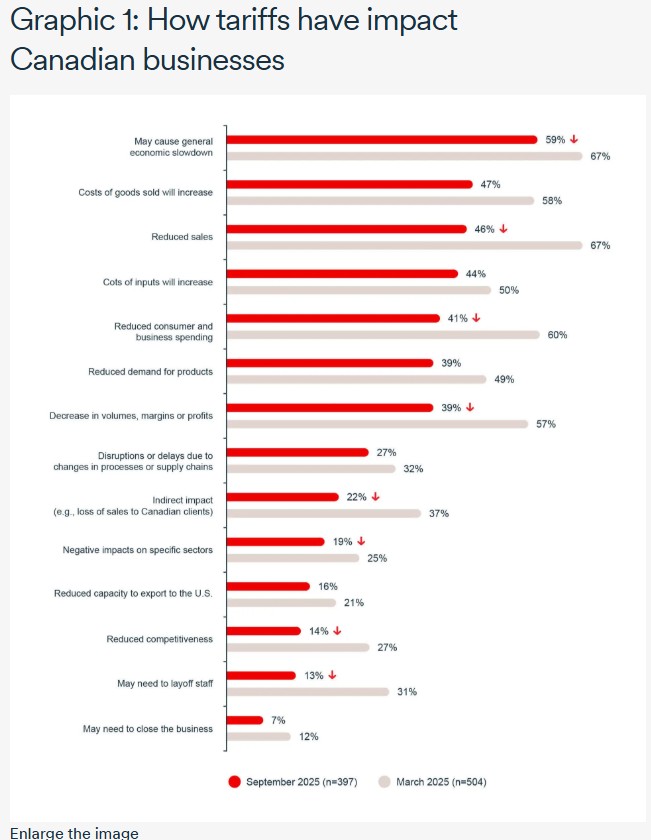
Here’s how companies have been impacted by tariffs, according to a previous BDC report:
Here are the job losses linked to tariffs:
|
Metric |
Figure |
Source |
|
Net Canadian jobs lost, January–April 2026 (cumulative) |
~112,000 |
Statistics Canada, Labour Force Survey |
|
Of which, full-time jobs lost |
~111,000 |
Statistics Canada |
|
Manufacturing jobs lost since January 2025 (as of May 2026) |
~44,000 (-2.3%) |
Statistics Canada, Labour Force Survey, May 2026 |
|
Goods-producing sector jobs lost in April 2026 alone |
26,800 |
Statistics Canada, Labour Force Survey, April 2026 |
|
Steel industry jobs lost nationally to date |
~1,000 (with up to 6,000 more at risk) |
Employment and Social Development Canada, citing the Canadian Steel Producers Association |
|
Manufacturing jobs added in May 2026 (partial rebound) |
+15,000 (+0.8%) |
Statistics Canada, Labour Force Survey, May 2026 |
|
Change in permanent layoffs, October 2025–April 2026 |
down ~10% |
RBC Economics |
|
National unemployment rate, May 2026 |
6.6% (down from 6.9% in April) |
Statistics Canada |