Canadian business leaders sound alarm over Canada-U.S. trade uncertainty: report
Canadian business leaders are sounding the alarm over the future of U.S.-Canada trade, with the vast majority warning that losing current protections under the Canada-U.S.-Mexico Agreement (CUSMA) would be the greatest risk to their companies, according to a report.
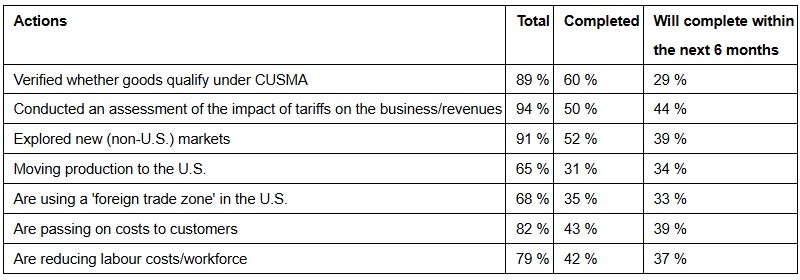
As a result, more than four in 10 have completed or are looking at reducing labour costs.
Nearly 9 in 10 (88%) of Canadian business leaders surveyed said the loss of CUSMA protections would pose the most significant threat to their operations, while 84% expect to pay some amount of U.S. tariffs even if their goods qualify under a future continental trade agreement, reports KPMG.
More than nine in 10 respondents believe that a negative outcome in renegotiating the free trade agreement with the U.S. would be “the greatest risk to Canada’s economic future,” according to the report.
"Although exemptions for CUSMA-compliant goods are providing an escape hatch from many U.S. tariffs, the framework and rules may change under a new trade deal in the future," says Joy Nott, partner for trade and customs, KPMG. "Historically, a North American free trade zone has allowed all three countries to act against global supply chain threats and work together in a highly competitive world trading environment. However, we could see a situation in which a bilateral agreement with the U.S. replaces CUSMA in 2026 and alters the playing field."
More than nine in 10business leaders want the government to provide broader supports and expanded financing options for companies affected by tariffs, with 80% of business leaders saying their companies are struggling due to U.S. tariffs, according to a previous KPMG report.
Canadian businesses hurting
The KPMG survey of 501 business leaders—conducted Sept. 11 to Oct. 2, 2025—highlights that 93% of business leaders agree unpredictable U.S. policies and the cost of accessing the U.S. market are among the most pressing issues facing the Canadian economy.
Eight in 10 (80%) say Canada’s retaliatory tariffs against the U.S. have hurt their business, and 82% agree that the loss of the $800 duty-free exemption on shipments to the U.S. has hurt their profits.
Trade uncertainty is also affecting business decisions: 75% say they are pausing new investments, and 73% report they cannot afford the added costs of exploring new markets, such as legal, regulatory, and transportation expenses.
Given evolving trade dynamics, four in five business leaders say they would support a bilateral agreement with the U.S. only. Nott points out that while a trilateral agreement is preferred, a Canada-U.S. agreement would still be an acceptable outcome of negotiations for a majority of business leaders. Furthermore, if a bilateral agreement is reached, Canada will still have a free trade agreement with Mexico under the Comprehensive and Progressive Agreement for Trans-Pacific Partnership, although under different terms, according to the report.\
Reducing labour costs among actions taken
Most Canadian businesses have taken short-term measures to mitigate trade disruption and uncertainty, including moving product into the U.S. in advance of new tariff measures and the use of 'foreign trade zones', says Wolfers.
However, "although about half of survey respondents have been exploring new markets overseas, many businesses are yet to take longer-term measures such as establishing new trade corridors or shifting production activities to the U.S.," Wolfers says.
Full effect of tariffs 'only beginning'
The impact of U.S. tariffs is being felt across the board, with 88% of respondents saying tariffs are having an effect—though most describe the impact as moderate. Still, a majority report that tariffs have made their businesses less competitive, and many cite the high cost of accessing new overseas markets and the loss of the U.S. $800 duty-free exemption as significant challenges.
“The full effect of U.S. tariffs is only beginning to make its way through the economy now. In the initial phase, affected businesses chose to absorb the tariffs, whereas going forward we are expecting to see more businesses pass on the tariff costs through to end consumers,” says Lachlan Wolfers, national leader, KPMG Law.
Over eight in 10 (82%) of businesses believe U.S. tariffs—requiring all countries, including Canada, to pay for access to the American market—are likely to remain in place.
“Although exemptions for CUSMA-compliant goods are providing an escape hatch from many U.S. tariffs, the framework and rules may change under a new trade deal in the future,” says Joy Nott, partner, Trade and Customs at KPMG. “Historically, a North American free trade zone has allowed all three countries to act against global supply chain threats and work together in a highly competitive world trading environment. However, we could see a situation in which a bilateral agreement with the U.S. replaces CUSMA in 2026 and alters the playing field.”
Nearly one in five (19%) Canadian small businesses facing tariff-related costs say they will not survive more than six months if current conditions persist, according to a previous Canadian Federation of Independent Business (CFIB) report.