
CFIB cites need for greater cost-of-doing-business relief and measures to help employers manage ongoing challenges

Canadian small businesses are bracing for a sharp pullback in private investment even as the broader economy rebounds, which signals slower hiring and delayed workplace technology upgrades in the coming quarters, according to a recent report.
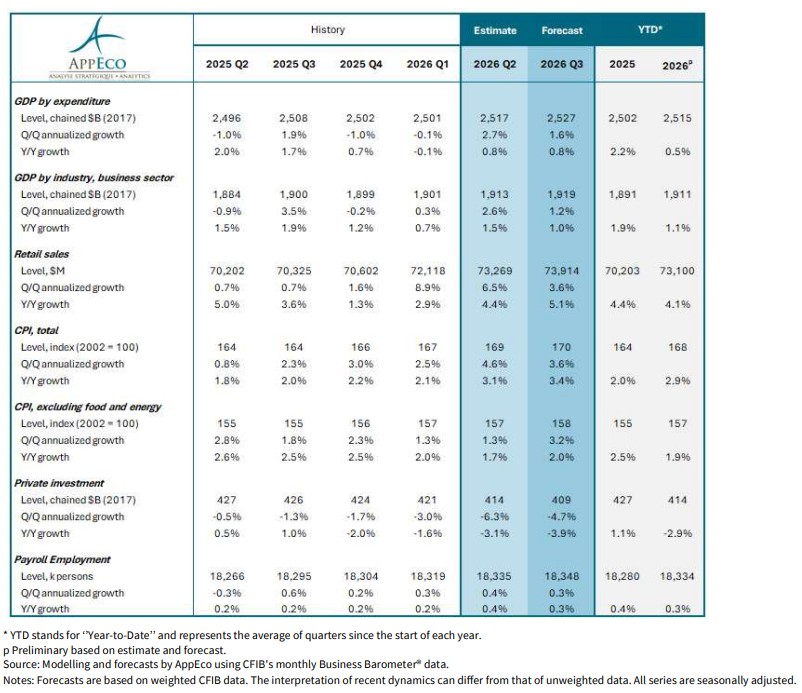
The Canadian Federation of Independent Business (CFIB) – working with economic consultancy AppEco – forecasts Canada's GDP will grow by 2.7% in the second quarter of 2026 and 1.6% in the third quarter, following a 0.1% contraction in the first quarter.
The rebound is expected to be driven primarily by strong oil and gas production and sustained construction activity, rather than broad-based growth across all sectors, the CFIB's Main Street Quarterly report states.
Simon Gaudreault, CFIB's chief economist and vice-president of research, said the headline growth numbers obscure rising costs facing small firms. "While rising energy prices are lifting GDP, they're also driving up costs on Main Street," Gaudreault said, adding there is "a need for greater cost-of-doing-business relief and measures to help small business owners manage the ongoing challenges."
Small business confidence in Canada fell sharply in May, signalling weaker hiring, tighter wage budgets and more cautious workforce planning for HR professionals, according to a previous report.
Investment and equipment costs squeeze employers
Private investment is forecast to contract by 6.3% in the second quarter and 4.7% in the third quarter, a decline the report links to uncertainty surrounding the Canada-United States-Mexico Agreement (CUSMA) review process, according to the CFIB.
This comes as business investment per worker in Canada declined from 87.3% of the U.S. level in 2014 to 54.0% in 2024, a recent Fraser Institute study revealed. Fraser Institute economist Tegan Hill linked this directly to worker outcomes: "The economic well-being of Canadians depends in large part on the strength of business investment, so poor investment performance is bad news for workers," she said.
Capital equipment and technology costs are also weighing on employers, with 38% of small and medium-sized enterprises (SMEs) reporting these costs as a challenge in Q2 2026, up from a historical average of 24% since 2009, CFIB noted. Pressure is highest among transportation and utilities firms, at 60%, and increases with company size.
The report attributes part of the increase to currency fluctuations, noting a one-cent decline in the Canadian dollar would raise annualized import costs for machinery, equipment and electronics by an estimated $2.7 billion. CFIB says the findings underscore the need for measures to help SMEs manage exchange-rate volatility.
Trade uncertainty and business exits mount
The U.S. administration's decision not to renew CUSMA at its July 1, 2026 deadline has left the agreement in force but shifted to annual reviews until 2036. About 35% of Canadian SMEs report it is too soon to determine the impact on their business plans, according to CFIB survey data.
Despite the uncertainty, 64% of business owners said Ottawa should take the time needed to secure a stronger agreement rather than rush a deal, the report found. Nearly half of businesses trading with the U.S. have shifted toward non-U.S. suppliers or customers over the past year.
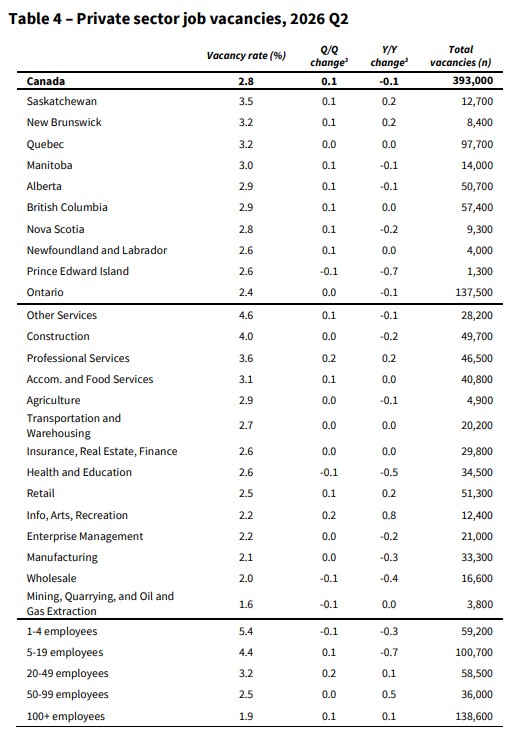
Separately, Statistics Canada data cited in the report show business exits have outpaced entries for three consecutive quarters as of Q3 2025, with a net loss of 7,561 businesses — the first sustained period of net losses since the pandemic. Health care and education were the only sectors showing consistent business creation momentum, while the national private sector job vacancy rate held steady at 2.8%, representing roughly 393,000 unfilled positions, per CFIB.
More Canadian businesses are closing than opening, with exits outpacing entries for six consecutive quarters – a reversal that threatens job creation, wage growth and career mobility across Canada, the CFIB previously noted in a report released in April.


.jpg)