CHRO’s communication background inspires people-centred focus to foster mentorship, retention during global expansion
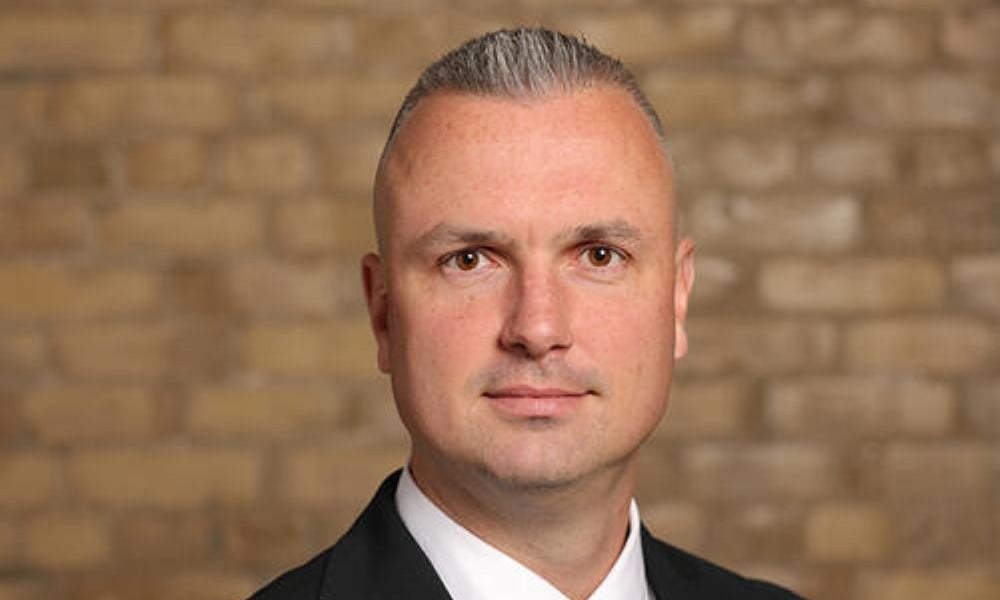
Being a leader in a fast-growing, founder-led tech company isn’t a job for the faint of heart.
At Info-Tech Research Group, with roughly 1,650 employees across six countries and a majority based in Canada, HR sits at the centre of global expansion, shifting expectations, and the rise of AI — right where HR belongs, according to Shawn Gibson, Info-Tech’s Chief Human Resources Officer.
“HR needs to dig in and HR leaders need to continue to have a strong voice at the table,” says Gibson. “They need to help design how work gets done.”
Gibson says he’s always had a focus on the employee communication side of things, completing a post‑graduate program in corporate communications focused on internal audiences after a business degree at Western University in London, Ont. He joined Info‑Tech out of an internship, handling special projects and acting as a kind of community manager – roles that kept him “people-focused early on in my career,” as he puts it.
A move to GoodLife Fitness followed, where he spent more than a decade in operations communications and organizational effectiveness before returning to Info‑Tech in an HR operations role in 2020. After moving through a few HR leadership roles, Gibson became CHRO in 2023.
HR philosophy rooted in empathy and strong communication
If that experience gave Gibson technical and strategic depth, his core philosophy remains human-centred.
“When I was at GoodLife, organizational factors like operations and major projects along with having really strong mentors reinforced my take on HR, which is really a focus on empathy and caring,” he says. “I really love communications, so [having] those mentors through my career, I think that really helped out with my trajectory, how I mentor my own team, and how I help others in our organization.”
That communications lens shapes where Gibson believes HR adds the most value. “I really care about the interaction between managers and employees,” he says. “I think that's fundamentally where I see HR's major influence, along with other things.”
When Gibson returned to Info‑Tech, the CHRO’s role with the executive team was still maturing. “Before I came back to the organization, Info-Tech, to be honest, struggled a bit with HR leaders,” he says. “We’re a founder‑led organization and I think that we really needed someone who was trusted by the executive as a partner.”
Making HR a strategic partner
Today, Gibson says his closer partnership with the executive team shows up most clearly in global expansion.
“As Info-Tech has grown globally, we've had a seat at the table where sometimes an organization might not,” he says. “As we look to expand across North America into different states, the UK, Australia, APAC, and, most recently, Singapore, we've played a central role in the operating model.” He says that means wrestling with questions such as how to support countries in other time zones and structuring those teams so that they make sense, because in some regions the teams are small.
On the tech side, Info‑Tech is “deep into a project around an AI-powered HR assistant,” for the global organization, says Gibson — a way to give people fast, accurate answers wherever they sit. “If a whole country has to wait for a whole time zone to wake up to get support, that doesn't help us speed up the business — we really should be able to provide the same service in any time zone,” he says.
He’s just as deliberate about fostering in‑person connections. “While I see other companies have decreased their budgets on events and that kind of thing, we've actually increased it,” he says. “Even in smaller markets and countries, we've increased our budget in terms of in-person events, so whether that's something like Fun Day, holiday parties, or different sporting events for our employees to go to, we've dug into that.”
Mentorship, recognition programs bring visible results
For Gibson, culture has to be visible in programs and behaviour, not just words. Info‑Tech has expanded its internal mentorship program, Rise Up: “We've found that having mentors is really important as we try to expand globally — a mentor can be in North America and supporting someone in the UK,” he says.
He also points to the company’s X Factor recognition program that ensures “winners and nominees are celebrated and made visible across the organization.”
Gibson also points to inclusion as one of Info‑Tech’s recent successes, despite the pushback against DEI in the US and ripple effects elsewhere. He says the company has invested heavily in its seven employee resource groups and monthly feedback from employees. “We've remained committed to our focus [on DEI],” he says.
He’s also been able to show the payoff of these initiatives to leadership, according to Gibson. “The biggest sign that this is all working is that we see strong internal mobility — we've got a ton of promotions within our organization,” he says. “We've been very fortunate to be able to retain our top performers, creating that great culture — compensation is a huge piece to that, but also creating this culture from in-person events, spending more on the mentorship program, that's led to us seeing a strong retention of top performers.”
People connections at centre of transformation
Looking ahead, Gibson frames HR’s mandate over the next few years, in his organization and elsewhere, in three parts.
“My advice to other leaders is that HR needs to dig in, and they need to continue to really have a strong voice at the table and help design how work gets done,” he says. “In this AI world, there’s a lot of concern and angst from managers and employees around the impact of AI, so it’s vitally important that IT and HR be closer partners — it’s been important in the past, but with the speed of the world, it's just a non-negotiable that in the age of AI we need to see that partnership with IT.”
Gibson’s second focus is leadership development. “As technology continues to get faster and faster, how do we develop our leaders in this world — it's so important, so vital, because a lot of employees say that their experience with an organization is through their manager,” he says. “So HR, even more so in this day and age, needs to focus on developing leaders.”
For all the technology, Gibson keeps coming back to the basic people function. “Stay grounded in real problems so you can find the friction in an organization and solve them where the problems are happening,” he says. “The more transactional work gets automated, you can move the value of HR to judgment, coaching, and the ability to connect people,” he says. “I think humans are going to want to have more human connection, so how can we in HR ensure there's that human connection?”