‘The United States experienced the largest business investment growth (31.3%) over the same period’

Canada's provinces are diverging sharply on business investment per worker, with the country's oil-producing regions falling furthest and fastest even as they remain among the strongest performers nationally, according to a new Fraser Institute report.
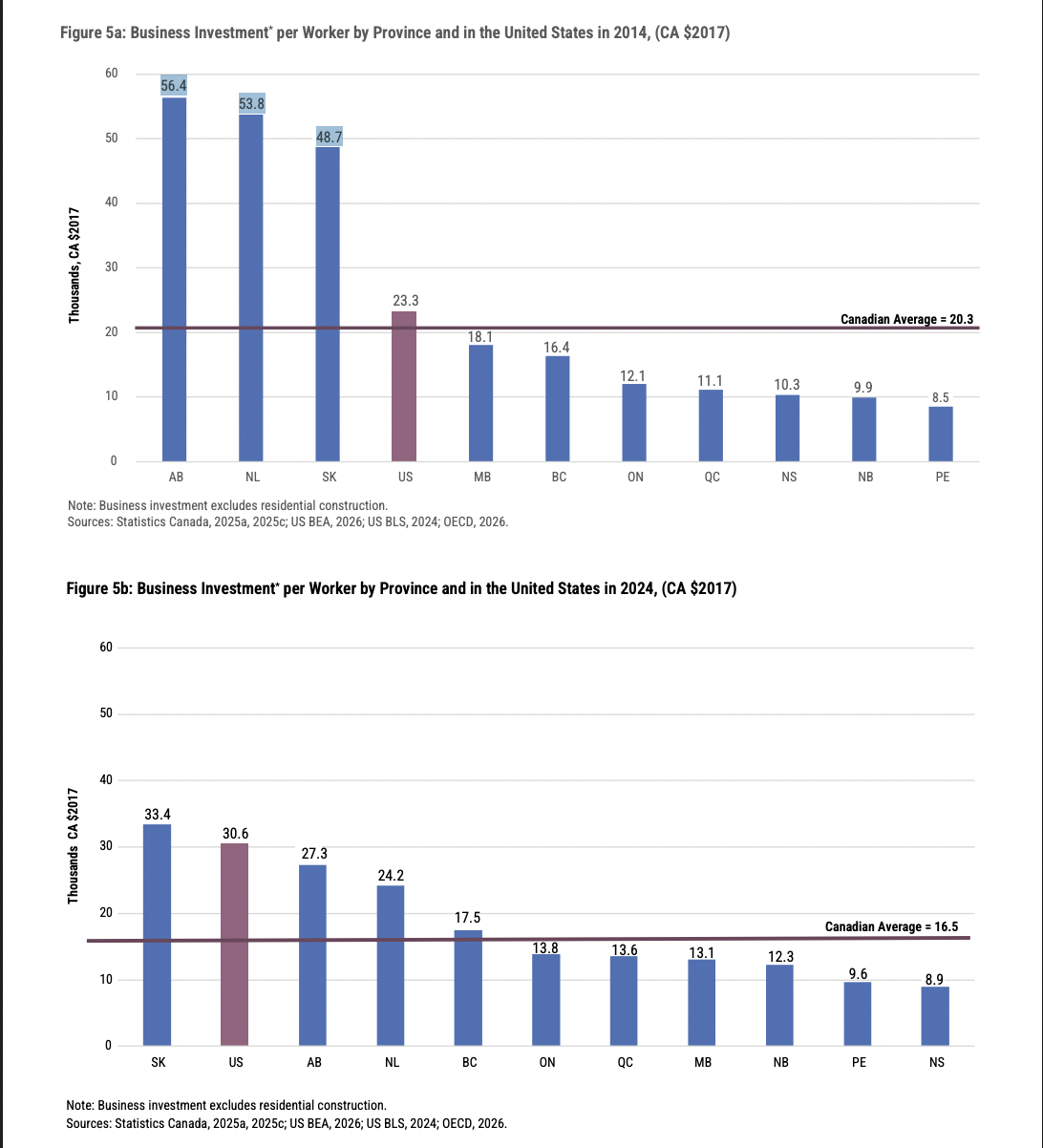
In 2014, three provinces — Alberta ($56,401), Newfoundland and Labrador ($53,779) and Saskatchewan ($48,715) — posted business investment per worker well above the U.S. figure of $23,263, according to the report by Tegan Hill, Joel Emes and Taylor Oliver, published by the Fraser Institute in 2026. By 2024, only Saskatchewan ($33,386) still exceeded the U.S. level, which had climbed to $30,555. Alberta had fallen to $27,294 and Newfoundland and Labrador to $24,241, roughly half their 2014 levels.
The declines were steepest in precisely those oil-producing provinces: Newfoundland and Labrador fell 54.9% between 2014 and 2024, Alberta fell 51.6% and Saskatchewan fell 31.5%, alongside declines in Manitoba (27.9%) and Nova Scotia (13.3%). Five provinces in total saw investment per worker shrink over the decade.
“In sum, real business investment per worker declined in five provinces from 2014 to 2024: Newfoundland & Labrador (−54.9%), Alberta (−51.6%), Saskatchewan (−31.5%), Manitoba (−27.9%), and Nova Scotia (−13.3%). While it increased in British Columbia (6.4%), Prince Edward Island (13.4%), Ontario (14.3%), Quebec (21.9%), and New Brunswick (24.3%),” according to the report.
“The United States experienced the largest business investment growth (31.3%) over the same period.”
At the other end, growth was concentrated in provinces that started from a much lower base.
Business investment per worker increased in British Columbia (6.4%), Prince Edward Island (13.4%), Ontario (14.3%), Quebec (21.9%) and New Brunswick (24.3%) over the same period.
Even so, Ontario ($13,827) and Quebec ($13,584) — Canada's two largest provinces by population — remained at less than half the U.S. investment level in 2024. Nova Scotia ranked lowest of all provinces that year, with business investment per worker at $8,926, less than a third of the U.S. figure.
National gap widens sharply after 2014
The provincial divergence mirrors a broader national trend. Real, inflation-adjusted business investment per worker in Canada declined from $17,345 in 2007 to $16,493 in 2024 — a drop of $852 — while U.S. investment per worker climbed from $19,352 to $30,555 over the same period, an increase of roughly $11,203. That amounts to a 4.9% decline in Canada compared to a 57.9% increase south of the border.
The gap held relatively steady between 2010 and 2014, with Canadian investment ranging from 87.3% to 90.4% of the U.S. level, the report says. It then fell sharply to 75.6% in 2015 and 66.9% in 2016, before settling at 54.0% by 2024 — its lowest point over the 17-year period studied. The authors note the decline cannot be attributed to workforce growth alone: Canada's business-sector workforce grew by 21.6% over the period, faster than the 13.2% growth seen in the U.S., but adjusting for that factor does not change the overall trend.
The report identifies the 2014 oil-price collapse as a significant factor, noting that Canadian oil and gas investment did not recover the way it did in the United States. It also points to broader concerns about federal tax and regulatory policy contributing to capital flight, citing a rise in Canadian investment abroad from $35.8 billion in 2010 to $102.3 billion in 2022 while foreign investment into Canada remained largely stagnant.
Training investment data
Separately, a previous Statistics Canada analysis found that overall business investment per worker fell 20% between 2006 and 2021, equivalent to $628.80 less per employee, with the steepest declines among large firms, which cut spending 70% per worker over that period.
StatCan attributed roughly a third of the decline to falling business entry rates, alongside a shift toward intangible investments such as brand equity and training that go unrecorded in traditional investment measures.
“From 2007 to 2024, Canada’s business investment per worker was consistently lower than investment in the United States; moreover, the gap between Canada and the United States has widened significantly since 2014. This reflects a real decline in business investment in Canada, and correspondingly, lower growth in business investment per worker than in the United States,” the Fraser Institute researchers concluded in their report.
“Policy makers across Canada need to recognize this challenge, understand its causes, and prioritize policies that support business investment and stronger economic growth moving forward.”