‘Event is ‘an innovative way for HR people to really connect with each other’
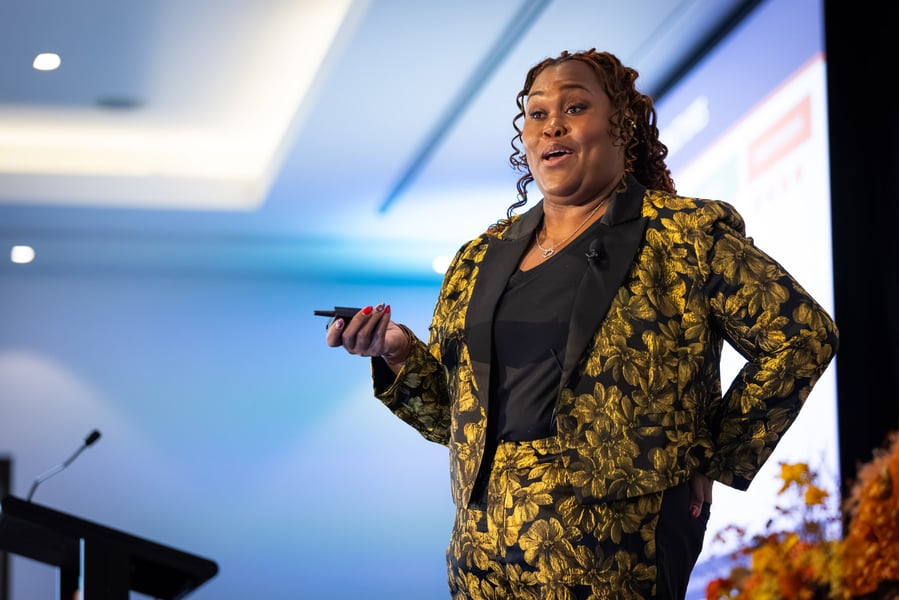
HRFest speaker Kalifa Oliver says the profession's biggest blind spot isn't a lack of data — it's a lack of storytelling.
"It's big on storytelling with data, but storytelling with data specifically to executives," Oliver says in an interview ahead of this year's event, describing the focus of one of her two HRFest sessions. For HR professionals struggling to get executive buy-in despite years of data collection, that distinction may be the most useful idea they hear all year.
For HR leaders tired of conferences that all start to look alike, HRFest is something different — and Oliver, senior director of technology, people and legal analytics at Lowe's, is leaning into exactly the tension keeping HR leaders up at night: how to prove the function's value while AI reshapes every part of the business faster than HR can keep pace.
Oliver, appearing on two separate tracks this year, says HRFest stands apart from the standard industry circuit precisely because of its format.
"It's an innovative way for HR people to really connect with each other," she says, describing an atmosphere that allows attendees to "just relax" and focus on real challenges rather than sit through a "stoic conference where you're just being spoken to all day."
Storytelling, AI implementation
Oliver's first appearance, a lab session titled "From Surveys to Storytelling: Making People Analytics Land with the C-Suite," tackles a gap she says plagues HR analytics teams: an obsession with the data itself rather than the business decisions it's meant to support.
"We love to be nerdy when we talk about analytics, and we don't focus on business problems and business decisions and business impact," says Oliver, who is also founder of Kalifa K Oliver Experience Coaching.
Her second appearance is as moderator of "The AI Implementation Files: Case Studies in Ethics, Risk and What Got Paused," a panel featuring Michelle Lu and Diana Vela.
The discussion will cover how organizations have implemented AI across talent acquisition, listening, and learning functions — including the moments sme companies chose to pause. "One of the questions I will be asking is the idea of: ‘We could, but should we do this thing?’" Oliver says.
Central to Oliver's message is that executives asking for dashboards aren't really asking for dashboards. "When an executive asks us, for example, for a dashboard, they're really asking us for a decision," she said, arguing HR teams need to build toward the decision, not just the deliverable they can visually present.
On AI specifically, Oliver says the profession risks losing employee buy-in if it fails to frame automation as a tool rather than a threat. "If you phrase it as this thing is coming to take your job, then why would they adopt it?" she says. Instead, she argues the right question is "how can I get more productivity from AI in order to help people" — not the reverse. Strong analytics, she adds, can help strip away hype from substance: "Good analytics helps take away the propaganda and the marketing from the actual use case."
Beyond AI: HR's structural lag
Oliver points to two additional pressures facing HR departments. The first is a widening capability gap, as technology outpaces the function's ability to adapt.
"We're moving faster than we have the capacity for," she says, noting that employees already encounter more sophisticated technology as consumers than they often do at work.
The second is HR's long-standing data hoarding without a matching ability to act on it quickly. "We are data holders. We are data rich," Oliver says. "But we are not decision ready." That disconnect, she said, is part of why HR continues to be perceived as a cost centre rather than a strategic driver of business value.
HRFest — set to be held at Rebel, Toronto on Nov. 10–11, 2026 — brings together HR professionals for two days of sessions, panels, and networking in a format built to feel less like a traditional conference and more like a genuine festival. Attendees can expect programming on AI implementation, people analytics, and the practical challenges reshaping HR — delivered, organizers promise, in an environment that's informal, colourful, and built around real connection between HR professionals.