Cross-border trade tensions test how leaders handle missteps
An executive's personal social media post can now become a workforce and reputational problem within days, as a Michigan credit union just discovered amid heightened cross-border trade tensions.
For Canadian HR leaders, this is a live case study in how quickly executive conduct, not just tariffs or supply chains, can become a governance risk.
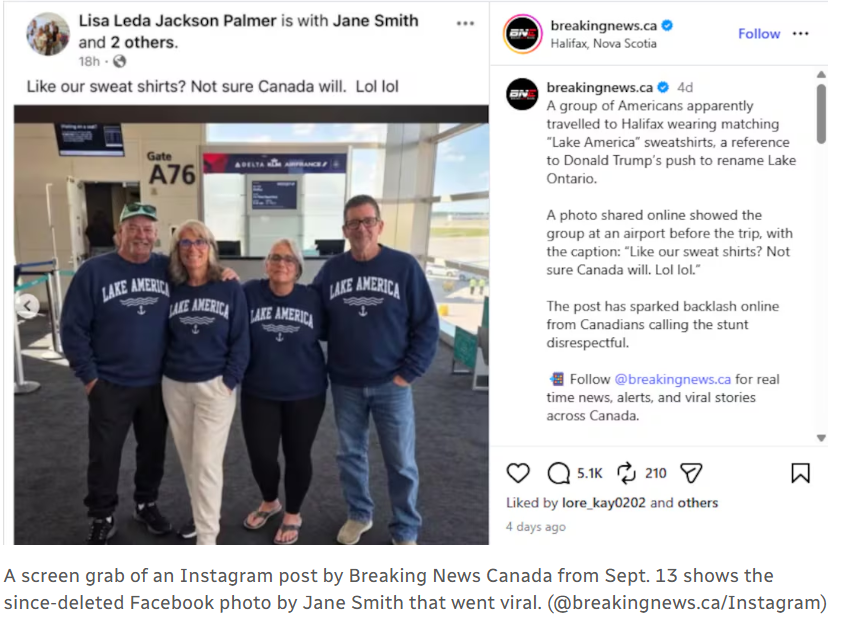
Jane Smith, chief executive officer of Family First Credit Union in Saginaw, Michigan, used artificial intelligence (AI) to generate a photo of herself and three family members wearing "Lake America" sweatshirts before a Sept. 11, 2026 trip to Halifax, Nova Scotia, according to CBC News.
The image, captioned "Like our sweatshirts? Not sure Canada will," referenced US President Donald Trump's Aug. 27 executive order renaming Lake Ontario. Smith says she ran a photo of the group through ChatGPT to add the sweatshirts, then posted the result to her private Facebook page with an AI label. Her sister, Lisa, reposted it publicly from Halifax without that label, and it spread rapidly.
The backlash was swift and, at points, hostile. CBC News reported one Haligonian commented online that the group had "messed with the wrong city." Smith says she received death threats and cut the family's 10-day trip short, returning home early.
"We weren't trying to make a political statement," she told ABC12 News. "However, we were, you know, kind of poking fun at the fact that you know one of the Great Lakes' names [was] getting changed." She added that the sweatshirts were never real: "We never had actual sweatshirts. We never wore sweatshirts."
Online speculation also wrongly linked Smith's trip to a Saint Mary's University conference in Halifax; program manager Erin Hancock told ABC12 News, "She is not part of our program and we do not know her. This is an internet urban legend." Smith later apologized, telling ABC12 News, "It was insensitive, distasteful and in poor judgment. It should never have been created or shared."
Family First Credit Union's board said separately it "disapproves and rejects" the post and "supports and respects our Canadian neighbours."
The Halifax District RCMP told CBC News it cannot confirm whether any investigation is tied to the incident unless charges are laid.
How do cross-border trade tensions raise the stakes for HR?
The incident lands against a backdrop of Canada-US friction over the lake renaming, which Prime Minister Mark Carney has said Canadians will reject "now and always," and which Nova Scotia Premier Tim Houston called "some real foolishness." Roughly three in five Canadians say they are avoiding US goods where a domestic alternative exists, according to a Research Co. tracking poll on Canadian sentiment toward US tariffs. That sensitivity means employers can no longer treat leaders' social posts on the trade dispute as low-risk personal matters.
The credit union's board felt compelled to publicly distance itself from its own CEO within days – exactly the kind of exposure governance and HR teams are increasingly expected to plan for, not just react to. As Canadian HR leaders manage mounting workforce pressure tied to the tariff dispute, executive conduct now belongs in the same risk conversation as staffing and supply chains.
A December 2024 memo from the C.D. Howe Institute urged Canadian businesses with US exposure to reassess their footing before a crisis forces their hand – advice that now extends to how leaders use AI-altered images and social media when tied to the federal government's response to renewed US tariff measures. Ambiguity over the image's AI origin was central to how fast this incident escalated.