As RTO ramps up, unsupported change — not the office environment — is driving anxiety

The big move back to the office isn’t just coming. For many, it’s already here.
Statistics Canada announced earlier this year that the proportion of employed people commuting who work mostly outside their home rose for the fourth consecutive year in 2025 to 82.6 per cent in May 2025. However, divisions are showing.
Executive teams want collaboration and culture, while employees want some element of control and respect. In the middle sit HR leaders, trying to design policies that get employees back in a productive way.
Beyond practical considerations such as the number of desks, meeting room bookings, and office protocols, there may be something missing from some RTO strategies that could be just as important — mental health support for the employees coming back.
A recent U.S. survey by Modern Health puts a sharp focus on the issue: 70 per cent of employees report heightened anxiety about returning to the office (RTO), even as 85 per cent say RTO can strengthen collaboration and culture when it’s done well.
The same pressures are surfacing in Canada and ignoring the mental health dimension is a strategic mistake to RTO plans, according to Canadian mental health experts.
Employer support lacking for RTO
“The opportunity lies in aligning RTO strategies with what employees need most — intentional design, flexibility, and meaningful support,” say experts from the Canadian Mental Health Association (CMHA): Rucha Shelat, National Account Manager, Workplace Mental Health; Sarah Grzincic, National Workplace Mental Health Trainer; and Mathew Kennedy, National E-learning Specialist.
They argue that the core issue isn’t physical space, but rather psychological infrastructure: “While employees acknowledge the potential benefits of in-person collaboration, the anxiety reflected in the data shows that what they’re missing is not the office itself — it’s the conditions that make the office feel safe, purposeful, and supportive."
In the Modern Health survey, 34 per cent of employees describe their employer’s RTO support as “lacking” or “nonexistent,” and 81 per cent say they would feel more positive about RTO if they had input into its design.
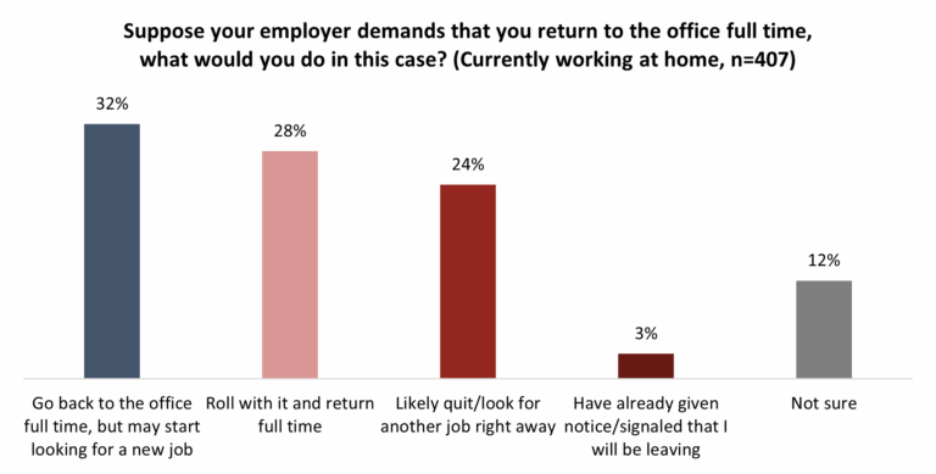
Angus Reid survey data from earlier this year shows that employees may have similar anxiety north of the border. A majority of Canadian workers would rather spend most of their working time at home, and that figure jumps to 76 per cent among people who have already experienced remote work. Nearly six in 10 employees working from home said they would either quit or would consider looking for a new job if asked to return to the office full-time, the survey found.

RTO colliding with caregiving stresses, psychological safety
The Modern Health report highlights how RTO policies are hitting caregivers the hardest, especially the “sandwich generation” caring for both children and aging relatives. The CMHA team sees the same pattern across Canadian organizations.
They stress that policies built around a one-size-fits-all model are particularly punishing for these employees. “Canadian employers can better support the sandwich generation by rethinking RTO policies through the lens of flexibility, empathy, and family-conscious benefits,” they say, adding that when caregiving pressures go unaddressed, working parents and caregivers report lost hours to distraction, absenteeism and strain.
As far as what RTO success should look like, it doesn’t start with badge swipes or occupancy, according the CMHA team: “From the perspective of a workplace mental health advocate, the defining measure of RTO success should be employee well-being and engagement, rather than traditional metrics like attendance or output alone."
They believe that tracking how supported people actually feel is key to RTO strategy. This includes monitoring employee assistance plan (EAP) utilization and feedback about workload, culture and social support, as well as running engagement surveys and pulse checks focused on psychosocial risks.
“HR leaders can shift from a top-down approach to a collaborative, psychologically safe RTO process by creating consistent opportunities for open, judgment-free dialogue about employee well-being," says the group. “This means moving beyond one-way communication and inviting employees to meaningfully participate in shaping how RTO is designed and implemented.”
Manager capability a make-or-break factor
Evidence is mounting that managers are the front line of mental health at work, and Shelat, Grzincic, and Kennedy note that research from organizations such as the University of New South Wales in Australia, Deloitte, and the American Psychological Association has shown that increasing managers’ mental health knowledge has a direct positive correlation to the employee experience.
In addition, a recent report by Canada Life and Workplace Strategies for Mental Health found that 52 per cent of employees say their some performance was impacted by their mental health, but only three in five managers say their workplace provides them with the tools and skills to effectively manage emotionally distressed employees.
“Effective manager training equips managers with the necessary knowledge, skills and self-reported efficacy to foster positive employee mental health," they say. “A collective understanding by employees that managers perceive psychological safety as important has a statistically significant influence on their well-being.”
The CMHA team refers to studies by Sunlife Financial, Deloitte, and the U.S. National Library of Medicine showing that effective manager mental health training is associated with a 28-per-cent reduction in work-related sick leave, a 27-per-cent reduction in mental health disability duration and a 20 per cent reduction in related costs.
Clear expectations, etiquette matter
The CMHA team also flags a quieter but growing stressor: people returning to offices where the unwritten rules have shifted.
“Uncertainty around workplace etiquette such as dress codes, hybrid meeting norms, shared spaces, and day-to-day social interactions can increase employee stress, especially for those new to in-person work,” they say. “When expectations feel unclear, employees may worry about making mistakes or not fitting in.”
The group suggests that organizations can ease this stress by collaborating on clear, updated guidelines with their teams — such as written guidance on hybrid schedules, meeting norms, and shared spaces backed by a phased return that prioritizes collaboration, mentorship, and meaningful interactions.
“RTO success should be measured by how employees feel, thrive, and connect, which goes beyond mere presence in the office and aligns organizational goals with mental health and sustainable engagement,” says the CMHA Workplace Mental Health team.