Burnout, discrimination, harassment on the rise among government workers

HR professionals in the federal public service must do a better job in providing a suitable workplace for workers, as a recent report points to falling satisfaction in the office alongside rising discrimination and burnout.
Satisfaction with physical work environments fell sharply in 2024, according to results published by the Government of Canada.
Only 65% of respondents agreed their workspace was suitable for their job requirements, down from 80% in 2022 and 78% in 2020.
Negative responses to the same question rose to 26% in 2024, roughly double the 13% recorded in 2022, the data show.
As the federal government called workers back to the office, some agencies had to delay their RTO policies due to a lack of office space, according to previous reports.
Discrimination reports increase
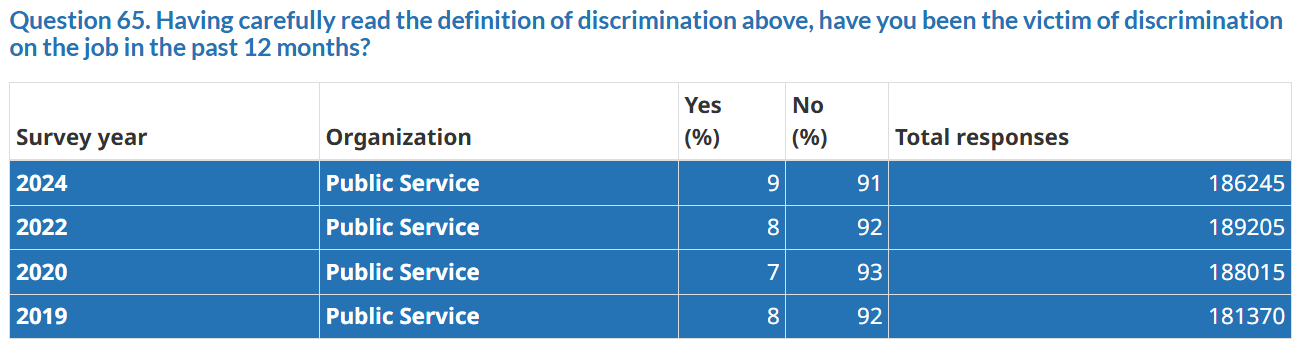
Employees who reported experiencing discrimination on the job rose to 9% in 2024, up from 8% in 2022 and 7% in 2020, according to the 2024 Public Service Employee Survey (PSES), administered by Statistics Canada in partnership with the Treasury Board of Canada Secretariat. The study drew responses from 186,635 employees across 93 federal departments and agencies, a 50.5% response rate.
The report defines discrimination as "unjust or prejudicial treatment of a person or group of people" that limits their access to opportunities available to others.
Among those who experienced discrimination, 75% said it came from someone with authority over them, and 53% said they took no action to address it.
Fear of reprisal remained the top reason cited for not filing a formal discrimination complaint, at 45%, the survey found.
In 2024, the federal government faced a $2.5 billion ‘Black Class Action’ lawsuit. The suit, in which a group of Black federal employees is alleging systemic discrimination within the federal government, is being heard for certification in federal court this week after a three-year wait. It argues that despite government policies intended to support diversity and inclusion, racial discrimination has left many Black employees marginalized, especially in senior roles.
Harassment reports increase
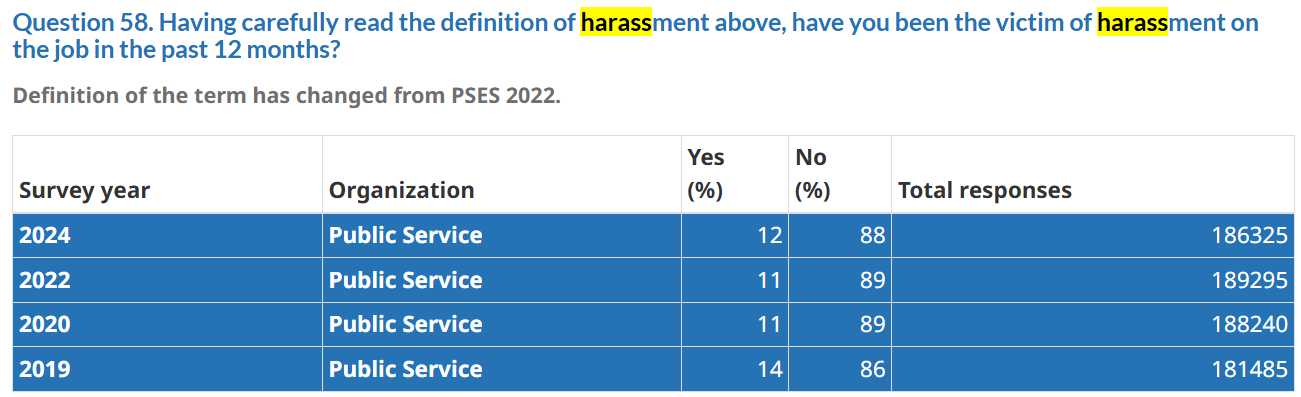
Federal employees who said they were the victim of harassment on the job in the past 12 months rose to 12% in 2024, up from 11% in both 2022 and 2020, according to the Government of Canada. The report defines harassment as conduct that can "reasonably be expected to cause offence, humiliation" or injury, whether from a single severe incident or a pattern of behaviour.
Of those who experienced harassment, 60% said it came from someone with authority over them, while 45% said co-workers were responsible, the data show.
Fear of reprisal was again the leading reason employees gave for not filing a formal harassment complaint, cited by 47% of those affected, and 28% said they took no action at all.
Burnout indicators climb
Nearly one-quarter of federal employees, 23%, reported high or very high work-related stress in 2024, compared with 16% in 2019, the data show.
Nearly two-thirds of respondents, 65%, said heavy workload caused them at least a moderate degree of work-related stress, and 35% said they always or often felt emotionally drained after their workday.
The share of employees describing their workplace as psychologically healthy fell to 59%, down from 68% in 2020. The report defines a psychologically healthy workplace as one that "promotes employees' psychological well-being and actively works to prevent harm."
Previously, Prime Minister Mark Carney's 2025 budget pledged to reduce the public service by 4.5% — approximately 16,000 positions — within three years.
In July 2025, the Public Service Alliance of Canada (PSAC) said that the job cuts are causing a lot of pain for workers.
“Workers are feeling overworked, facing deteriorating office conditions, dealing with ongoing discrimination in the workplace, frustrations with the Phoenix pay system and worsening work-life balance, to name a few of the major issues highlighted in the survey results,” said the group.
Rather than cutting jobs, the group said that the federal government must invest in the public services and workers who keep Canada running.
“A strong public service starts with a workforce that’s respected and supported, not run into the ground,” PSAC said. “Cutting or capping the public service will worsen many of the issues highlighted in the survey, such as overwork, stress, burnout, workers’ mental health and their ability to respond to the needs of people in Canada.”
The Treasury Board of Canada Secretariat, in its own Departmental Results Report, acknowledged it missed its internal targets on psychologically healthy workplace and respect-for-differences measures.