Among Canadian employers, 55% say it is up to workers to adapt to company culture, while 45% believe company culture should evolve with employees: survey

When it comes to adapting to workplace culture in Canada, hiring managers and job seekers simply cannot agree, according to a recent report.
Among employers, more than half (55%) say it is up to workers to adapt to company culture, while 45% believe company culture should evolve with employees.
Meanwhile, among job seekers, 56% believe companies should adapt to evolving employee needs, while 44% say employees should adapt to company culture.
However, among job seekers, there are significant differences between genders and generations, according to Express’ reports based on two surveys: one among 505 Canadian hiring decision-makers, conducted Nov. 11–26, 2024, and the other among 505 Canadians aged 18 and older, conducted between Nov. 21 and Dec. 6, 2024.
Women (62%) are more likely than men (51%) to believe companies should adapt to employee needs, as are Gen Z (61%) and Millennials (63%) compared to Gen X (43%) and boomers (45%).
Workers globally have grown more confident over the past year, yet far fewer report being satisfied with their jobs, according to a previous ManpowerGroup report.
‘The most effective path forward’
Over eight in ten (82%) companies say they already have the tools to train new hires to integrate into their workplace, with 28% strongly backing their ability to shape cultural alignment from day one for new employees, finds Express' survey.
But faced with rising concerns about turnover and hiring challenges, many employers are signalling a willingness to evolve.
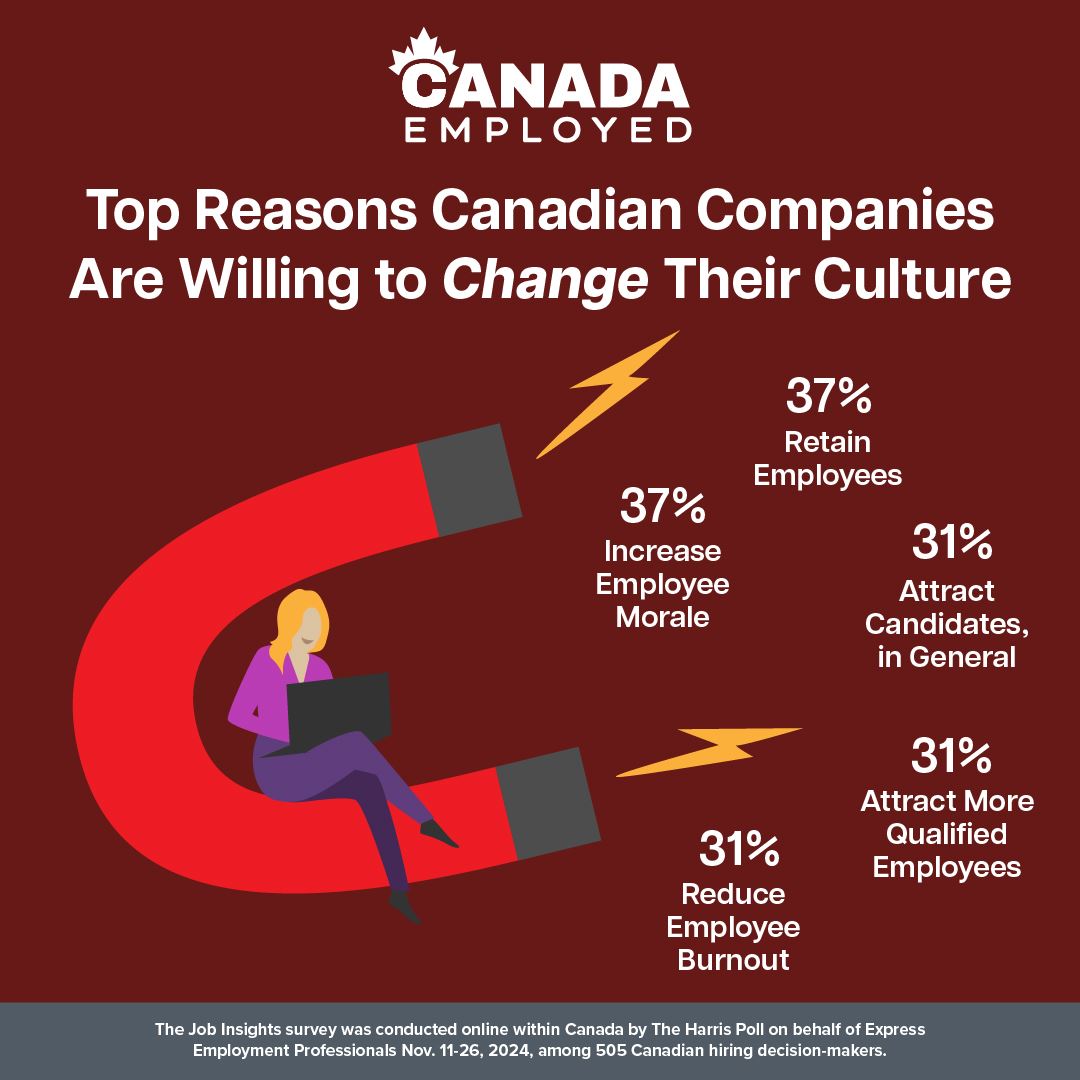
Overall, 78% of hiring managers say their organisation is open to changing its culture to meet business needs. They would do this for the following reasons:
- to retain current employees (37%)
- to increase employee morale (37%)
- to attract more qualified candidates (31%)
- to broaden their appeal to job seekers in general (31%)
- to reduce burnout (31%)
“When it comes to workplace culture, the most effective path forward is one where both employers and employees are willing to adapt,” says Express CEO Bob Funk, Jr. “Success isn’t about one side yielding to the other. It’s about meeting in the middle to build a culture that supports business goals while also resonating with today’s workforce.”
Nearly 30% of hiring managers across Canada anticipate that staff turnover will increase before the year’s end, according to a previous Express report.
How can you build a good culture in the workplace?
Here are some ways to build a positive work environment, according to Kate Heinz, a Built In product marketing manager:
- Establish core values
- Set clear departmental goals
- Communicate the organisation’s broader goals
- Promote diversity and inclusivity
- Encourage all employees to share their ideas
- Create an employee recognition program
- Accept and utilise your employees’ feedback
- Be flexible
- Be transparent
- Plan social outings
“Work culture will naturally form within every organisation and sometimes to the detriment of the business. Allowing negative behaviours and toxic attitudes to fester will cultivate an unfavourable work experience — and an expensive one too,” says Heinz.
“Work culture not only guides employees in the workplace, but it also guides customers on whether they want to do business with you.”
Pay is no longer the most powerful tool employers can use to attract Canadian workers, according to findings from a previous Randstad report. Work-life balance has now emerged as the top workplace priority, particularly among younger employees.