As study finds more strategic HR departments are run by men, academic says more women need to connect to executive level – and AI can help

Recent research by Sapient Insights has revealed a powerful case for the elevation of HR in organizations; those that use human resources as a strategic function achieve significantly better business outcomes.
However, the stereotype of HR being a largely administrative department is revealed to be a serious barrier to its being taken seriously at the top level:
“While women make up over 70% of HR professionals, their presence in top leadership positions decreases as company size and visibility increase … indicating a clear pattern: as the perceived strategic value – and visibility – of the HR function increases, so too does its shift toward male leadership.”
Strategic HR partners add bottom-line value
The report finds that while HR is often viewed as a support function, organizations that leverage HR’s strategic potential see up to 34-per-cent higher business outcomes over five years, including increased profitability, innovation, and market share.
However, roughly half of HR functions are currently perceived as strategic by their organizations, the report states.
According to Laura Nelson, professor of sociology at the University of British Columbia, this perception gap is closely tied to deep-seated stereotypes and structural barriers, many of which are gendered in nature.
“When a profession is dominated by women, like nursing or early childhood education, it tends to be valued less, just in general,” she says.
“Even when industries shift from being male-dominated to women-dominated, they get devalued in the process.”
This “promotion gap” is visible across sectors, Nelson adds – including medicine, law, and academia, where women are well-represented at entry- to mid- levels of leadership but fall off at executive stages of promotion.
Stereotypes of women leaders as collaborators
A major theme in the Sapient Insights report and accompanying analysis is the way gendered expectations shape both the distribution and experience of work in HR as well as recognition of strategic value.
For example, women are 50 percent more likely to have “no opportunity to share regular HR metrics with the executive leaders,” the report states.
It also revealed that women HR leaders are 56 per cent more likely to focus employee experience around collaboration and teamwork, while male HR leaders are more likely to focus on a manager-led employee experience.
“Men are much more strategic than women,” Nelson says.
“Thinking about, ‘What can I do in this job to get listened to by the executives, and to make it seem like I'm not just doing a support role, but I'm actually advancing the bottom line?’”
Women HR leaders as collaborators
However, Nelson cautions about taking these findings at face value, as they are not rooted in ability but in how workplace cultures reward or penalize certain behaviours.
“When women don't act as team players, they tend to be penalized if they are too aggressively individualistic,” she says,
“When people feel like women are trying to promote themselves, they get dinged … there's a lot of research to show that if a woman goes and wants to ask for a raise or promotion, if they say, ‘I'm asking for this raise because it will help my team,’ they're much more likely to get the raise, versus, I go in and say, ‘Look at how good I'm performing. I should get a raise.’ That's seen as aggressive.”
As Nelson explains, female-coded leadership styles, such as focusing on collaboration and teamwork, are reactions learned over time as a rational adaptation to workplace dynamics, she says, “because that's the way that they're respected, the only way that they get respected in their team. And they've learned that through trial and error.”
The outcome is a “cognitive burden”, says Nelson.
“My interpretation … based on my expert knowledge, is that women have so much cognitive burden on them, for not just doing their jobs, but having to say, ‘How does this help the team, and not just me?’”
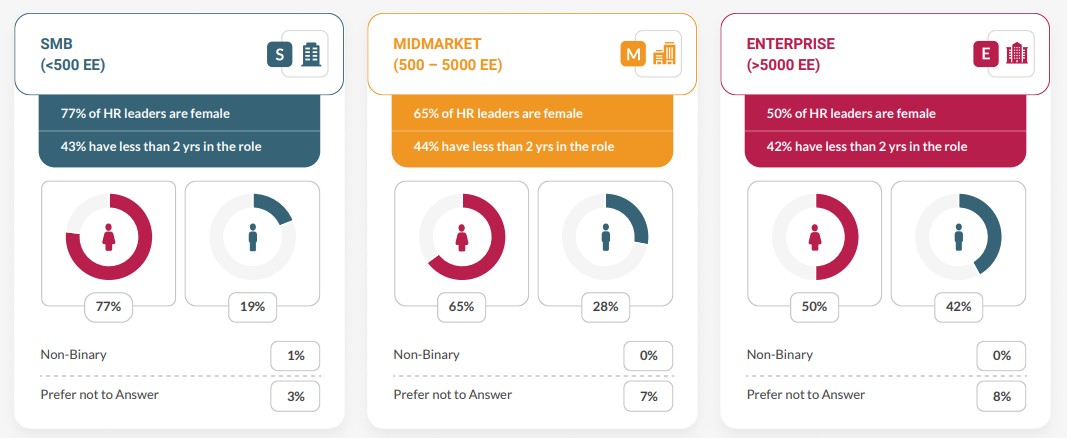
Source: Sapient Insights Group
Technology, task allocation, and the strategic gap
The Sapient report highlights that women in HR are almost two times as likely (1.8%) than male counterparts to adopt AI and automation into their roles. Men take a more reserved approach to AI adoption, the report implies, with the top reason being cost.
As Nelson points out, these statistics also don’t tell the whole story; rather than preferring innovation, women may be adopting these tools as ways to lessen cognitive burden.
“Women use AI more as necessary helpmates,” she says.
“If AI is saying, ‘We can release your cognitive burden,’ women are like, ‘Bring it on.’ Men are like, ‘I don't have that much cognitive burden, so why would I do that?’”
This data should be a warning signal to employers, Nelson goes on, because although AI may be proving useful now in reducing cognitive burden through performing more low-promotability tasks (such as providing feedback and organizing social connection activities) it doesn’t solve the underlying issue.
In fact, it may be prolonging it.
“Of course, they want to offload that stuff to AI. They don't get promoted for it. It doesn't benefit them, and it's a huge cognitive burden on them and distracts them from being able to do the strategic, tough stuff that gets promotions and gets women to that next level,” says Nelson.
“It's not forcing these organizations to confront the fact that women are doing these tasks. It burdens them. It could be a reason why they're not getting promoted at as high rates. And what we really need is men to take on these tasks as well or get rid of the tasks so they're not a part of the workload.”
Visibility, reporting lines, and access to the executive suite
One of the most actionable recommendations relates to the reporting structure and visibility of HR within organizations.
“Women are disconnected from the executive level … if men are saying ‘hey’ to the executive leadership, they're constantly pushing things up to them saying, ‘Look at this report. Look at what I've done. I can help your bottom line. I can help your business goals. Here's all this data. Here's how I'm going to do it’ – the executive leadership is seeing that,” Nelson explains.
“They're seeing the name attached to it. They're seeing that they're actually contributing to the bottom line of the organization. Women are not doing that. They're not speaking to the executive leadership.”
To address this, Nelson’s advice is simple: if there is currently no direct line between HR and executive leadership, establish one. Through direct exposure to HR practices, senior leaders will see firsthand the strategic value of the function.
“Make sure that the HR team is reporting directly to the executive leadership, so that they're seeing how the work can be strategic to the executive leadership,” she says.
“It's not just something that is ‘there’ and has to exist in the organization, but it's actually something the executive leadership should be paying attention to.”
Data collection: the foundation for closing the gender gap
A central theme in the Sapient report is the importance of robust data collection, as a foundation for real progress on gender equity within HR departments. Rather than relying on assumptions or anecdotal evidence, organizations should systematically gather data on the day-to-day tasks that HR professionals perform.
“Watch those promotion rates,” Nelson says.
“Watch what the actual people in HR are doing on a day-to-day basis. Are they doing service work, support-type roles, or are they being brought into the product room and the executive room to say, ‘Here's the strategy, here's how HR can contribute to strategy?’”
This data is essential, Nelson asserts, for identifying if strategic work is equitably distributed or if there are patterns where women are concentrated in support roles rather than being included in strategic discussions and decision-making forums.
“That just requires collecting that data, or at least someone's paying attention to that … if there are roadblocks or things happening that aren't visible,” she says, adding that the root is rarely intentional but still crucial to identify.
“If women are overburdened with these mundane, low-promotability tasks, they're not being brought into the executive room, and they want to be … there's some reason why they're not. Try and figure that out, and figure out how to reduce that gender disparity.”