Statistics Canada offers insights on firm-level labour productivity amid 'continued workforce aging'

At a time when Canada continues to deal with a productivity crisis, and with many workers looking to switch jobs, a recent study shows why employers must prioritise to recruit and retain workers in their late 40s.
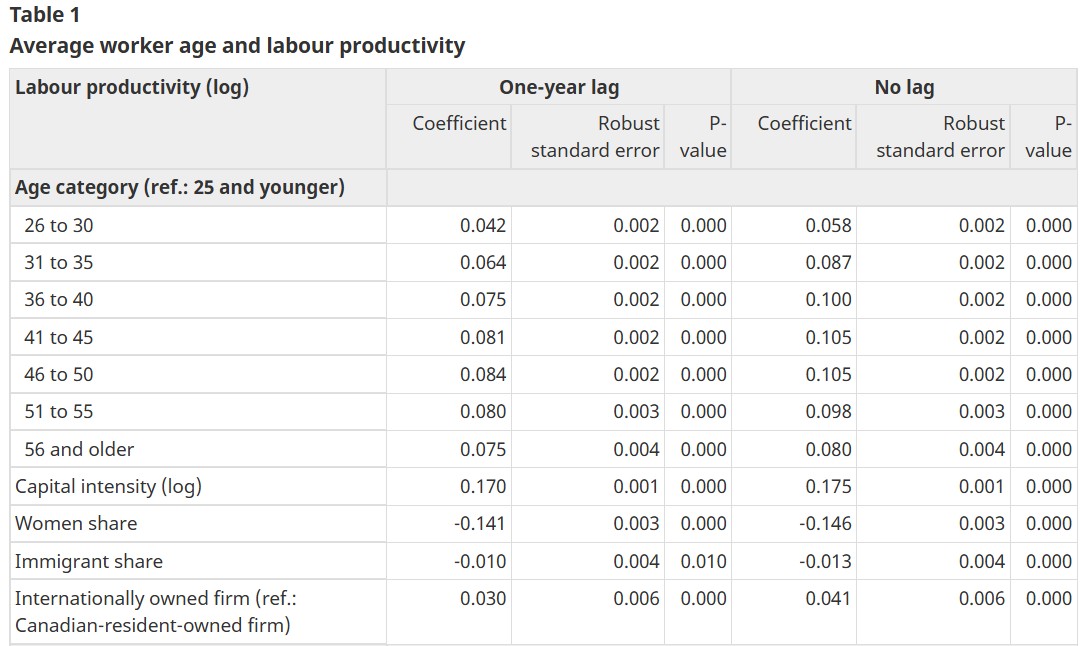
That’s because firm-level labour productivity peaks when the average worker age reaches 46 to 50 years old, according to Statistics Canada (StatCan).
Firms with an average worker age of 46 to 50 "are 8.8% more productive than baseline firms with an average worker age of 25 and younger, while they are 1.0% more productive than firms with an average worker age of 56 and older,” according to the report titled Workforce aging and labour productivity.
Productivity declines only slightly after the peak age range, a pattern the report describes as a "concave age–productivity profile,” notes Hassan Faryaar, who is with the Economic and Social Analysis and Modelling Division, Analytical Studies and Modelling Branch at StatCan.
"Continued workforce aging is likely to place increasing downward pressure on labour productivity in the coming years" at the economy-wide level, though the report characterizes this pressure as modest under some model specifications, he says.
The share of older workers in Canadian firms doubled over two decades, with manufacturing showing the steepest shift of any industry and the trend accelerating across almost every sector of the economy, according to a previous report from StatCan.
A similar trend is happening in the United States.
“Workforce aging is no longer a future issue; it is happening right now across the American labor market,” says Dr. Jasmine Escalera, career expert at MyPerfectResume, in a statement emailed to HRD. “As more workers delay retirement and some industries struggle to attract younger talent, employers may face growing pressure to plan for succession, retention, and knowledge transfer.”
Industry-level results show wide variation
The latest StatCan report breaks results down by sector and finds that construction and manufacturing firms peak earlier, at an average worker age of 36 to 40, and decline more sharply afterward than other industries studied. Faryaar attributes this pattern in part to the physical demands of the work, stating that in construction, "experience may play a smaller role in enhancing productivity, or the gains from experience among older workers may be partially offset by a decline in physical capabilities".
In both the construction and manufacturing sectors, the report found that firms with an average worker age of 56 and older had lower labour productivity than firms in the youngest reference category, a finding that did not hold true across other sectors examined.
By contrast, the finance and insurance sector showed continued productivity gains into the late 40s with only a modest decline afterward. StatCan cautions, however, that "the finance and insurance sector has substantially larger robust standard errors than the other sectors examined in this study," and recommends greater caution when interpreting those particular estimates.
Wholesale trade, retail trade, and transportation and warehousing firms peaked at ages 41 to 45, with productivity in the oldest age category remaining significantly above that of the youngest reference group, a pattern the report says suggests experience continues to carry more weight in these sectors than in physically demanding ones, notes Faryaar.
Other findings and policy context
The report also found that labour productivity declines as the share of women and immigrant workers within a firm increases, though the study does not offer a causal explanation for this association and flags it as an area requiring further research.
StatCan's report points to international policy research to frame potential employer responses to an aging workforce.
The study's author ran multiple robustness checks, including an alternative productivity model and a comparison of small firms against medium and large firms, and found that the overall concave age-productivity relationship held consistent across these alternative specifications, according to StatCan.
Faryaar concludes: “While population aging poses challenges, it also creates important economic opportunities when supported by appropriate policies.
“The report shows that aging becomes an economic asset when policies foster multigenerational workplaces, requiring employers to adopt age‑inclusive practices in recruitment, retention, training and retirement transitions. It also emphasizes that expanding lifelong learning is essential to sustain productivity as workers age. Moreover, healthy working conditions and flexible arrangements help older workers remain engaged and enhance team performance through experience‑driven complementarities.”
Nearly a quarter (23 per cent) of Canadian workers are planning to leave their jobs, according to a recent study. And 74% of Canadian hiring managers feel positive about their company's hiring outlook for the remainder of 2026, up from 67% in the fall of 2025, according to another report.