Sparkways head of people Issa Negussie says mentorship from outside your industry can offer HR leaders a fresh perspective

Issa Negussie has spent more than a decade in human resources, but some of the most valuable career advice he has received came from a panel beater.
The Head of People at Sparkways, a Melbourne-based not-for-profit early childhood education and care provider, says his mentor of 20 years has shaped how he thinks about leadership, trust and the purpose of HR, and that mentors can be found in the most unlikely places.
"That's the biggest advice I have for anyone. It's not just having a mentor but having a group of people that you seek regular counsel and advice from in all different backgrounds as well," Negussie told HRD.
"I've got a mentor of mine who's a panel beater. He's been with me for the last at least 20 years in terms of support. But, you know, I get the greatest amount of wisdom from him."
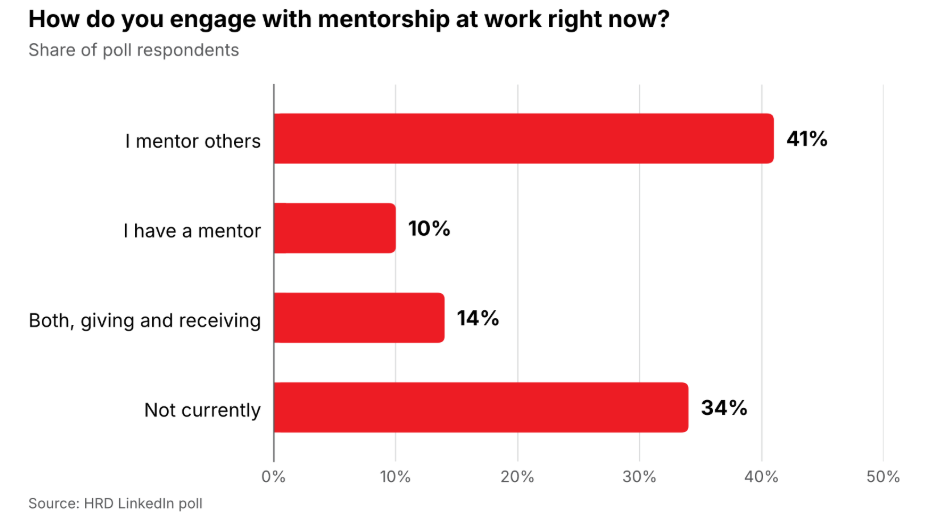
His story arrives as many HR professionals remain on the outside of mentoring relationships. A recent HRD LinkedIn poll found 41 per cent of respondents mentor others, 10 per cent have a mentor and 14 per cent do both, while 34 per cent are not currently engaged in mentorship at all, meaning fewer than one in four are receiving mentoring.
From panel shop to 20-year mentor
The relationship began when Negussie, then late teens and in his final years of high school, took his first car – a banged-up 1999 Mitsubishi Lancer – in for repairs.
"I met a panel beater who asked me the question, why? Why do you want to work on this car? Why do you want this fixed? He didn't quote me on the job," he said.
The repairs took time, and the conversations kept going. "He was always keen on having conversations that are more than just what's in front of us. And so what that taught me early on was, one, it's so important to understand why we do something," Negussie said.
When Negussie later asked his mentor for a job, the answer was no. "He said, 'I don't think you're well suited for this. I think you're suited for something else,'" he said. Negussie went on to build his career in HR at for-purpose organisations across disability, youth and early childhood.
Why a mentor from outside your industry brings perspective
Today, Negussie still takes workplace problems to his mentor, who runs his own business.
"I'll go to him with an HR issue and I'll say, what would you do? How would you see this from a business lens perspective? He's very commercial-minded, but also very human. And what I realised is that the best leaders are those people that are very human-centred," he said.
That outside view is the point. "You don't need a mentor that has a senior fancy title that's stuck within your discipline. Sometimes the problem is everyone within the same discipline thinks the same, says the same things, repeats the same framing," he said.
Formal programs are now common in large organisations – 98 per cent of US Fortune 500 companies have mentoring programs, according to MentorcliQ's 2024 Mentoring Impact Report.
For HR leaders building a mentorship program that fits company culture, Negussie's experience suggests informal relationships outside the business deserve a place alongside structured schemes and approaches such as reverse mentoring across a multigenerational workforce.
Trust and confidence as the currency of HR
The most lasting lesson from the panel beater's workshop was about trust. Negussie said his mentor was on "the shortlist of a lot of people" because of the confidence and trust he had built.
"He would say to me that those are the two things that we trade with people in our roles, whether you're a panel beater or a leader in HR. The currency you have is trust and confidence," Negussie said. "As soon as the trust and confidence goes down, people are less likely to seek your advice and less likely to come to you."
"The transaction is important, but the thing on top of that is the relationship," he added.
That lesson now shapes how he sees the function. "We need to be giving people a transformative experience at the end of this. People need to feel as though the organisation has supported them and helped to make them a better version of themselves," he said.
What the research says about why mentoring works
Research supports the link between mentoring and how people feel about work. A study by Lisa Baranik, Elizabeth Roling and Lillian Eby, published in the Journal of Vocational Behavior, examining why mentoring works, surveyed 733 substance abuse counsellors across 27 community treatment programs in the US.
It found that certain forms of mentoring – sponsorship, exposure and visibility, and role modelling – were linked to perceived organisational support, meaning the extent to which employees believe their organisation values them and cares about their wellbeing. That perception was in turn linked to higher job satisfaction and organisational commitment, and to lower intentions to quit.
The study focused on supervisory mentors, and the authors called for further research into informal mentoring and other workplace relationships. Negussie's experience suggests those relationships can matter well beyond the workplace.