Poor communication about AI is driving some staff to undermine their employer's own strategy
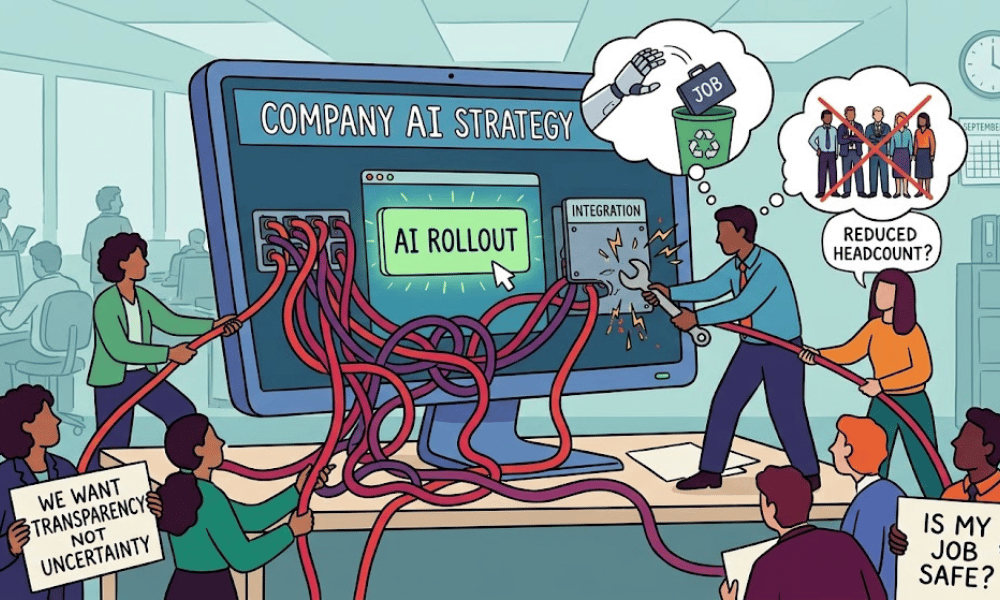
A meaningful share of employees are actively working against their own employer's artificial intelligence (AI) rollout, according to new workforce data presented at Telus Health's Feel Well Work Well event in Sydney on 9 September 2026.
Jamie MacLennan, vice president and managing director, Asia-Pacific at Telus Health, told the audience the company's research is picking up "a significant number of staff who are actively sabotaging their company's AI strategy" – behaviour he linked directly to how badly that strategy is being explained, rather than to opposition to the technology itself.
"For a lot of people, the communication to them, especially younger staff, is that AI is going to take your job," MacLennan said. "In that context, why would staff not behave negatively or destructively?"
Roughly a third of chief executives report they intend to use AI to cut headcount, a strategy he was sceptical of: "You can't cut your way to success," he said, arguing leaders who frame AI as a tool for differentiation, not headcount reduction, get a better response from staff.
Why are workers undermining AI adoption?
MacLennan's answer sits inside a broader plateau in workforce mental health that Telus Health's Mental Health Index (MHI) has tracked since it launched in April 2020. The MHI, scored out of 100 with 80 to 100 optimal and below 50 distressed, recorded 63.1 for the first quarter of this year – in the "strained" band, and a level MacLennan said is "essentially" the same as during the mid-2020 lockdowns.
Behind that score, 34 per cent of workers are at high risk of poor mental health, 35 per cent report feeling anxious, 28 per cent say they feel depressed, and 32 per cent say it is affecting their productivity.
MacLennan linked the plateau to a lingering physiological effect of the pandemic rather than new stresses alone. "Our ability to absorb new stresses has been fundamentally diminished by COVID and that extended stress and lockdowns," he said, pointing to cost of living, geopolitical uncertainty and job security piling on top – AI chief among the newer pressures.
Nearly three in ten workers now report feeling helpless, while roughly a third say they are more suspicious of colleagues' motives and angrier than before.
Younger workers, women and managers under the most strain
Scores typically improve with age, MacLennan said, but that has not held since the pandemic: "The 20 to 29 and 30 to 39 age groups consistently [score] lower" – a cohort that includes many organisations' emerging leaders and is most exposed to AI-driven job insecurity.
Women continue to score worse than men, and for the first time since the MHI began, managers score worse than the staff who report to them.
Employers navigating AI-driven change alongside these pressures can find further context in new rules for reducing psychosocial risks at work, which extend obligations into exactly this kind of change-driven hazard.
Psychosocial risk investment already pays for itself
Oliver Brecht, clinical psychologist and vice president, Center for Organizational Effectiveness at Telus Health, said the commercial case for acting on psychosocial risk – including the kind of AI-driven strain MacLennan described – is strong even before regulators get involved.
"If you can reduce your injuries by one per cent, your psychosocial risk interventions will pay for themselves," he said. Financial exposure runs well beyond fines, Brecht added.
"The largest psychosocial risk penalty to date is around $380,000 – comparatively, it's not much. But when you factor in what can happen reputationally through media pickup … there's some real damage there. And adding 30 per cent to your insurance premium bill, that can be significant."
Telus Health's modelling found a 10,000-person organisation loses, on average, the equivalent of 80 full-time staff annually to attrition and injury linked to psychosocial hazards. HRD has previously outlined practical steps employers can take to lessen psychosocial hazards.
Start small, but start with the data
Asked where confused HR leaders should begin – whether the trigger is AI, restructuring or something else – Brecht pointed to information most organisations already hold: "Go back and review some of the datasets that you've already got access to … your exit interviews … your incident and injury records … and your EAP (employee assistance program) data as well."
None of that alone constitutes a formal risk assessment, he cautioned, but it gives employers "a lead indicator" before committing to a full review. "You're only going to find what is present," he said. "You're not going to conjure up something that doesn't exist."
Frontline managers remain central to any program working in practice – a point HRD has separately reported on in coverage of why managers who visibly support their own mental health cut staff sick days.
MacLennan closed by tying the numbers to return on investment: organisations with strong mental health support see 49 per cent fewer working days lost, resting on three pillars – workplace context, leadership behaviour and individual health support. "Mental health and well-being isn't a nice to have," he told the Sydney audience. "It's a strategic and commercial imperative for organisations."