Canadian Patrol Submarine Project will lead to ‘over 100,000 well-paying jobs,’ says PM
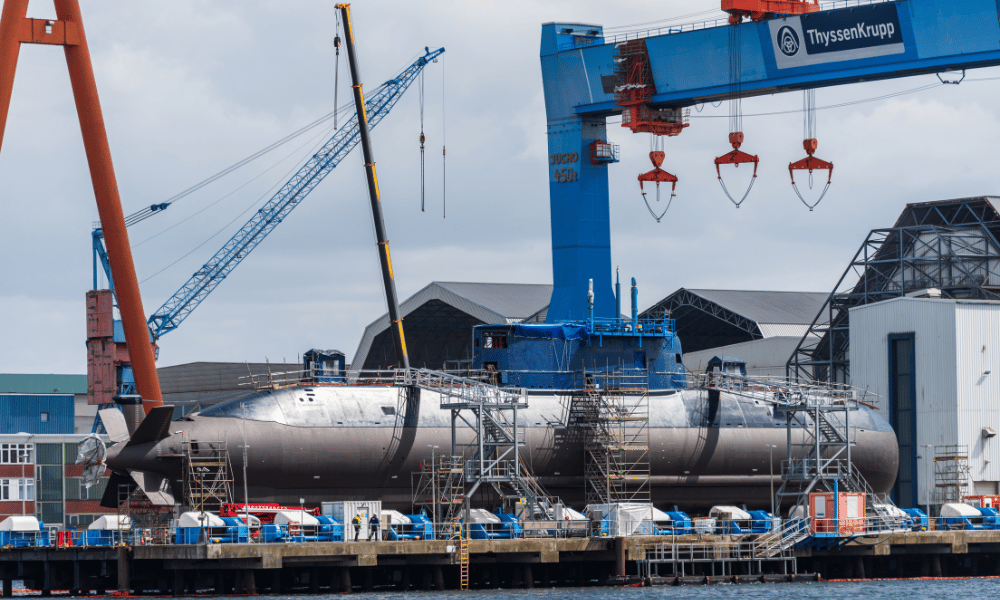
Prime Minister Mark Carney confirmed in Halifax on July 6, 2026, that Germany's ThyssenKrupp Marine Systems (TKMS), bidding jointly with Norway, has been selected as the preferred supplier to build Canada's next fleet of up to 12 submarines, beating out South Korea's Hanwha Ocean in what Carney called the largest defence procurement in the country's history.
The Royal Canadian Navy is looking to replace its aging Victoria-class submarines, only one of which is typically operational at any given time. The full program – covering acquisition, operations and decades of maintenance – could reach roughly $100 billion over 30 years, with the submarines themselves valued at $20 billion to $30 billion.
Both bidders leaned heavily on economic promises to win the contract. The TKMS bid, backed by German Defence Minister Boris Pistorius, was pitched as adding $86 billion to Canadian GDP and generating more than 650,000 "job-years" of employment over the life of the agreement – a job-year meaning one job sustained for one year, not one distinct position. Hanwha's competing offer promised more than $70 billion in trade and investment and roughly 25,000 jobs annually between 2026 and 2044.
Ottawa raises the jobs figure
At a press conference in Halifax, Carney said the TKMS contract would "directly create and sustain an ecosystem of well over 100,000 well-paying jobs" across the country, on top of the previously reported figure of up to 50,000 jobs in Canada within the first five years. He also confirmed the program is not fully locked in: Hanwha's KSS-III design remains the official reserve supplier, and Canada can turn to the South Korean company if contract negotiations with TKMS break down. A senior federal official travelling with the prime minister said Ottawa hopes to conclude a contract with TKMS within the next year, and that the first submarine's delivery could be advanced from 2036 to as early as 2034, CBC News reported.
Oliver Burkhard, chief executive officer of TKMS in Kiel, Germany, said in a press release that the company is ready to work with Canadian industry and its German and Norwegian partners to deliver the program's economic benefits. TKMS has also signed 19 memorandums of understanding with Canadian firms, including Seaspan Shipyards and EllisDon, as part of its bid, according to CTV News.
The clearest new workforce angle to emerge since the original story is a setback for one specific Canadian employer: Algoma Steel in Sault Ste. Marie, Ont. As part of its now-unsuccessful bid, Hanwha had signed a $345-million memorandum of understanding in January 2026 to fund a new structural steel beam mill at Algoma Steel and to purchase the company's products. That mill could have rehired roughly 500 of the approximately 1,000 workers Algoma Steel laid off in March 2026, CBC News reported.
What this means for workforce planners
The submarine program lands on top of a national skilled trades shortage that HR leaders across sectors are already managing, compounding pressure highlighted in Ottawa's Team Canada Strong skills initiative, aimed at training up to 100,000 new tradespeople and echoing staffing strain already visible in NAV Canada's ongoing air traffic controller shortage. Canada's domestic marine industry faces a projected shortfall of more than 8,000 workers by the end of the decade, and it now sits alongside forecasts that Canada's construction sector alone will need 380,500 additional workers by 2034, a reminder that defence, construction and marine employers are increasingly drawing from the same shrinking pool of welders, pipefitters, electricians and systems technicians.
Northern Ontario's steel and manufacturing sector, which stood to benefit directly under Hanwha's rejected bid, is no longer in the immediate frame; instead, the workforce buildout is expected to concentrate around TKMS's Canadian partners and Atlantic Canada's shipbuilding base. Employers competing for the same trades – whether in shipbuilding, construction, aviation or utilities – have a narrowing window to lock in apprenticeship pipelines, cross-training agreements and retention strategies before a decades-long government program pulls talent toward the waterfront.