Canada's economy grew 3.3% annualized in Q2 2026; Q1 data that raised recession concerns revised upward

Canada's economy grew at its fastest pace in more than three years during the second quarter of 2026, offering human resources (HR) leaders a clearer foundation for workforce planning after months of economic uncertainty.
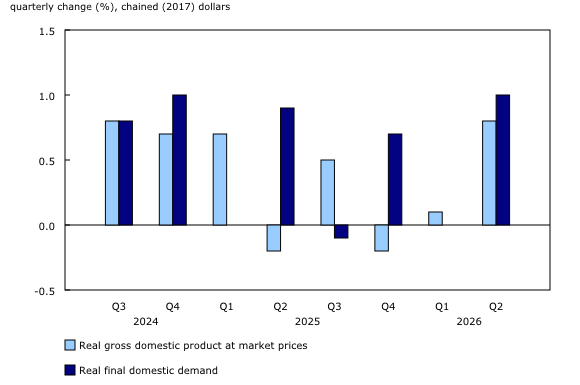
Statistics Canada reported on Friday that real gross domestic product (GDP) expanded at an annualized rate of 3.3 per cent in the second quarter, with monthly GDP also rising 0.3 per cent in June. The figures came close to market forecasts: a Reuters poll of economists compiled through LSEG Data and Analytics had expected an annualized gain of 3.4 per cent, according to the Canadian Press.
The result is the strongest quarterly performance in more than three years and closes a chapter of economic uncertainty that had many organizations holding cautious workforce positions.
Recession debate over
The second-quarter data resolves a question that had preoccupied Canadian business leaders since May, when StatCan's initial first-quarter reading showed a slight decline in real GDP. That figure reignited debate over whether Canada had entered a recession.
As part of its routine revisions, StatCan has now confirmed that first-quarter growth in 2026 was actually somewhat positive, quashing talk of a prolonged downturn. For businesses who built conservative headcount strategies based on those early signals, the revised picture invites a reassessment.
What drove second-quarter growth
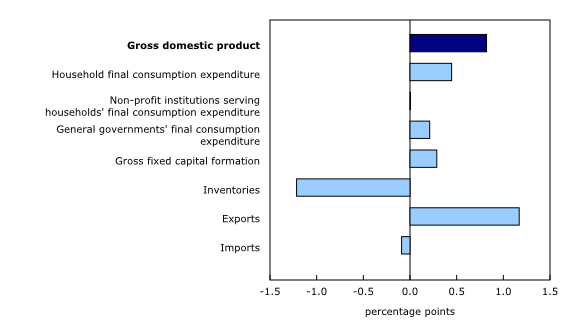
Two factors powered the rebound. Exports surged last quarter in part because auto production re-accelerated after faltering over the previous six months. Exports increased by 3.6 per cent in the second quarter, fuelled by a 27-per-cent jump in exports of passenger cars and light trucks. Canadian auto manufacturing's recovery is likely to translate into continued workforce demand in Ontario's manufacturing corridor and beyond.
Business capital investment was up 2.3 per cent in the second quarter, snapping a streak of five consecutive quarters of decline. For HR strategy, this is perhaps the most instructive data point. Investment in capital typically precedes hiring, as organizations expanding their physical and technological capacity tend to follow with workforce additions. HR leaders tracking workforce planning shifts and talent acquisition trends in Canada should treat this reversal as an early leading indicator.
Implications for people strategy
Strong gross domestic product growth does not automatically produce a hiring surge. However, the combination of export momentum, investment recovery, and an upwardly revised Q1 2026 baseline creates conditions in which organizations may feel more willing to make longer-term people commitments.
The previous 18 months were defined by restraint. Faced with trade uncertainty tied to U.S. tariff actions and a softening economic outlook, many Canadian employers took a cautious approach to hiring.
Now that the economic picture has brightened, the strategic question for HR leaders is how quickly to act. Moving too fast risks overcommitting on headcount if conditions shift; moving too slowly risks ceding ground in a tightening talent market.
Trade tensions between Canada and the U.S. remain an active variable, as StatCan’s data predates the recent 50-per-cent U.S. tariffs and Canadian counter-tariffs scheduled to come into effect on Sept. 8. The intensifying trade relationship continues to affect business confidence in export-dependent sectors, and HR leaders should maintain scenario-planning capacity as part of their operational toolkit. Those managing talent strategy in tariff-affected Canadian industries and sectors will find the Q2 numbers encouraging, but they aren’t a reason to abandon contingency planning entirely.