National unemployment rate drops to 6.6% in May, with rise in full-time jobs fully offsetting losses from first four months of 2026

Canada's labour market posted its strongest monthly performance in six months in May 2026, with employment rising by 88,000 (+0.4 per cent) and the unemployment rate declining 0.3 percentage points to 6.6 per cent, according to Statistics Canada's Labour Force Survey released June 5, 2026.
The gain reverses a net decline of 112,000 jobs recorded over the first four months of 2026. The May rebound is meaningful, but it lands in a labour market that has remained structurally weaker than the pre-pandemic norm for more than two years.
Full-time employment jumps after downward trend
Full-time employment drove the recovery, rising by 154,000 in May, fully offsetting a downward trend from January to April in which full-time work fell by 156,000. Part-time employment, by contrast, declined by 66,000. For HR leaders, this shift matters: it suggests employers are making more confident, longer-term hiring commitments rather than filling gaps with contingent labour.
The employment rate — the share of Canadians aged 15 and older who are employed — rose 0.2 percentage points to 60.7 per cent in May, the first increase since November 2025. Yet on a year-over-year basis, the employment rate was unchanged, a sign that the underlying participation challenge hasn’t been resolved.
Talent leaders watching the wage line will note that average hourly wages among employees increased three per cent year-over-year in May, up $1.10 to $37.24, following stronger growth of 4.5 per cent in April. The deceleration in wage growth may ease some compensation pressure for employers, but real wage competition remains alive in sectors actively hiring.
Construction, culture and recreation, transportation lead the way
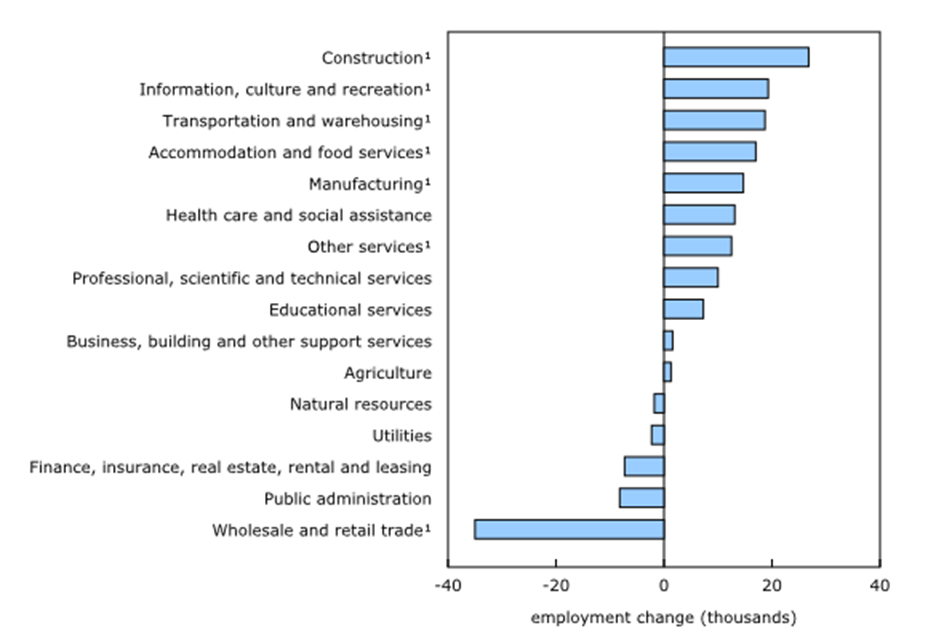
Employment gains were broad-based, with the largest increases recorded in construction (+27,000), information, culture and recreation (+19,000), transportation and warehousing (+19,000), and accommodation and food services (+17,000), according to StatCan. HR teams in those sectors may be facing immediate talent pressure as employment rebounds.
The picture isn’t uniformly positive. Wholesale and retail trade shed 35,000 jobs in May, continuing a downward trend that began in October 2025 — with employment in that sector now down 64,000 from a year earlier.
Manufacturing employment grew modestly, adding 15,000 jobs in May, but employment in the sector remains down 44,000 from January 2025, with heightened economic uncertainty driven by US tariff policies continuing to weigh on long-range headcount planning. This is a sector where scenario-based workforce planning — not linear forecasting — is now an operational necessity.
Ontario, Toronto area see lowest unemployment rates in years
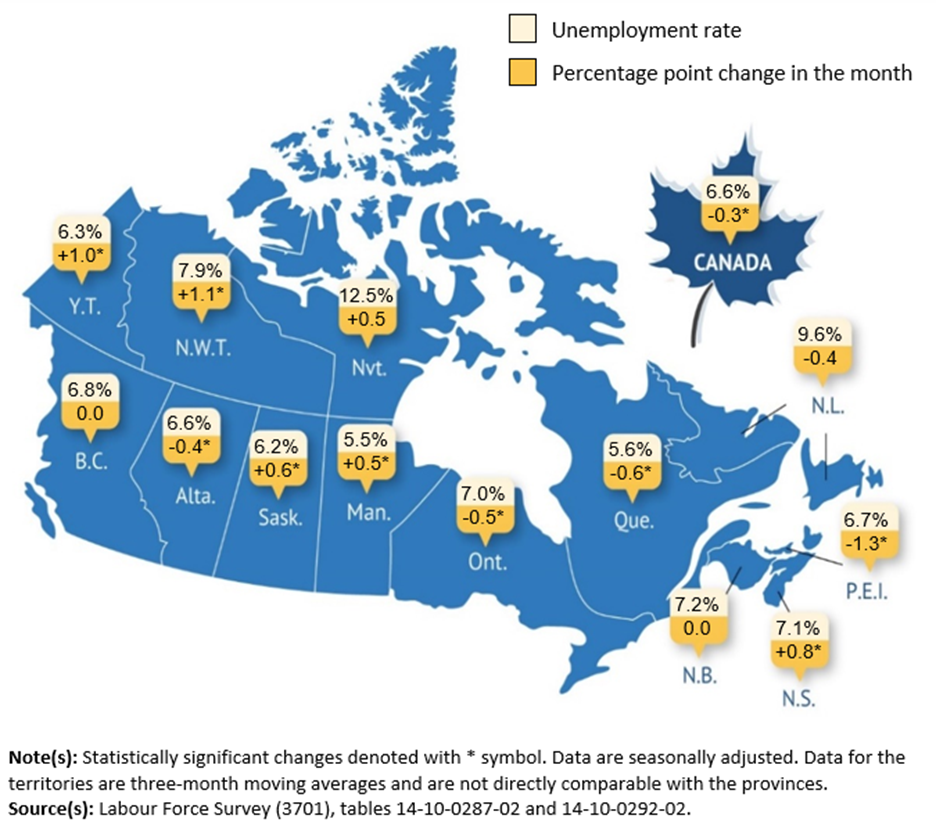
Workforce planning strategies must now account for significant regional divergence. Ontario recorded employment growth of 42,000 in May, bringing cumulative gains for April and May to 84,000, while the provincial unemployment rate fell 0.5 percentage points to 7 per cent — the lowest since September 2024.
Alberta posted the largest year-over-year gain among all provinces, as the province saw employment rise 14,000, putting it up 104,000 (more than four per cent) from May 2025. The provincial unemployment rate fell to 6.6 per cent. In British Columbia, employment rose 25,000 in May, partially recovering from a cumulative loss of 39,000 in February and March, according to StatCan.
The unemployment rate in the Toronto census metropolitan area fell 1.1 percentage points to 6.8 per cent — the lowest level since November 2023 and well below the recent peak of nine per cent in May 2025. Montreal and Vancouver also saw drops in their unemployment rates, with the former dropping 1.2 percentage points to 6.5 per cent and the latter 0.6 points to 6.4 per cent.
For HR professionals based in Canada's largest labour markets, competition for talent may be tightening once more.
Youth and the summer job market
The unemployment rate among youth aged 15 to 24 fell 0.9 percentage points to 13.4 per cent in May — the first decline since January — but remains well above the pre-pandemic average of 10.8 per cent. This cohort represents both a recruitment opportunity and a retention challenge: young Canadians who struggled to find stable work in 2024 and 2025 are entering the workforce with less experience and potentially higher turnover risk.
Returning students aged 15 to 24 faced an unemployment rate of 18 per cent in May 2026, down 2.1 percentage points from 20.1 per cent in May 2025 — which was the slowest start to the summer job market since 2009, outside the pandemic years.
Remote work continues to decline
A notable finding for HR leaders managing workplace strategy: the proportion of employed Canadians working exclusively from home in May 2026 was 11.4 per cent, down one percentage point from May 2025 and down 7.3 percentage points from May 2022. Meanwhile, 78.8 per cent of Canadians worked exclusively outside the home, up from 77.6 per cent in May 2025.
Hybrid work arrangements remained stable at approximately 9.8 per cent of workers, a figure that has held relatively steady since May 2023. The data reinforces that return-to-office momentum has been gradual and consistent, not driven by a single policy push — and that hybrid is now a durable, though less prominent, feature of the Canadian workplace.