Gartner outlines how AI can support the 'human side of work'
Artificial intelligence tools can also support the "human side of work," Gartner has underscored, as its latest findings showed employees don't think AI tools are good for the workforce.
Gartner's fresh findings, which were presented during its HR Symposium/Xpo in London, revealed that employees are "less convinced" that AI is good for them, despite agreeing that AI is good for their organisation.
But Nicole Paripurana, senior principal analyst in the Gartner HR Practice, has maintained that AI can be good for employees and their wellbeing.
"While AI is often associated with efficiency and automation, organisations can also use AI to support the human side of work," Paripurana said.
Paripurana's remarks hint at a different approach to AI adoption, which research has shown is most commonly used to take over employees' tasks to ease their workload.
"AI can be leveraged by organisations to identify unhealthy work patterns, reduce friction, personalise support, and proactively address wellbeing risks," Paripurana said.
Using AI to improve wellbeing
In its report, Gartner identified three ways that HR leaders can use AI to improve employee wellbeing, starting with using the technology to identify patterns and signals that may indicate emerging challenges for employees.
AI can analyse various factors, such as frequent context-switching, exclusion signals, shifts in communication tone, and signs of disengagement or exclusion, to provide employees with early insights into potential risks before they escalate to burnout, disengagement, or reduced performance.
"This enhanced visibility enables organisations to move beyond periodic surveys and take a more proactive, data-driven approach to supporting employee wellbeing and empowering healthier employees," Gartner said.
Another way AI can improve employee wellbeing is by using it to identify and respond to workplace risks.
According to Gartner, AI can be used to surface indicators of burnout, excessive workloads, toxic behaviours, bias, and boundary violations, enabling leaders to take earlier action to protect employee wellbeing.
Beyond identifying risks, AI can also be used to further tailor the support provided to employees by using it to better understand their wellbeing preferences as well as recovery styles and needs.
"A few personalised inputs can make an experience feel meaningfully tailored to an employee's specific needs," Paripurana said.
Gartner's latest advice comes as it found that fewer than 35% of employees report good levels of overall wellness. The findings echo previous employee wellbeing data from other research.
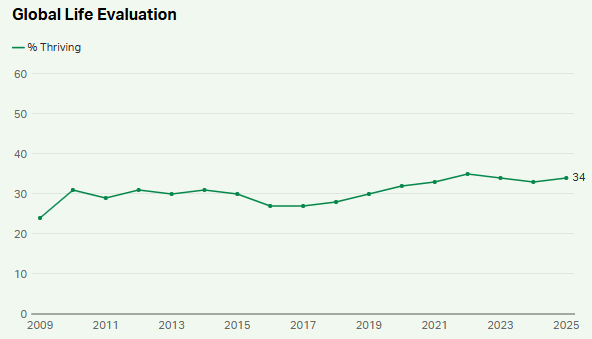
Gallup's State of the Global Workplace 2026 found that global thriving peaked in 2022 and then started declining before a slight rebound to 34% in 2025.
Employees who experience negative emotions also remained elevated compared to before 2020, with Gallup suggesting this may mean lasting psychological impacts from the pandemic, or a new and more challenging status quo.
Gartner's findings offer a slight hope that AI can help address declining employee wellbeing in workplaces.
"The future of AI at work isn't simply about productivity," Paripurana said. "The organisations that see the greatest value from AI will be those that use it to improve employee wellbeing, build resilience, and create healthier, more sustainable ways of working."