As expert knowledge becomes easier to access, a KPMG transformation partner says the competitive advantage may lie elsewhere

For decades, expertise was something organizations had to find. They hired specialists, paid consultants and built entire institutions around people who knew what others didn't. But at the Nrth Festival in Toronto last week, KPMG Canada Transformation Practice partner Frankie Llewellyn-Thomas argued that generative AI is disrupting that long-standing model.
"Historically expertise has been stored inside people," Llewellyn-Thomas said. "We've built institutions around that reality: schools, universities, companies, law firms, accounting firms like my own, even governments. But still, expertise remained scarce with competing uses. Then something remarkable happened. Expertise began to separate from experts."
"Thanks to generative AI, it became possible to access expert-level knowledge, analysis, reasoning without directly accessing experts," she added. "Not perfect, not human, but for the first time in history, one of civilization's most valuable scarce resources suddenly became abundant."
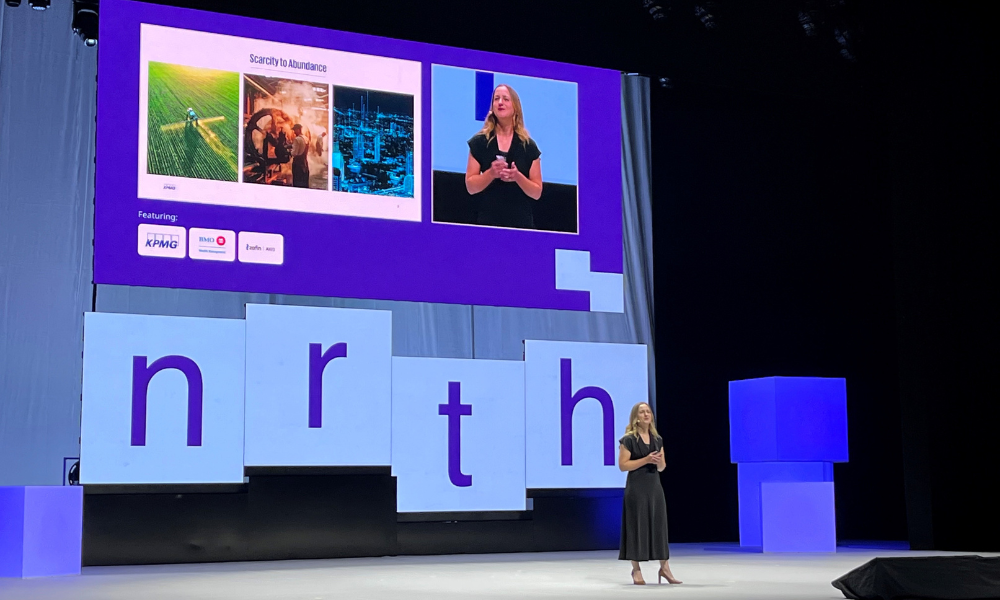
Frankie Llewellyn-Thomas, Partner, Transformation, KPMG Canada, speaks at the Nrth Festival in Toronto on Sept. 23, 2026.
To illustrate her point, Llewellyn-Thomas described walking into an exam on tax law in 2008 hauling a suitcase loaded with books on legislation, regulations, and case law.
"The purpose of the examination was not to know the answer, but rather knowing where to find it, and if you didn't know where to find the answer, the information might as well not exist," she said. "Today, in 2026, a new graduate can ask the same examination questions in plain English and get a reasonable, informed response from GenAI, often in seconds."
What actually stays scarce
When expertise was rare, accumulating it, whether through the best consultants, the most experienced lawyers or the deepest specialists, was itself a competitive advantage, Llewellyn-Thomas said.
That's no longer the case.
"In the age of AI, it's no longer just a question of how much expertise do you have, but rather what can you do with that expertise that others cannot," Llewellyn-Thomas said.
"Put simply, what remains scarce? The scarce resources of the next decade will not be knowledge, expertise. They will be the things that remain uniquely human: judgment, leadership, relationships, ethics, accountability, and trust. The ability to bring together human and machine intelligence to create something that either alone could not."
Llewellyn-Thomas isn't alone in seeing judgment become a bigger differentiator as AI spreads. PwC's Global AI Jobs Barometer has found a similar shift: demand for judgment and creativity is rising relative to some technical skills as organizations adopt AI.
That shift could also change what companies look for when they hire and promote. Credentials and years of experience have long been convenient ways to signal expertise, but they don't necessarily capture someone's ability to exercise judgment or make decisions when the answers are increasingly easy to find.
AI won't work if the work stays the same
Llewellyn-Thomas, who has spent nearly two decades advising companies through disruption, offered two ways organizations can adapt. First, she argued, companies should stop treating expertise as something that only a few people can provide and find ways to make that knowledge available across the workforce.
"Capture the best thinking of your people and your advisors and embed them in AI-enabled workflow tools and decisions," she said. "Let AI scale expertise so that your best people can focus on judgment, leadership, and accountability."
The second recommendation is to rebuild how work gets structured, rather than simply adding AI tools on top of processes that already exist.
"Let's stop layering AI onto existing processes," she said. "Let's start redesigning work intentionally around teams composed of people and agents working together to produce better outcomes."
The idea isn't entirely new. HRD America's reporting on AI investment has similarly found that productivity gains can stall when organizations add AI to existing workflows without changing the underlying roles and processes.
Another HRD America report explored the capability to continually redesign work as AI evolves, with Gartner research finding that companies with that capability are twice as likely to sustain AI-driven transformation by 2028.
Llewellyn-Thomas closed by framing reinvention as unavoidable rather than optional. That broader push to rethink work and talent structures also features in HRD America's rundown of HR's priorities for 2026, which highlighted the need to reimagine how organizations structure work as AI becomes more deeply embedded.
The World Economic Forum's Future of Jobs Report 2025 points toward a similar conclusion, projecting that a large share of the global workforce will need meaningful reskilling before 2030 as core skill requirements shift.
The organizations that thrive in the next decade, Llewellyn-Thomas argued, won't be the ones that started out with the most expertise.
"They will be the ones that adapt using the very technology that is disrupting them by building a hybrid workforce that amplifies that which makes people indispensable," she said. "AI bringing expertise, people bringing judgment, each contributing what they do best."