Around 75% of extra jobless Australians over the past year were under 35. Among 20 to 24 year olds, women's unemployment is rising more than twice as fast as men's

The 4.9 per cent unemployment rate grabbed the headlines yesterday. The age breakdown behind it shows the slowdown is hitting younger workers hardest.
The number of unemployed Australians rose by about 92,000 in the year to October, according to ABS Labour Force figures. Roughly 69,000 of them were under 35, or about three in every four. Using 12-month averages, which smooth out monthly noise, the under-35 share is more than four in five.
Workers aged 35 and over, who make up most of the workforce, account for the other 23,000 or so.
The age figures are the bureau's unadjusted series, so the comparisons here match October with October to avoid seasonal swings.
The jobless rate is highest among teenagers. In October, 16.2 per cent of 15 to 19 year olds in the labour force were unemployed, up from 13.4 per cent a year earlier and the highest October reading since 2021. For 25 to 34 year olds, where most graduates and early-career professionals sit, the rate rose from 3.6 to 4.3 per cent.
In seasonally adjusted terms, the ABS put unemployment among 15 to 24 year olds at 11.3 per cent, its highest since October 2021 and well above the 9.2 per cent average since May 2022, according to the bureau's media release.
Youth employment did grow, by about 12,000 over the year among 15 to 24 year olds. The number of young people looking for work grew much faster.
Analysts at Moody's described the latest weakness as sitting "at the margins" of the labour market, in part-time work and among the young. The Reserve Bank expects unemployment to keep rising, to 5.1 per cent by the end of 2028, so the squeeze on new entrants is unlikely to ease soon.
Read next: Australia's unemployment rate reaches highest since 2021
Women in their early 20s are copping it hardest
The sharpest shift is among women aged 20 to 24. The number of unemployed women in that bracket rose from about 33,700 to 48,800 in a year, an increase of roughly 45 per cent. Their unemployment rate climbed from 4.8 to 6.7 per cent.
Men the same age went the other way. Their rate edged down from 7.3 to 7.0 per cent.
One month can exaggerate a trend, so the annual averages are a useful check. On that measure, unemployment among women aged 20 to 24 rose from 5.4 to 6.6 per cent, the highest annual average since early 2022. For men in the same age group it rose from 7.3 to 7.8 per cent. Young men are still more likely to be out of work, but the gap is closing quickly.
Young women are also more likely to be looking for work than a year ago. Average participation among women aged 15 to 24 rose from 70.7 to 71.9 per cent over the year, while young men's slipped slightly.
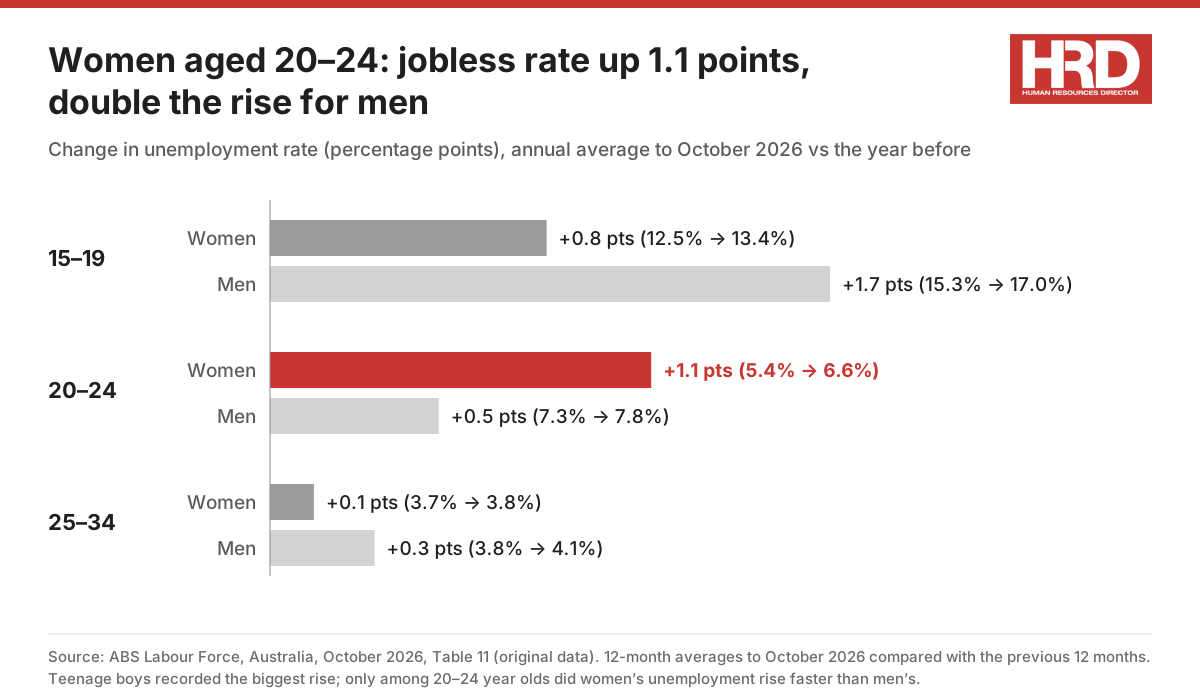
Teenage boys still recorded the biggest rise of any group. But only among 20 to 24 year olds did women's unemployment climb faster than men's.
Read next: Graduate hiring and AI: RBA spots early warning signs for young workers
Why the young are first in line
The labour force survey can't say why this is happening, but other research offers some clues.
Employers under pressure tend to stop hiring before they start sacking. US research covered by HRD in May found that where firms shrank junior headcount, they mostly did it by hiring fewer people, not by laying off juniors already on the books. That hurts anyone trying to get a foot in the door. ABS head of labour statistics Sean Crick said October showed "a higher proportion of people remaining unemployed than we would usually see in October" since the pandemic.
The type of work being cut matters too. Part-time roles took most of the job losses in September and October, and workforce platform Deputy found frontline businesses in hospitality, retail and services cut shift hours for a second straight month. Those are the jobs many teenagers rely on.
Then there's AI, where the evidence is still thin. A Reserve Bank paper published on 9 November found little evidence that AI has materially disrupted the Australian labour market so far. It did find "tentative signs" of weaker outcomes in AI-exposed occupations, particularly for young workers. The RBA is careful to add that youth employment was unusually strong in 2022, so some of the softening may just be a tight market cooling.
If AI does turn out to be a factor, young women may be more exposed. An HRD article produced with Great Place To Work, published in March, noted that young women are concentrated in administrative, clerical and junior support roles, which are among the first that generative AI is expected to reshape. If those entry points disappear without new pathways, general manager Rebecca Moulynox warned, "we shrink the whole pipeline of future female leaders".
Read next: Is it really AI that's killing junior hiring, or is remote work the hidden culprit?
What HR teams can do now
Check your own numbers. National data won't show whether your organisation's junior hiring is quietly shrinking, or tilting by gender. Break applications, offers, hires and exits down by age band and gender for the past two years and look for the drift.
Think twice before cutting the graduate intake. An Oliver Wyman Forum and NYSE survey, detailed in the same HRD report, found 64 per cent of CFOs expect to shift away from junior roles, while 70 per cent plan to step up succession planning. Cutting intakes now leaves fewer experienced staff to promote in five to ten years.
Look closely at redundancy criteria. LegalVision employment practice group leader Joel Hayden has warned that informal or subjective selection criteria open employers up to discrimination claims, which carry uncapped compensation, HRD has reported. Rules of thumb such as "casuals first" or last in, first out can land heavily on younger staff, so test them before any decisions are final.
Sponsor, don't just mentor. Great Place To Work's advice is for senior leaders to put junior women's names forward for high-profile projects and succession plans.
Read next: After a record high, women in their 40s are stepping back from work
Monthly figures for small groups jump around, and BetaShares chief economist David Bassanese has suggested changes to how the survey is run could be making the jobs market look weaker than it is. But the annual averages show the same pattern, so this is unlikely to be a one-month blip.
Fact, data and quote check
Every figure was checked twice against your uploaded ABS tables (6202.0, October 2026) or the linked source. Age-by-sex figures come from Table 11, which is original (unadjusted) data, so comparisons are October 2026 against October 2025 unless marked as 12-month averages.