Workforce participation among women aged 40 to 49 has slipped a full point since late last year, while men's has held steady

For a decade, one of the success stories of the Australian labour market was women in their 40s. Their participation rate has climbed through most of the past decade, reaching a record late last year.
Now it is heading the other way.
On a 12-month rolling average, the participation rate for women aged 40 to 49 peaked at 85.5 per cent in November 2025, the highest since the Australian Bureau of Statistics series began in 1978. By September 2026 it had fallen to 84.5 per cent, according to ABS labour force data released on Thursday. For men the same age, the rate was unchanged over the year at 90.9 per cent.

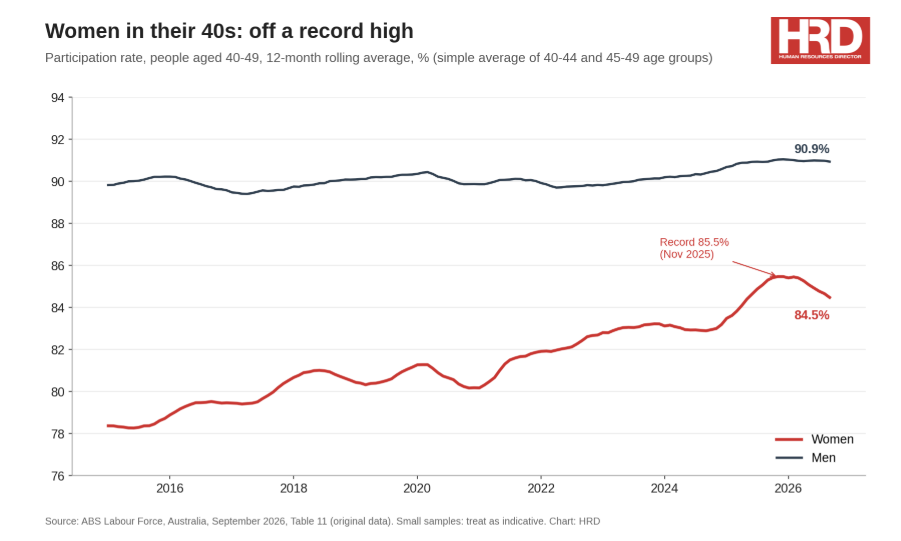
The pullback shows up in both five-year age groups. For women aged 40 to 44, the rolling average has dropped from 86.4 to 85.2 per cent since February. For women aged 45 to 49, it is down from 84.7 to 83.7 per cent since October last year. For women aged 50 to 54, by contrast, participation edged up over the past year.
Read next: Age bias hits young and old workers differently
A warning, but not necessarily a long term trend
These figures need handling with care. Breakdowns by both age and sex rely on small slices of the ABS survey sample, they come from original rather than seasonally adjusted data, and the ABS has made several changes to its survey this year. A one-point fall from a record high could still turn out to be noise.
But it has now persisted for most of a year, and it hasn't shown up for men. That is enough to justify a closer look at your own data.
Why women might be stepping back
The ABS figures don't say why, and there is no single answer.
Caring is the most obvious candidate. Women in their 40s are often managing school-age children and ageing parents at the same time. The Gender Equity Insights 2026 report from the Bankwest Curtin Economics Centre and the Workplace Gender Equality Agency, released this week, found women do more unpaid work than their partners even when both work full-time, and that women are more likely than men to resign from leadership roles.
Perimenopause is another possible factor, as symptoms commonly begin in a woman's 40s. A 2024 Senate inquiry into menopause and perimenopause, which HRD covered at the time, heard that symptoms can push some women to cut hours or leave work early. But the committee also found the evidence does not clearly separate the effect of menopause from the other reasons women leave the workforce in midlife.
There may also be a link to the shift HRD reported in this week's labour force coverage, where women's part-time jobs have been falling while full-time roles grow. If the part-time option narrows, some women who can't work full-time may stop working altogether.
Read next: Menopause and perimenopause at work: How employers should foster a safe and inclusive workplace
What HR can check
Women in their 40s are often at the stage where they are ready for senior roles. Losing them now costs employers their future leaders.
Three questions are worth asking of your own workforce data. Are resignations among women aged 40 to 49 rising, and what do exit interviews say? Can people in senior or management roles actually use flexible arrangements, or only junior staff? And do your leave, flexibility and wellbeing policies cover both caring and menopause, and do managers know how to use them?
Read next: Fixing productivity with better work design
Read next: Unemployment rises to 4.6% as full-time jobs slip in August